
Title
3D Shape: Its Unique Place in Visual Perception,Used
Sold by Ergodebooks, an authorized reseller.
Returns accepted within 30 days | support@ergodebooks.com
Shipping Information
- Free Standard Shipping — United States only
- Processing Time: 3–5 business days
- Estimated Delivery: 6–10 business days after dispatch
- Double-boxed, fully insured & discreetly packaged
- Tracking number sent via email once dispatched
Returns & Refund
Returns accepted within 30 days of delivery.
Damaged or Defective Item
Free return shipping + replacement or full refund
Wrong Item Received
Free return shipping + replacement or full refund
Change of Mind
Return shipping at customer's expense · 25% restocking fee applies
Payment Option

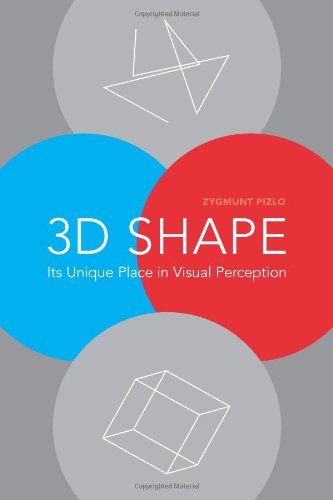
A new account of how we perceive the 3D shapes of objects and how to design machines that can see shapes the way we do.The uniqueness of shape as a perceptual property lies in the fact that it is both complex and structured. Shapes are perceived veridically perceived as they really are in the physical world, regardless of the orientation from which they are viewed. The constancy of the shape percept is the sine qua non of shape perception; you are not actually studying shape if constancy cannot be achieved with the stimulus you are using. Shape is the only perceptual attribute of an object that allows unambiguous identification. In this first book devoted exclusively to the perception of shape by humans and machines, Zygmunt Pizlo describes how we perceive shapes and how to design machines that can see shapes as we do. He reviews the long history of the subject, allowing the reader to understand why it has taken so long to understand shape perception, and offers a new theory of shape.Until recently, shape was treated in combination with such other perceptual properties as depth, motion, speed, and color. This resulted in apparently contradictory findings, which made a coherent theoretical treatment of shape impossible. Pizlo argues that once shape is understood to be unique among visual attributes and the perceptual mechanisms underlying shape are seen to be different from other perceptual mechanisms, the research on shape becomes coherent and experimental findings no longer seem to contradict each other. A single theory of shape perception is thus possible, and Pizlo offers a theoretical treatment that explains how a threedimensional shape percept is produced from a twodimensional retinal image, assuming only that the image has been organized into twodimensional shapes. Pizlo focuses on discussion of the main concepts, telling the story of shape without interruption. Appendixes provide the basic mathematical and computational information necessary for a technical understanding of the argument. References point the way to more indepth reading in geometry and computational vision.
⚠️ WARNING (California Proposition 65):
This product may contain chemicals known to the State of California to cause cancer, birth defects, or other reproductive harm.
For more information, please visit www.P65Warnings.ca.gov.