If you have any questions, you are always welcome to contact us. We'll get back to you as soon as possible, withing 24 hours on weekdays.
Customer service
All questions about your order, return and delivery must be sent to our customer service team by e-mail at yourstore@yourdomain.com
Sale & Press
If you are interested in selling our products, need more information about our brand or wish to make a collaboration, please contact us at press@yourdomain.com
Help
If you have any questions, you are always welcome to contact us. We'll get back to you as soon as possible, withing 24 hours on weekdays.
Customer service
All questions about your order, return and delivery must be sent to our customer service team by e-mail at yourstore@yourdomain.com
Sale & Press
If you are interested in selling our products, need more information about our brand or wish to make a collaboration, please contact us at press@yourdomain.com
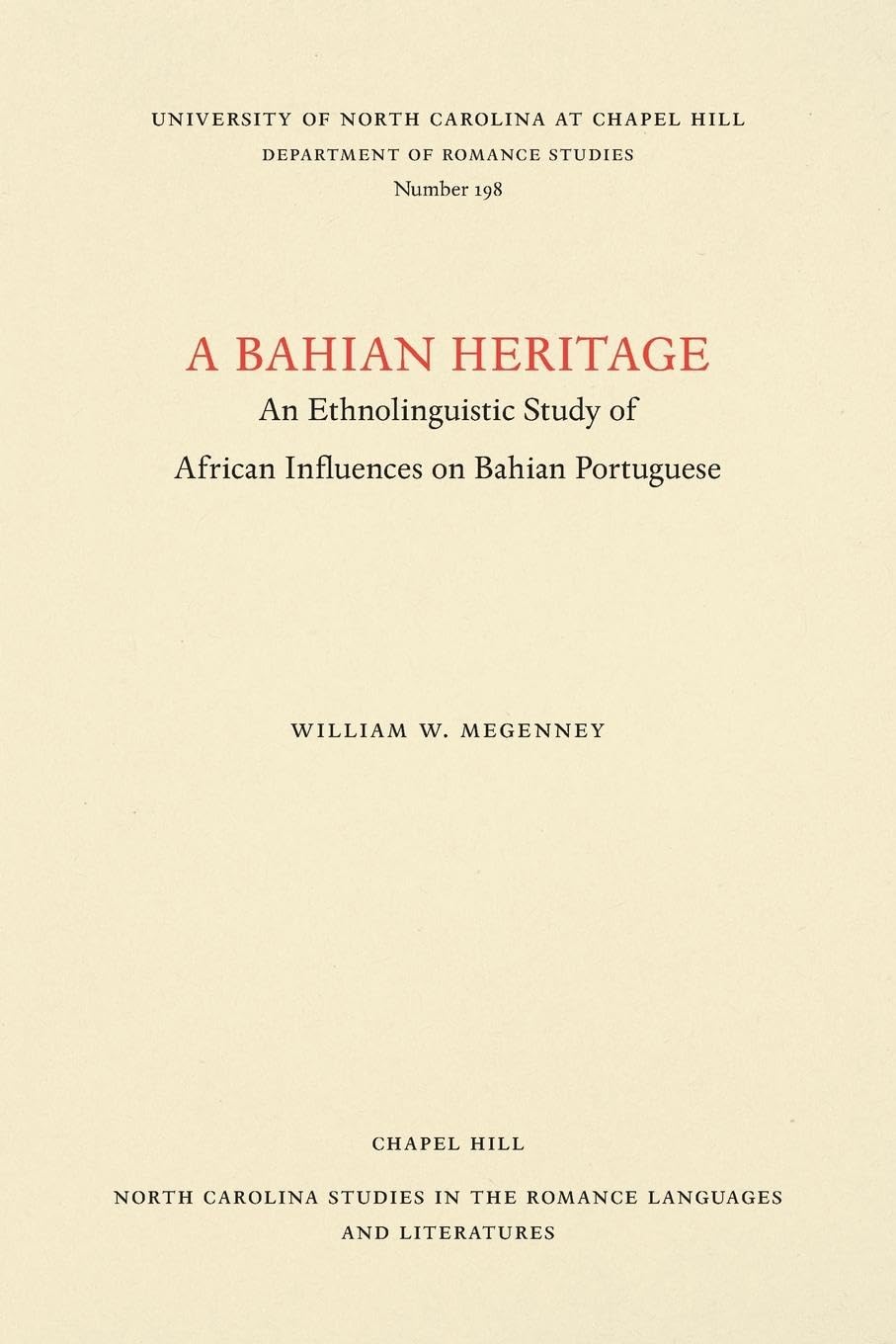
In this impactful addition to the field of ethnolinguistics, Willian W. Megenney dissects the influence of African languages and cultures on contemporary Bahian Portuguese. The author aims at studying the connection between the use of Africanisms and socioeconomic class. Megenney interrogates a broad swath of claims concerning potential syntactic, morphological, and phonemic influences in the field, giving sound analysis and drawing the conclusion that, with the potential exception of a causal correlation between the musical intonation in areas of high population density of people of African descent and the tonality of some of the studied languages, the only aspect that is incontrovertibly influenced is vocabulary, though direct sourcetraces prove problematic at best. Megenney's primary study of the interrelation of socioeconomic class and the use of Africanisms, and the circumstances that allowed for the survival of such Africanisms in Brazil, is an intriguing read for any scholar of ethnolinguistics, as well as an excellent resource for researchers working in the Lusophone world.
⚠️ WARNING (California Proposition 65):
This product may contain chemicals known to the State of California to cause cancer,
birth defects, or other reproductive harm.
For MAP (Minimum Advertised Price) violations and Intellectual Property (IP) or Trademark concerns, please contact:
support@ergodebooks.com
⚠️ California Proposition 65 Warning: Some products sold on this website may expose you to chemicals known to the State of California to cause cancer, birth defects, or other reproductive harm. For more information, visit www.P65Warnings.ca.gov.