
Title


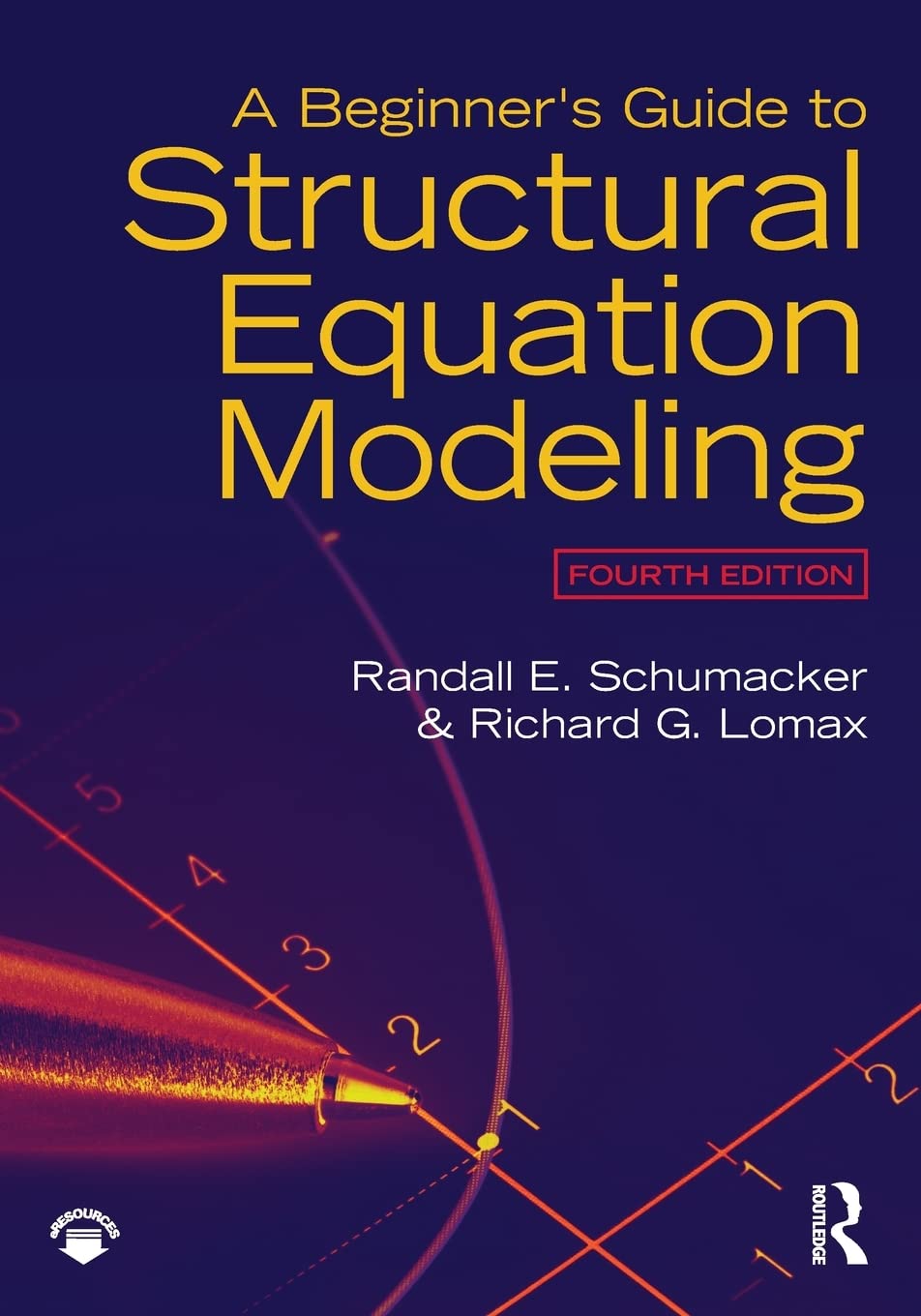
A Beginner's Guide to Structural Equation Modeling: Fourth Edition,Used
Sold by Ergodebooks, an authorized reseller.
Returns accepted within 30 days | support@ergodebooks.com
Shipping Information
- Free Standard Shipping — United States only
- Processing Time: 3–5 business days
- Estimated Delivery: 6–10 business days after dispatch
- Double-boxed, fully insured & discreetly packaged
- Tracking number sent via email once dispatched
Returns & Refund
Returns accepted within 30 days of delivery.
Damaged or Defective Item
Free return shipping + replacement or full refund
Wrong Item Received
Free return shipping + replacement or full refund
Change of Mind
Return shipping at customer's expense · 25% restocking fee applies
Payment Option

Noted for its crystal clear explanations, this book is considered the most comprehensive introductory text to structural equation modeling (SEM). Noted for its thorough review of basic concepts and a wide variety of models, this book better prepares readers to apply SEM to a variety of research questions. Programming details and the use of algebra are kept to a minimum to help readers easily grasp the concepts so they can conduct their own analysis and critique related research. Featuring a greater emphasis on statistical power and model validation than other texts, each chapter features key concepts, examples from various disciplines, tables and figures, a summary, and exercises.Highlights of the extensively revised 4th edition include:Uses different SEM software (not just Lisrel) including Amos, EQS, LISREL, Mplus, and R to demonstrate applications.Detailed introduction to the statistical methods related to SEM including correlation, regression, and factor analysis to maximize understanding (Chs. 1 6).The 5 step approach to modeling data (specification, identification, estimation, testing, and modification) is now covered in more detail and prior to the modeling chapters to provide a more coherent view of how to create models and interpret results (ch. 7).More discussion of hypothesis testing, power, sampling, effect sizes, and model fit, critical topics for beginning modelers (ch. 7). Each model chapter now focuses on one technique to enhance understanding by providing more description, assumptions, and interpretation of results, and an exercise related to analysis and output (Chs. 8 15).The use of SPSS AMOS diagrams to describe the theoretical models.The key features of each of the software packages (Ch. 1).Guidelines for reporting SEM research (Ch. 16).www.routledge.com/9781138811935 which provides access to data sets that can be used with any program, links to other SEM examples, related readings, and journal articles, and more.Reorganized, the new edition begins with a more detailed introduction to SEM including the various software packages available, followed by chapters on data entry and editing, and correlation which is critical to understanding how missing data, nonnormality, measurement, and restriction of range in scores affects SEM analysis. Multiple regression, path, and factor models are then reviewed and exploratory and confirmatory factor analysis is introduced. These chapters demonstrate how observed variables share variance in defining a latent variables and introduce how measurement error can be removed from observed variables. Chapter 7 details the 5 SEM modeling steps including model specification, identification, estimation, testing, and modification along with a discussion of hypothesis testing and the related issues of power, and sample and effect sizes.Chapters 8 to 15 provide comprehensive introductions to different SEM models including Multiple Group, SecondOrder CFA, Dynamic Factor, MultipleIndicator MultipleCause, Mixed Variable and Mixture, MultiLevel, Latent Growth, and SEM Interaction Models. Each of the 5 SEM modeling steps is explained for each model along with an application. Chapter exercises provide practice with and enhance understanding of the analysis of each model. The book concludes with a review of SEM guidelines for reporting research.Designed for introductory graduate courses in structural equation modeling, factor analysis, advanced, multivariate, or applied statistics, quantitative techniques, or statistics II taught in psychology, education, business, and the social and healthcare sciences, this practical book also appeals to researchers in these disciplines. Prerequisites include an introduction to intermediate statistics that covers correlation and regression principles.
⚠️ WARNING (California Proposition 65):
This product may contain chemicals known to the State of California to cause cancer, birth defects, or other reproductive harm.
For more information, please visit www.P65Warnings.ca.gov.