
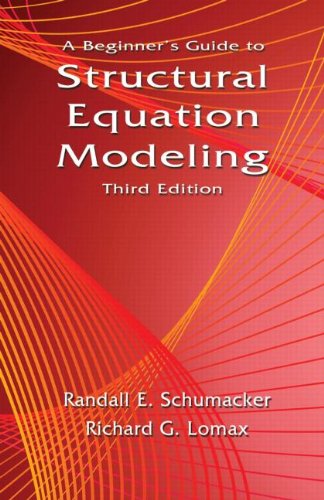
Title
A Beginner's Guide to Structural Equation Modeling: Third Edition,Used
Sold by Ergodebooks, an authorized reseller.
Returns accepted within 30 days | support@ergodebooks.com
Shipping Information
- Free Standard Shipping — United States only
- Processing Time: 3–5 business days
- Estimated Delivery: 6–10 business days after dispatch
- Double-boxed, fully insured & discreetly packaged
- Tracking number sent via email once dispatched
Returns & Refund
Returns accepted within 30 days of delivery.
Damaged or Defective Item
Free return shipping + replacement or full refund
Wrong Item Received
Free return shipping + replacement or full refund
Change of Mind
Return shipping at customer's expense · 25% restocking fee applies
Payment Option

This bestseller introduces readers to structural equation modeling (SEM) so they can conduct their own analysis and critique related research. Noted for its accessible, applied approach, chapters cover basic concepts and practices and computer input/output from the free student version of Lisrel 8.8 in the examples. Each chapter features an outline, key concepts, a summary, numerous examples from a variety of disciplines, tables, and figures, including path diagrams, to assist with conceptual understanding.The book first reviews the basics of SEM, data entry/editing, and correlation. Next the authors highlight the basic steps of SEM: model specification, identification, estimation, testing, and modification, followed by issues related to model fit and power and sample size. Chapters 6 through 10 follow the steps of modeling using regression, path, confirmatory factor, and structural equation models. Next readers find a chapter on reporting SEM research including a checklist to guide decisionmaking, followed by one on model validation. Chapters 13 through 16 provide examples of various SEM model applications. The book concludes with the matrix approach to SEM using examples from previous chapters.Highlights of the new edition include: A website with raw data sets for the book's examples and exercises so they can be used with any SEM program, all of the book's exercises, hotlinks to related websites, and answers to all of the exercises for Instructors only New troubleshooting tips on how to address the most frequently encountered problems Examples now reference the free student version of Lisrel 8.8 Expanded coverage of advanced models with more on multiplegroup, multilevel, & mixture modeling (Chs. 13 & 15), secondorder and dynamic factor models (Ch. 14), and Monte Carlo methods (Ch. 16) Increased coverage of sample size and power (Ch. 5) and reporting research (Ch. 11) New journal article references help readers better understand published research (Chs. 13 17) and 25 % new exercises with answers to half in the book for student review.Designed for introductory graduate level courses in structural equation modeling or factor analysis taught in psychology, education, business, and the social and healthcare sciences, this practical book also appeals to researchers in these disciplines. An understanding of correlation is assumed. To access the website visit the book page or the Textbook Resource page at http://www.psypress.com/textbookresources/ for more details.
⚠️ WARNING (California Proposition 65):
This product may contain chemicals known to the State of California to cause cancer, birth defects, or other reproductive harm.
For more information, please visit www.P65Warnings.ca.gov.
- Q: How many pages does this book have? A: This book has five hundred thirty-six pages. It covers a wide range of topics related to structural equation modeling.
- Q: What is the binding type of this book? A: This book is a paperback edition. This makes it lightweight and easy to carry for students and researchers.
- Q: Who is the author of this book? A: The author of this book is Randall E. Schumacker. He is well-known for his expertise in structural equation modeling.
- Q: What subjects does this book cover? A: This book covers structural equation modeling, regression, and factor analysis. It is suitable for graduate-level courses in psychology, education, and social sciences.
- Q: Is this book suitable for beginners? A: Yes, this book is designed for beginners in structural equation modeling. It introduces fundamental concepts and practical applications.
- Q: What kind of examples does the book provide? A: The book provides numerous examples from various disciplines. These examples help to illustrate complex concepts in an accessible manner.
- Q: How can I access the website mentioned in the book? A: You can access the website by visiting the book page or the Textbook Resource page at the publisher's site. It offers raw data sets and additional resources.
- Q: Are there exercises included in the book? A: Yes, the book includes exercises for practice. Some exercises have answers provided for students' reference.
- Q: Does this book include troubleshooting tips? A: Yes, this new edition includes troubleshooting tips. These tips address frequently encountered problems in structural equation modeling.
- Q: Is this book helpful for researchers? A: Yes, this book is also beneficial for researchers in various disciplines. It provides insights into conducting and reporting SEM research.
- Q: What is the main focus of this book? A: The main focus of this book is to introduce readers to structural equation modeling. It aims to help them conduct analyses and critique research.
- Q: Are there new references in this edition? A: Yes, the new edition includes recent journal article references. These references help readers understand published research better.
- Q: Does the book provide a checklist for reporting SEM research? A: Yes, the book features a checklist for reporting SEM research. This checklist aids in decision-making for researchers.
- Q: What advanced topics are covered in the new edition? A: The new edition covers advanced models like multi-level and mixture modeling. It also discusses second-order and dynamic factor models.
- Q: Is prior knowledge of correlation needed to use this book? A: Yes, an understanding of correlation is assumed. This foundational knowledge is crucial for grasping the concepts presented.
- Q: What audience is this book intended for? A: This book is intended for graduate students and researchers in psychology, education, and social sciences. It suits anyone interested in SEM.