
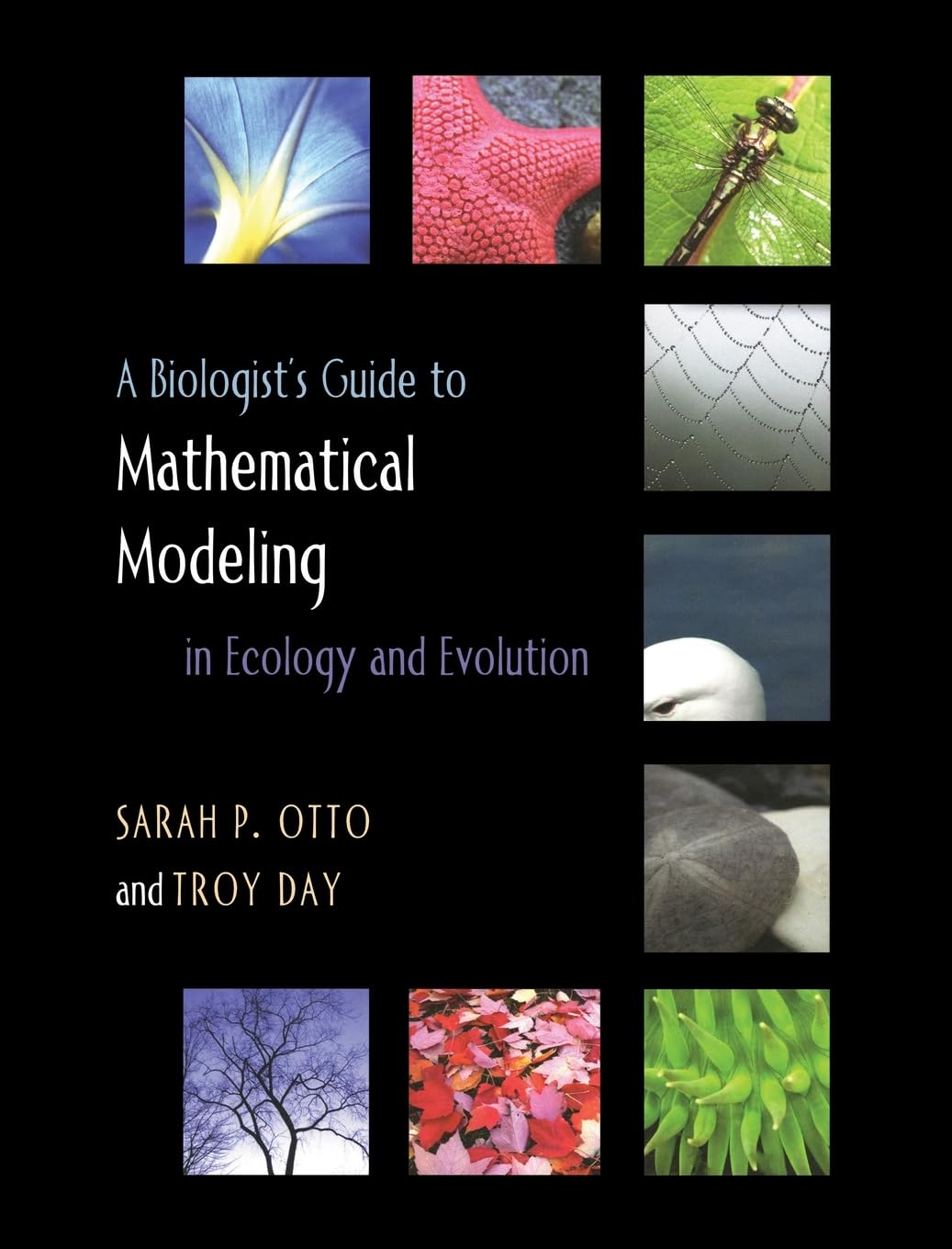
Title
A Biologist's Guide to Mathematical Modeling in Ecology and Evolution,Used
Sold by Ergodebooks, an authorized reseller.
Returns accepted within 30 days | support@ergodebooks.com
Shipping Information
- Free Standard Shipping — United States only
- Processing Time: 3–5 business days
- Estimated Delivery: 6–10 business days after dispatch
- Double-boxed, fully insured & discreetly packaged
- Tracking number sent via email once dispatched
Returns & Refund
Returns accepted within 30 days of delivery.
Damaged or Defective Item
Free return shipping + replacement or full refund
Wrong Item Received
Free return shipping + replacement or full refund
Change of Mind
Return shipping at customer's expense · 25% restocking fee applies
Payment Option

Thirty years ago, biologists could get by with a rudimentary grasp of mathematics and modeling. Not so today. In seeking to answer fundamental questions about how biological systems function and change over time, the modern biologist is as likely to rely on sophisticated mathematical and computerbased models as traditional fieldwork. In this book, Sarah Otto and Troy Day provide biology students with the tools necessary to both interpret models and to build their own.The book starts at an elementary level of mathematical modeling, assuming that the reader has had high school mathematics and firstyear calculus. Otto and Day then gradually build in depth and complexity, from classic models in ecology and evolution to more intricate classstructured and probabilistic models. The authors provide primers with instructive exercises to introduce readers to the more advanced subjects of linear algebra and probability theory. Through examples, they describe how models have been used to understand such topics as the spread of HIV, chaos, the age structure of a country, speciation, and extinction.Ecologists and evolutionary biologists today need enough mathematical training to be able to assess the power and limits of biological models and to develop theories and models themselves. This innovative book will be an indispensable guide to the world of mathematical models for the next generation of biologists.A howto guide for developing new mathematical models in biologyProvides stepbystep recipes for constructing and analyzing modelsInteresting biological applicationsExplores classical models in ecology and evolutionQuestions at the end of every chapterPrimers cover important mathematical topicsExercises with answersAppendixes summarize useful rulesLabs and advanced material available
⚠️ WARNING (California Proposition 65):
This product may contain chemicals known to the State of California to cause cancer, birth defects, or other reproductive harm.
For more information, please visit www.P65Warnings.ca.gov.
- Q: How many pages does this book have? A: This book has seven hundred forty-four pages. It offers an extensive exploration of mathematical modeling in ecology and evolution.
- Q: What is the binding type of this book? A: This book is hardcover. This durable binding ensures longevity and protection for the content inside.
- Q: What are the dimensions of this book? A: The dimensions of this book are eight inches long, one point seventy-five inches wide, and ten inches high. This size makes it suitable for both reading and reference.
- Q: Is this book suitable for beginners in mathematics? A: Yes, this book is suitable for beginners. It starts with elementary mathematical concepts, assuming only high school math knowledge.
- Q: Can I use this book for advanced studies in biology? A: Yes, this book can be used for advanced studies. It gradually introduces more complex models suitable for higher-level biology courses.
- Q: Are there exercises included in this book? A: Yes, there are exercises included at the end of every chapter. These exercises help reinforce the concepts learned and provide hands-on practice.
- Q: How should I store this book to keep it in good condition? A: Store this book upright in a cool, dry place. Avoid direct sunlight to prevent fading of the cover and pages.
- Q: Is there a warranty or return policy for this book? A: Yes, there is a return policy for this book. If it arrives damaged or you are unsatisfied, you can return it for a refund.
- Q: What should I do if I receive a damaged copy of this book? A: If you receive a damaged copy, contact customer support immediately. They can guide you through the return process.
- Q: Are there any appendices in this book? A: Yes, this book includes appendices that summarize useful rules. These appendices are designed to aid in understanding the material.
- Q: Does this book cover topics like HIV spread and extinction? A: Yes, the book explores topics such as the spread of HIV and extinction. It uses these examples to illustrate the application of mathematical models.
- Q: Is this book published by a reputable publisher? A: Yes, this book is published by Princeton University Press. It is known for its quality academic publications in various fields.
- Q: Do the authors provide step-by-step guidance in the book? A: Yes, the authors provide step-by-step recipes for constructing and analyzing models. This approach helps readers grasp complex concepts.
- Q: What mathematical topics are covered in this book? A: The book covers important mathematical topics including linear algebra and probability theory. It provides primers to introduce these subjects.
- Q: Is this book appropriate for professional biologists? A: Yes, this book is appropriate for professional biologists. It equips them with the tools to assess and develop biological models.