
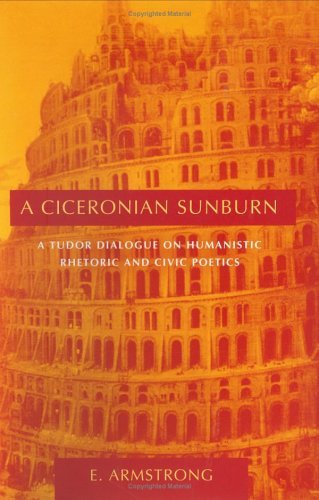
Title
A Ciceronian Sunburn: A Tudor Dialogue on Humanistic Rhetoric and Civic Poetics (Studies in Rhetoric/Communication),Used
Sold by Ergodebooks, an authorized reseller.
Returns accepted within 30 days | support@ergodebooks.com
Shipping Information
- Free Standard Shipping — United States only
- Processing Time: 3–5 business days
- Estimated Delivery: 6–10 business days after dispatch
- Double-boxed, fully insured & discreetly packaged
- Tracking number sent via email once dispatched
Returns & Refund
Returns accepted within 30 days of delivery.
Damaged or Defective Item
Free return shipping + replacement or full refund
Wrong Item Received
Free return shipping + replacement or full refund
Change of Mind
Return shipping at customer's expense · 25% restocking fee applies
Payment Option

The poetry of Spenser, Sidney, and their contemporaries viewed as rhetorical discourseA Ciceronian Sunburn reconsiders the complexion of Tudor poetics by demonstrating the ways in which poets and pedagogues appropriated the rhetorical brilliance of Cicero to inform their approaches to learning. By recasting the poetic texts of Edmund Spenser and Sir Philip Sydney as works that participated in sixteenthcentury debates on learning, E. Armstrong challenges conventional views of Tudor poetics. He argues that the poetry of Spenser, Sydney, and others of the period reflects a more fully developed understanding of Ciceronian rhetoric than is evident in the sources to which historians of humanistic rhetoric most frequently turn, namely, the lectures, pedagogical handbooks, and treatises of early modern scholars.Reclaiming poetics as a substantive force for the rhetorical tradition, Armstrong finds that the poetry of the period confirms Cicero's dictum that "the poet is the nearest kinsman to the orator." By showing how the poets' work contributed to and was appropriated by those immersed in the Tudor controversies on learning, Armstrong brings to the fore an argument that prizes the practical, ethically directed, and civicminded over the moral and philosophical detachment for which the poets traditionally are revered.Armstrong offers a study that operates on three interrelated levels. First he analyzes the writings of a circle of Tudor poets and scholars, all known to one other and in a sense conversingLodowick Bryskett, Spenser (and his glossarist E.K.), Abraham Fraunce, William Temple, and Sidney. On another level Armstrong broadens the context for the conversation by locating it within the divergent visions of learning and rhetoric advanced by Erasmus and Peter Ramus. On the third level Armstrong grounds these early modern disputes, both historically and intellectually, in topics discovered in Cicero's De oratore and De officiis.
⚠️ WARNING (California Proposition 65):
This product may contain chemicals known to the State of California to cause cancer, birth defects, or other reproductive harm.
For more information, please visit www.P65Warnings.ca.gov.