

Title
A Computational Approach to Statistical Learning (Chapman & Hall/CRC Texts in Statistical Science),Used
Sold by Ergodebooks, an authorized reseller.
Returns accepted within 30 days | support@ergodebooks.com
Shipping Information
- Free Standard Shipping — United States only
- Processing Time: 3–5 business days
- Estimated Delivery: 6–10 business days after dispatch
- Double-boxed, fully insured & discreetly packaged
- Tracking number sent via email once dispatched
Returns & Refund
Returns accepted within 30 days of delivery.
Damaged or Defective Item
Free return shipping + replacement or full refund
Wrong Item Received
Free return shipping + replacement or full refund
Change of Mind
Return shipping at customer's expense · 25% restocking fee applies
Payment Option

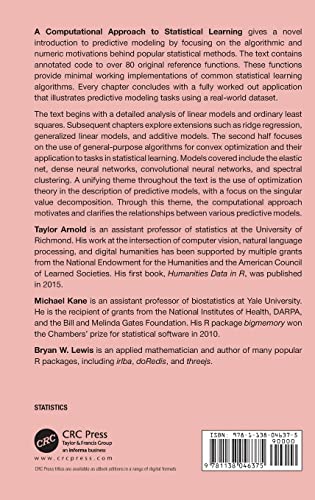
A Computational Approach to Statistical Learning gives a novel introduction to predictive modeling by focusing on the algorithmic and numeric motivations behind popular statistical methods. The text contains annotated code to over 80 original reference functions. These functions provide minimal working implementations of common statistical learning algorithms. Every chapter concludes with a fully worked out application that illustrates predictive modeling tasks using a realworld dataset.The text begins with a detailed analysis of linear models and ordinary least squares. Subsequent chapters explore extensions such as ridge regression, generalized linear models, and additive models. The second half focuses on the use of generalpurpose algorithms for convex optimization and their application to tasks in statistical learning. Models covered include the elastic net, dense neural networks, convolutional neural networks (CNNs), and spectral clustering. A unifying theme throughout the text is the use of optimization theory in the description of predictive models, with a particular focus on the singular value decomposition (SVD). Through this theme, the computational approach motivates and clarifies the relationships between various predictive models.Taylor Arnold is an assistant professor of statistics at the University of Richmond. His work at the intersection of computer vision, natural language processing, and digital humanities has been supported by multiple grants from the National Endowment for the Humanities (NEH) and the American Council of Learned Societies (ACLS). His first book, Humanities Data in R, was published in 2015.Michael Kane is an assistant professor of biostatistics at Yale University. He is the recipient of grants from the National Institutes of Health (NIH), DARPA, and the Bill and Melinda Gates Foundation. His R package bigmemory won the Chamber's prize for statistical software in 2010.Bryan Lewis is an applied mathematician and author of many popular R packages, including irlba, doRedis, and threejs.
⚠️ WARNING (California Proposition 65):
This product may contain chemicals known to the State of California to cause cancer, birth defects, or other reproductive harm.
For more information, please visit www.P65Warnings.ca.gov.