If you have any questions, you are always welcome to contact us. We'll get back to you as soon as possible, withing 24 hours on weekdays.
Customer service
All questions about your order, return and delivery must be sent to our customer service team by e-mail at yourstore@yourdomain.com
Sale & Press
If you are interested in selling our products, need more information about our brand or wish to make a collaboration, please contact us at press@yourdomain.com
Help
If you have any questions, you are always welcome to contact us. We'll get back to you as soon as possible, withing 24 hours on weekdays.
Customer service
All questions about your order, return and delivery must be sent to our customer service team by e-mail at yourstore@yourdomain.com
Sale & Press
If you are interested in selling our products, need more information about our brand or wish to make a collaboration, please contact us at press@yourdomain.com
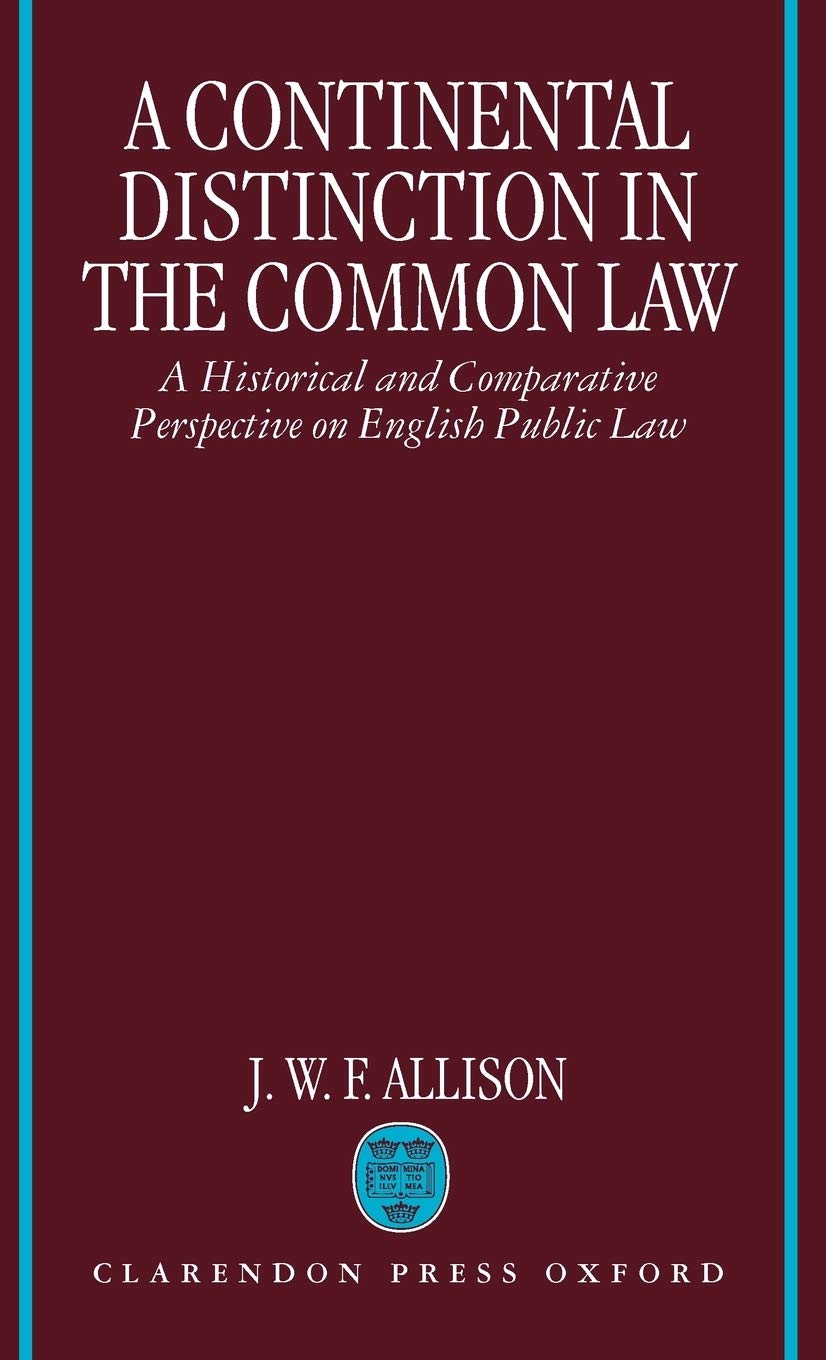
The development of an autonomous English public law has been accompanied by persistent problemsa lack of systematic principles, dissatisfaction with judicial procedures, and uncertainty about the judicial role. It has provoked an ongoing debate on the very desirability of the distinction between public and private law. In this debate, an historical and comparative perspective has been lacking. A Continental Distinction in the Common Law introduces such a perspective. It compares the recent emergance of a significant English distinction with the entranchment of the traditional French distinction. It explains how persistent problems of English public law are related to fundamental differences between the English and French legal and political traditions, differences in their conception of the state administration, their approach to law, their separation of powers, and their judicial procedures in publiclaw cases. The author argues that a satisfactory distinction between public and private law depends on a particular legal and political context, a context which was evident in latenineteenthcentury France and is absent in twentiethcentury England. He concludes by identifying the farreaching theoretical, institutional, and procedural changes required to accommodate English public law.
⚠️ WARNING (California Proposition 65):
This product may contain chemicals known to the State of California to cause cancer,
birth defects, or other reproductive harm.
For MAP (Minimum Advertised Price) violations and Intellectual Property (IP) or Trademark concerns, please contact:
support@ergodebooks.com
⚠️ California Proposition 65 Warning: Some products sold on this website may expose you to chemicals known to the State of California to cause cancer, birth defects, or other reproductive harm. For more information, visit www.P65Warnings.ca.gov.