If you have any questions, you are always welcome to contact us. We'll get back to you as soon as possible, withing 24 hours on weekdays.
Customer service
All questions about your order, return and delivery must be sent to our customer service team by e-mail at yourstore@yourdomain.com
Sale & Press
If you are interested in selling our products, need more information about our brand or wish to make a collaboration, please contact us at press@yourdomain.com
Help
If you have any questions, you are always welcome to contact us. We'll get back to you as soon as possible, withing 24 hours on weekdays.
Customer service
All questions about your order, return and delivery must be sent to our customer service team by e-mail at yourstore@yourdomain.com
Sale & Press
If you are interested in selling our products, need more information about our brand or wish to make a collaboration, please contact us at press@yourdomain.com
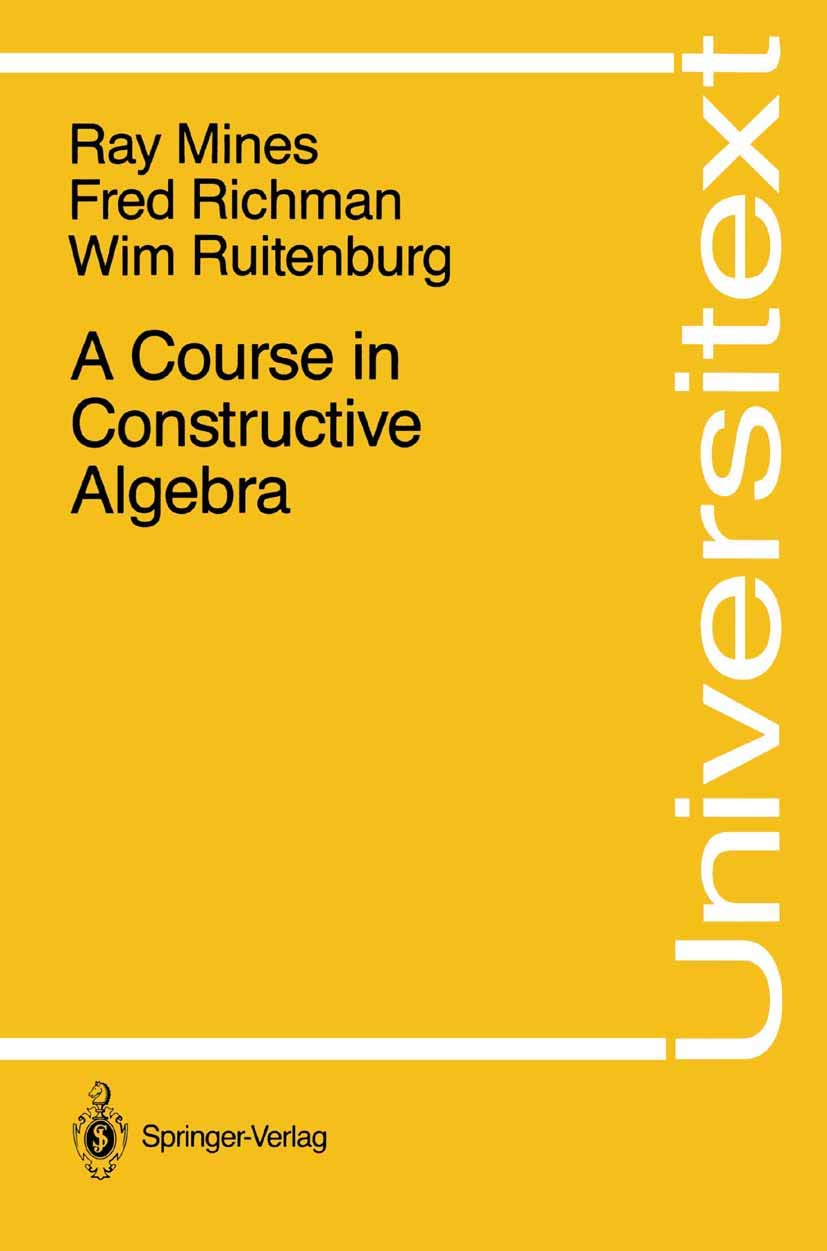
The constructive approach to mathematics has enjoyed a renaissance, caused in large part by the appearance of Errett Bishop's book Foundations of constr'uctiue analysis in 1967, and by the subtle influences of the proliferation of powerful computers. Bishop demonstrated that pure mathematics can be developed from a constructive point of view while maintaining a continuity with classical terminology and spirit; much more of classical mathematics was preserved than had been thought possible, and no classically false theorems resulted, as had been the case in other constructive schools such as intuitionism and Russian constructivism. The computers created a widespread awareness of the intuitive notion of an effecti ve procedure, and of computation in principle, in addi tion to stimulating the study of constructive algebra for actual implementation, and from the point of view of recursive function theory. In analysis, constructive problems arise instantly because we must start with the real numbers, and there is no finite procedure for deciding whether two given real numbers are equal or not (the real numbers are not discrete) . The main thrust of constructive mathematics was in the direction of analysis, although several mathematicians, including Kronecker and van der waerden, made important contributions to construc tive algebra. Heyting, working in intuitionistic algebra, concentrated on issues raised by considering algebraic structures over the real numbers, and so developed a handmaiden'of analysis rather than a theory of discrete algebraic structures.
⚠️ WARNING (California Proposition 65):
This product may contain chemicals known to the State of California to cause cancer,
birth defects, or other reproductive harm.
For MAP (Minimum Advertised Price) violations and Intellectual Property (IP) or Trademark concerns, please contact:
support@ergodebooks.com
⚠️ California Proposition 65 Warning: Some products sold on this website may expose you to chemicals known to the State of California to cause cancer, birth defects, or other reproductive harm. For more information, visit www.P65Warnings.ca.gov.