
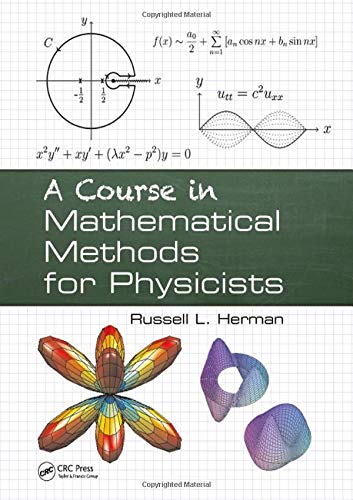
Title
A Course In Mathematical Methods For Physicists,Used
Sold by Ergodebooks, an authorized reseller.
Returns accepted within 30 days | support@ergodebooks.com
Shipping Information
- Free Standard Shipping — United States only
- Processing Time: 3–5 business days
- Estimated Delivery: 6–10 business days after dispatch
- Double-boxed, fully insured & discreetly packaged
- Tracking number sent via email once dispatched
Returns & Refund
Returns accepted within 30 days of delivery.
Damaged or Defective Item
Free return shipping + replacement or full refund
Wrong Item Received
Free return shipping + replacement or full refund
Change of Mind
Return shipping at customer's expense · 25% restocking fee applies
Payment Option

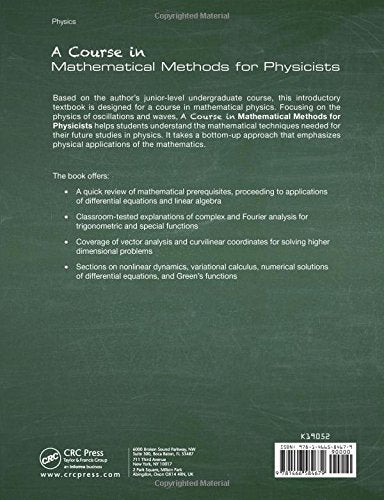
Based On The Authors Juniorlevel Undergraduate Course, This Introductory Textbook Is Designed For A Course In Mathematical Physics. Focusing On The Physics Of Oscillations And Waves, A Course In Mathematical Methods For Physicists Helps Students Understand The Mathematical Techniques Needed For Their Future Studies In Physics. It Takes A Bottomup Approach That Emphasizes Physical Applications Of The Mathematics.The Book Offers:A Quick Review Of Mathematical Prerequisites, Proceeding To Applications Of Differential Equations And Linear Algebra Classroomtested Explanations Of Complex And Fourier Analysis For Trigonometric And Special Functions Coverage Of Vector Analysis And Curvilinear Coordinates For Solving Higher Dimensional Problems Sections On Nonlinear Dynamics, Variational Calculus, Numerical Solutions Of Differential Equations, And Green'S Functions
⚠️ WARNING (California Proposition 65):
This product may contain chemicals known to the State of California to cause cancer, birth defects, or other reproductive harm.
For more information, please visit www.P65Warnings.ca.gov.
- Q: How many pages does this textbook have? A: This textbook has seven hundred ninety-two pages. It covers a comprehensive range of mathematical methods for physicists.
- Q: What is the binding type of this book? A: The binding type is paperback. This makes it lightweight and portable for students.
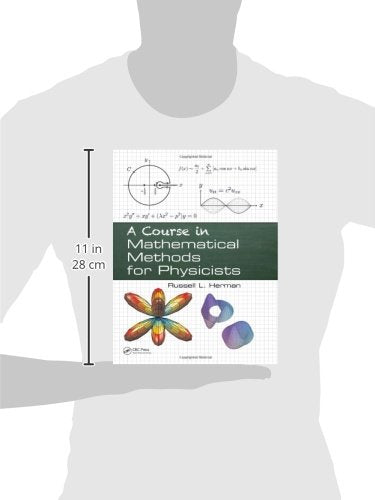
- Q: What are the dimensions of this book? A: The dimensions are eight point seventy-five inches in length, one point seventy-five inches in width, and eleven point twenty-six inches in height.
- Q: What topics are covered in this course? A: The course covers mathematical physics with a focus on oscillations, waves, and mathematical techniques needed for physics studies.
- Q: Who is the author of this book? A: The author is Russell L. Herman. He designed the course based on his experience teaching undergraduate students.
- Q: Is this book suitable for beginners? A: Yes, this book is suitable for beginners. It starts with a review of mathematical prerequisites before advancing to complex topics.
- Q: What level of education is this book intended for? A: This book is intended for junior-level undergraduate students. It is designed to support their studies in mathematical physics.
- Q: How can I apply the concepts learned in this book? A: You can apply the concepts by solving problems related to oscillations, waves, and differential equations as outlined in the book.
- Q: Is there a section on numerical solutions in this book? A: Yes, there is a section on numerical solutions of differential equations. It provides practical applications of mathematical techniques.
- Q: What is the best way to keep this textbook in good condition? A: To keep this textbook in good condition, store it in a cool, dry place and avoid exposing it to direct sunlight.
- Q: Can I highlight or write in this book? A: Yes, you can highlight or write in this book. The paperback format allows for easy note-taking.
- Q: What if my book arrives damaged? A: If your book arrives damaged, contact the seller for a return or exchange policy. Most sellers offer solutions for damaged items.
- Q: Does this book include exercises and examples? A: Yes, the book includes exercises and examples to help reinforce the mathematical methods covered in the text.
- Q: What kind of mathematical prerequisites should I have? A: You should have a basic understanding of calculus and linear algebra as a prerequisite for this course.
- Q: Is this book used in academic courses? A: Yes, this book is used in academic courses, particularly for those focused on mathematical methods in physics.
- Q: How does this book compare to other physics textbooks? A: This book emphasizes physical applications of mathematics, which sets it apart from other textbooks that may focus more on theory.