
Title
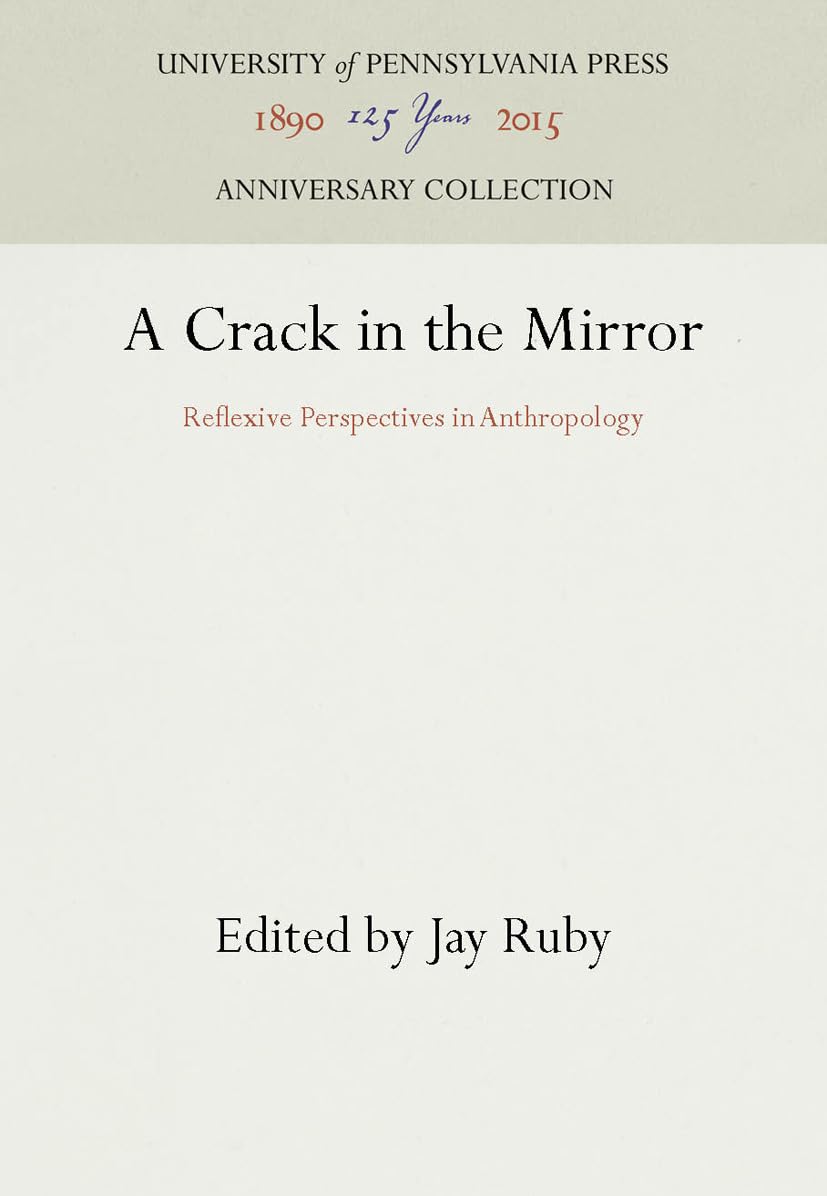
A Crack In The Mirror: Reflexive Perspectives In Anthropology (Anniversary Collection),Used
Sold by Ergodebooks, an authorized reseller.
Returns accepted within 30 days | support@ergodebooks.com
Shipping Information
- Free Standard Shipping — United States only
- Processing Time: 3–5 business days
- Estimated Delivery: 6–10 business days after dispatch
- Double-boxed, fully insured & discreetly packaged
- Tracking number sent via email once dispatched
Returns & Refund
Returns accepted within 30 days of delivery.
Damaged or Defective Item
Free return shipping + replacement or full refund
Wrong Item Received
Free return shipping + replacement or full refund
Change of Mind
Return shipping at customer's expense · 25% restocking fee applies
Payment Option

Like Conrad'S Marlow, Whose Tale Of Journeying Into The 'Heart Of Darkness' Gives Us As Much Insight Into One Man'S Personality As It Does Into The Mysteries Of The Dark World He Explored, So The Anthropologist'S Record Of Another Culture Contains More Than Objective, Scientific Data About His Investigation. Embedded Within It Are Clues To The 'Personality' Of Anthropology Itself: The Attitudes, Approaches, Even Prejudices That At Any Given Stage In History Are Inextricable From The Ideology Of The Anthropologist. Therefore, The Mirror He Holds Up To Show Us Another Culture Can Never Be A Perfect One. His Own Professional Attitude Toward His Subject, As Well As His Choice Of Medium, Are Factors That Create 'Cracks' In The Mirror Of Anthropology Through Which We Believe We View The Life Of Other Cultures.Hence, The Concept Of 'Reflexivity' And The Striving To Recognize How It Warps In The Portrayal Of Anthropological Truth Lie At The Core Of The Twelve Finely Wrought Essays Collected In This Volume. Wide Ranging In Geography As Well As Viewpoint, They Highlight Various Methods And Media (Film, Ethnography, Text) Through Which An Anthropologist Chooses To Portray A Culture, And The Various Forms, Such As Art, Theater, And Ritual, Through Which A Culture Portrays Itself. Recognizing The Link Between These Two Processes Provides The Key To Cultural And Methodological Self Awareness.Reflexivity Is Defined And Clarified In The Introduction And In Three Of The Essays, And The Remaining Nine Essays Evince The Principle Through Fieldwork And Startling Case Studies. Essays By Jay Ruby And Eric Michaels Shed New Light On The Enormous Potential Of Film And Video, Showing How A Form Generally Thought To Be 'Nonscientific' Can In Fact Give Fresh Insight Into The Scientific Premises Underlying The Discipline'S Methodology. Essays By Barbara Babcock And Carol Ann Parssinen Focus On The Novel And Ethnography, Examining Existing Works.Anthropologists, As Well As Students Of Film, Art, And Theater, Will Find That This Intriguing Work Begins To Redefine Traditional Distinctions Between Science And The Arts And Brings To Light Fresh Resources That Are Utilized In The Search For Anthropological Truth.Contributors: Richard Schechner, Victor Turner, Barbara Myerhoff, Jay Ruby, Eric Michaels, Dennis Tedlock, George Marcus, Paul Rabinow, Barbara Babcock, Carol Ann Parssinen, And Dan Rose.
⚠️ WARNING (California Proposition 65):
This product may contain chemicals known to the State of California to cause cancer, birth defects, or other reproductive harm.
For more information, please visit www.P65Warnings.ca.gov.
- Q: What is the page count of 'A Crack in the Mirror'? A: This book has two hundred eighty-eight pages. It provides an in-depth exploration of reflexivity in anthropology through various essays.
- Q: What is the binding type of this book? A: The book is hardcover. This durable binding is ideal for long-term use and protection.
- Q: What are the dimensions of 'A Crack in the Mirror'? A: The book measures six point fourteen inches in length, nine point twenty-one inches in height, and zero point seventy-five inches in width. These dimensions make it a convenient size for reading.
- Q: Who is the author of 'A Crack in the Mirror'? A: The author of this book is Jay Ruby. He is known for his contributions to anthropology and media studies.
- Q: What is the main theme of 'A Crack in the Mirror'? A: The main theme revolves around reflexivity in anthropology. It discusses how personal biases affect the portrayal of different cultures.
- Q: Is this book suitable for beginners in anthropology? A: Yes, the book is suitable for beginners. It presents complex ideas in an accessible manner through various essays.
- Q: How can I use 'A Crack in the Mirror' for academic purposes? A: You can use this book for academic purposes by referencing its essays in research papers or projects. It provides valuable insights into anthropological methodologies.
- Q: Is this book appropriate for students studying social sciences? A: Yes, this book is appropriate for social sciences students. It offers critical perspectives that enhance understanding of cultural studies.
- Q: How should I store 'A Crack in the Mirror'? A: Store this book in a cool, dry place to maintain its condition. Keep it away from direct sunlight to prevent fading.
- Q: Can I clean the cover of this hardcover book? A: Yes, you can gently wipe the cover with a soft, damp cloth. Avoid using harsh chemicals that might damage the cover.
- Q: What if the book arrives damaged? A: If the book arrives damaged, you should contact customer service for a replacement or refund. Most retailers have return policies for damaged items.
- Q: Is there a warranty for 'A Crack in the Mirror'? A: No, there is typically no warranty for books. However, you can check the return policy of the retailer for options.
- Q: How do I handle this book to avoid damage? A: To avoid damage, handle the book with clean hands and avoid bending the spine. Use a bookmark instead of folding pages.
- Q: What makes 'A Crack in the Mirror' unique? A: This book is unique due to its collection of essays from various contributors that highlight different aspects of anthropological reflexivity.
- Q: Does this book contain illustrations or photos? A: No, 'A Crack in the Mirror' primarily contains text-focused essays without illustrations or photos. It emphasizes written analysis.
- Q: Is 'A Crack in the Mirror' part of a series? A: Yes, it is part of the Anniversary Collection by the University of Pennsylvania Press, which includes other significant works in anthropology.