
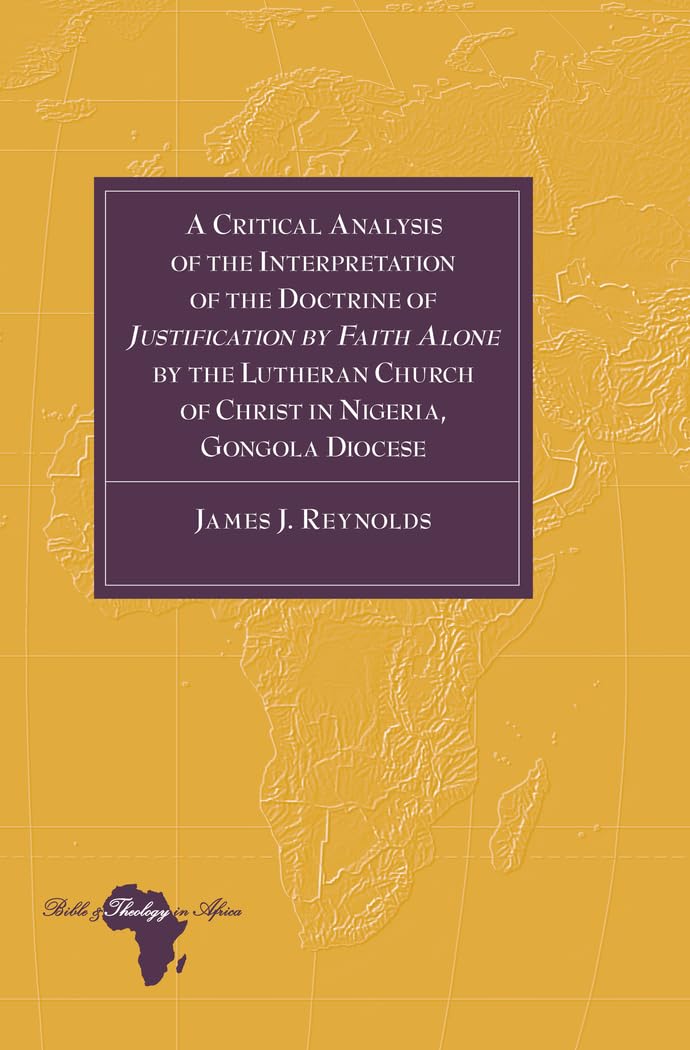
Title
A Critical Analysis of the Interpretation of the Doctrine of Justification by Faith Alone by the Lutheran Church of Christ in Ni,Used
Sold by Ergodebooks, an authorized reseller.
Returns accepted within 30 days | support@ergodebooks.com
Shipping Information
- Free Standard Shipping — United States only
- Processing Time: 3–5 business days
- Estimated Delivery: 6–10 business days after dispatch
- Double-boxed, fully insured & discreetly packaged
- Tracking number sent via email once dispatched
Returns & Refund
Returns accepted within 30 days of delivery.
Damaged or Defective Item
Free return shipping + replacement or full refund
Wrong Item Received
Free return shipping + replacement or full refund
Change of Mind
Return shipping at customer's expense · 25% restocking fee applies
Payment Option

Within the context of the Lutheran Church in Nigeria, Gongola Diocese, this book examines the issues of the interpretation, transmission, and appropriation of the doctrine of justification by faith alone. Using contextualization as the main tool in this exploration, James J. Reynolds argues that intercultural communication holds the key to unlocking how effectively and appropriately these three engagements with theology are executed. The Lutheran church, and indeed most Protestant denominations, assert that justification by faith alone is the cardinal doctrine of Christianity. Scholars, however, are concerned that there is a great level of ignorance among members and misappropriation of justification by faith alone in the lives of members of these denominations. To investigate these underlying factors, three theories are used as a framework with which to test the churchs interpretation of this doctrine: gospel and culture in dialogue, translatability, and contextual theological education programmes for the training of both clergy and laity. In order to initiate this process, the gospel and culture must engage in dialogue through a viable and contextual theological education programme for the training of both clergy and the laity. The Lunguda practice of ntsandah provides an ideal entry point for a proper informed interpretation of justification by faith alone. Ultimately, the author argues that the employment of intercultural communication in transmitting the message of justification by faith alone will be successful in helping address this problem.
⚠️ WARNING (California Proposition 65):
This product may contain chemicals known to the State of California to cause cancer, birth defects, or other reproductive harm.
For more information, please visit www.P65Warnings.ca.gov.