If you have any questions, you are always welcome to contact us. We'll get back to you as soon as possible, withing 24 hours on weekdays.
Customer service
All questions about your order, return and delivery must be sent to our customer service team by e-mail at yourstore@yourdomain.com
Sale & Press
If you are interested in selling our products, need more information about our brand or wish to make a collaboration, please contact us at press@yourdomain.com
Help
If you have any questions, you are always welcome to contact us. We'll get back to you as soon as possible, withing 24 hours on weekdays.
Customer service
All questions about your order, return and delivery must be sent to our customer service team by e-mail at yourstore@yourdomain.com
Sale & Press
If you are interested in selling our products, need more information about our brand or wish to make a collaboration, please contact us at press@yourdomain.com
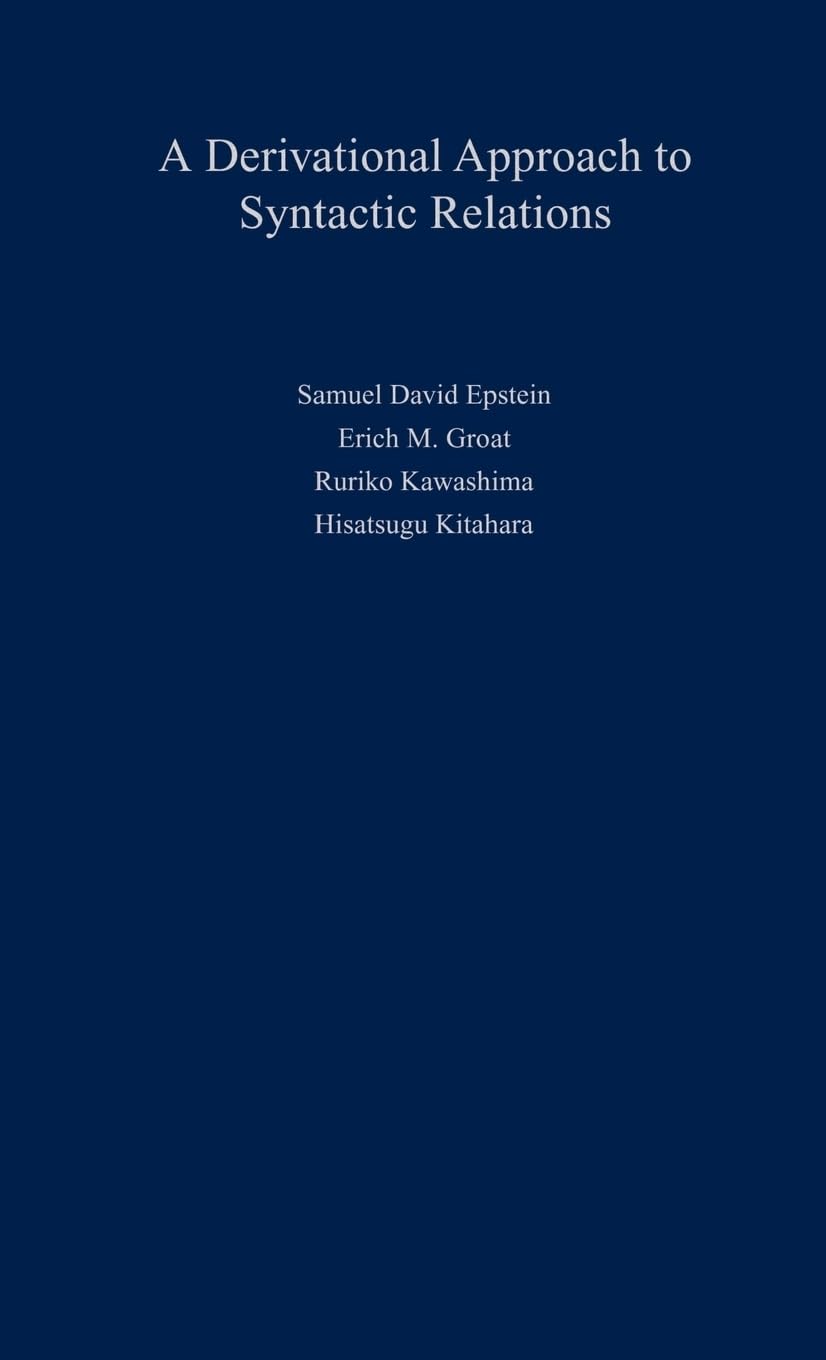
A fundamental concept in all syntactic theories is that of a syntactic relation between syntactic objects. While recent work in the Minimalist Framework has attempted to explain the nature of syntactic objects in terms of simple and conceptually necessary assumptions regarding the language faculty, the relations that hold between syntactic objects has not been similarly explored. The authors initiate such an exploration and argue that certain fundamental relations such as ccommand, dominance, and checking relations can be explained within a derivational approach to structurebuilding.This approach has significant consequences concerning the architecture of the syntactic component. Semantic and phonological interpretation need not operate upon the output phrasestructure representation created by the syntactic derivation. Interpretation is more readily computed derivationally, by interpreting the steps of a derivation, rather than the single output structure created by it. The result is a new and controversial levelfree model of the syntactic component of the human language faculty. This topical and timely Minimalist analysis will interest professional and theoretical linguists, syntacticians, and anyone interested in contemporary approaches to syntactic theory.
⚠️ WARNING (California Proposition 65):
This product may contain chemicals known to the State of California to cause cancer,
birth defects, or other reproductive harm.
For MAP (Minimum Advertised Price) violations and Intellectual Property (IP) or Trademark concerns, please contact:
support@ergodebooks.com
⚠️ California Proposition 65 Warning: Some products sold on this website may expose you to chemicals known to the State of California to cause cancer, birth defects, or other reproductive harm. For more information, visit www.P65Warnings.ca.gov.