If you have any questions, you are always welcome to contact us. We'll get back to you as soon as possible, withing 24 hours on weekdays.
Customer service
All questions about your order, return and delivery must be sent to our customer service team by e-mail at yourstore@yourdomain.com
Sale & Press
If you are interested in selling our products, need more information about our brand or wish to make a collaboration, please contact us at press@yourdomain.com
Help
If you have any questions, you are always welcome to contact us. We'll get back to you as soon as possible, withing 24 hours on weekdays.
Customer service
All questions about your order, return and delivery must be sent to our customer service team by e-mail at yourstore@yourdomain.com
Sale & Press
If you are interested in selling our products, need more information about our brand or wish to make a collaboration, please contact us at press@yourdomain.com
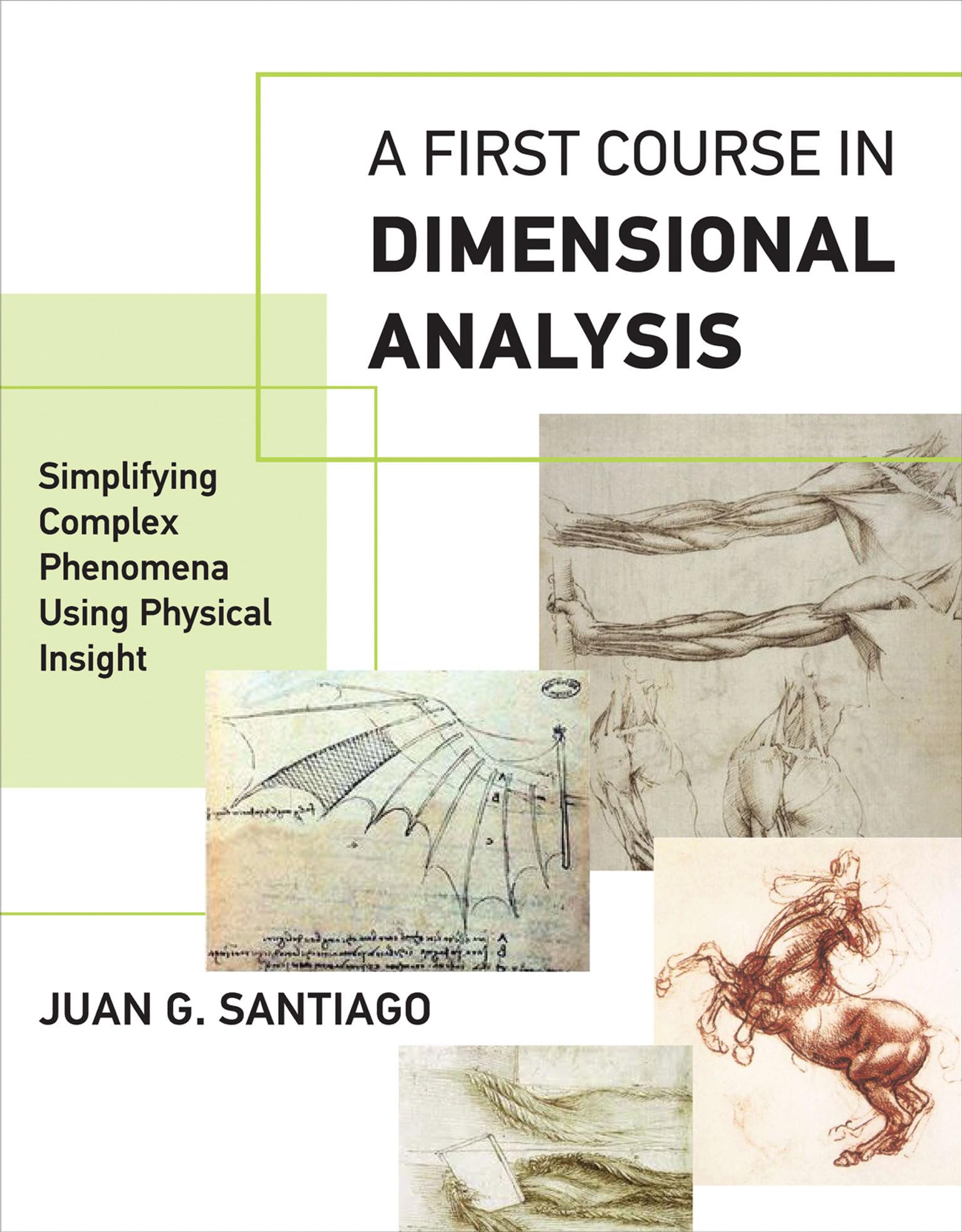
An introduction to dimensional analysis, a method of scientific analysis used to investigate and simplify complex physical phenomena, demonstrated through a series of engaging examples.This book offers an introduction to dimensional analysis, a powerful method of scientific analysis used to investigate and simplify complex physical phenomena. The method enables bold approximations and the generation of testable hypotheses. The book explains these analyses through a series of entertaining applications; students will learn to analyze, for example, the limits of worldrecord weight lifters, the distance an electric submarine can travel, how an upsidedown pendulum is similar to a running velociraptor, and the number of Olympic rowers required to double boat speed.The book introduces the approach through easytofollow, stepbystep methods that show how to identify the essential variables describing a complex problem; explore the dimensions of the problem and recast it to reduce complexity; leverage physical insights and experimental observations to further reduce complexity; form testable scientific hypotheses; combine experiments and analysis to solve a problem; and collapse and present experimental measurements in a compact form. Each chapter ends with a summary and problems for students to solve. Taken together, the analyses and examples demonstrate the value of dimensional analysis and provide guidance on how to combine and enhance dimensional analysis with physical insights. The book can be used by undergraduate students in physics, engineering, chemistry, biology, sports science, and astronomy.
⚠️ WARNING (California Proposition 65):
This product may contain chemicals known to the State of California to cause cancer,
birth defects, or other reproductive harm.
For MAP (Minimum Advertised Price) violations and Intellectual Property (IP) or Trademark concerns, please contact:
support@ergodebooks.com
⚠️ California Proposition 65 Warning: Some products sold on this website may expose you to chemicals known to the State of California to cause cancer, birth defects, or other reproductive harm. For more information, visit www.P65Warnings.ca.gov.