If you have any questions, you are always welcome to contact us. We'll get back to you as soon as possible, withing 24 hours on weekdays.
Customer service
All questions about your order, return and delivery must be sent to our customer service team by e-mail at yourstore@yourdomain.com
Sale & Press
If you are interested in selling our products, need more information about our brand or wish to make a collaboration, please contact us at press@yourdomain.com
Help
If you have any questions, you are always welcome to contact us. We'll get back to you as soon as possible, withing 24 hours on weekdays.
Customer service
All questions about your order, return and delivery must be sent to our customer service team by e-mail at yourstore@yourdomain.com
Sale & Press
If you are interested in selling our products, need more information about our brand or wish to make a collaboration, please contact us at press@yourdomain.com
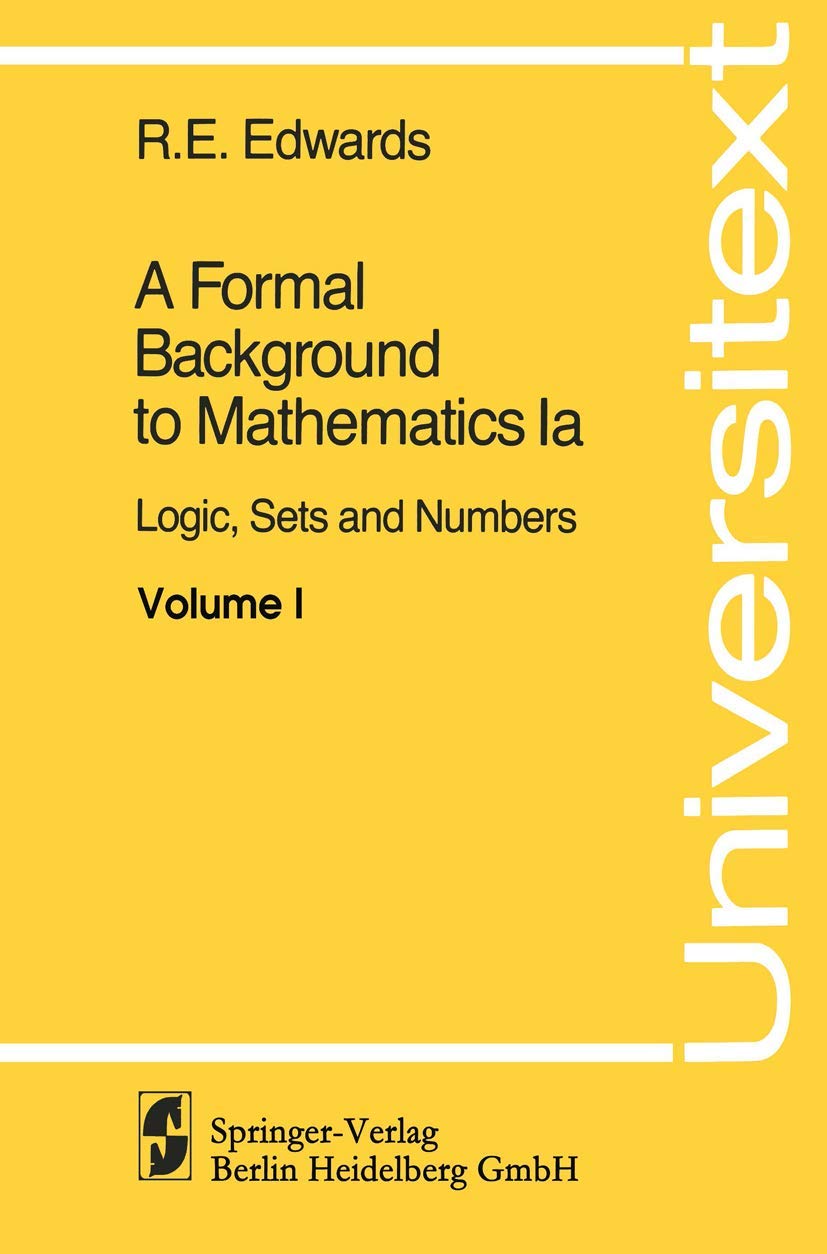
1 Faced by the questions mentioned in the Preface I was prompted to write this book on the assumption that a typical reader will have certain characteristics. He will presumably be familiar with conventional accounts of certain portions of mathematics and with many socalled mathematical statements, some of which (the theorems) he will know (either because he has himself studied and digested a proof or because he accepts the authority of others) to be true, and others of which he will know (by the same token) to be false. He will nevertheless be conscious of and perturbed by a lack of clarity in his own mind concerning the concepts of proof and truth in mathematics, though he will almost certainly feel that in mathematics these concepts have special meanings broadly similar in outward features to, yet different from, those in everyday life; and also that they are based on criteria different from the experimental ones used in science. He will be aware of statements which are as yet not known to be either true or false (unsolved problems). Quite possibly he will be surprised and dismayed by the possibility that there are statements which are "definite" (in the sense of involving no free variables) and which nevertheless can never (strictly on the basis of an agreed collection of axioms and an agreed concept of proof) be either proved or disproved (refuted).
⚠️ WARNING (California Proposition 65):
This product may contain chemicals known to the State of California to cause cancer,
birth defects, or other reproductive harm.
For MAP (Minimum Advertised Price) violations and Intellectual Property (IP) or Trademark concerns, please contact:
support@ergodebooks.com
⚠️ California Proposition 65 Warning: Some products sold on this website may expose you to chemicals known to the State of California to cause cancer, birth defects, or other reproductive harm. For more information, visit www.P65Warnings.ca.gov.