
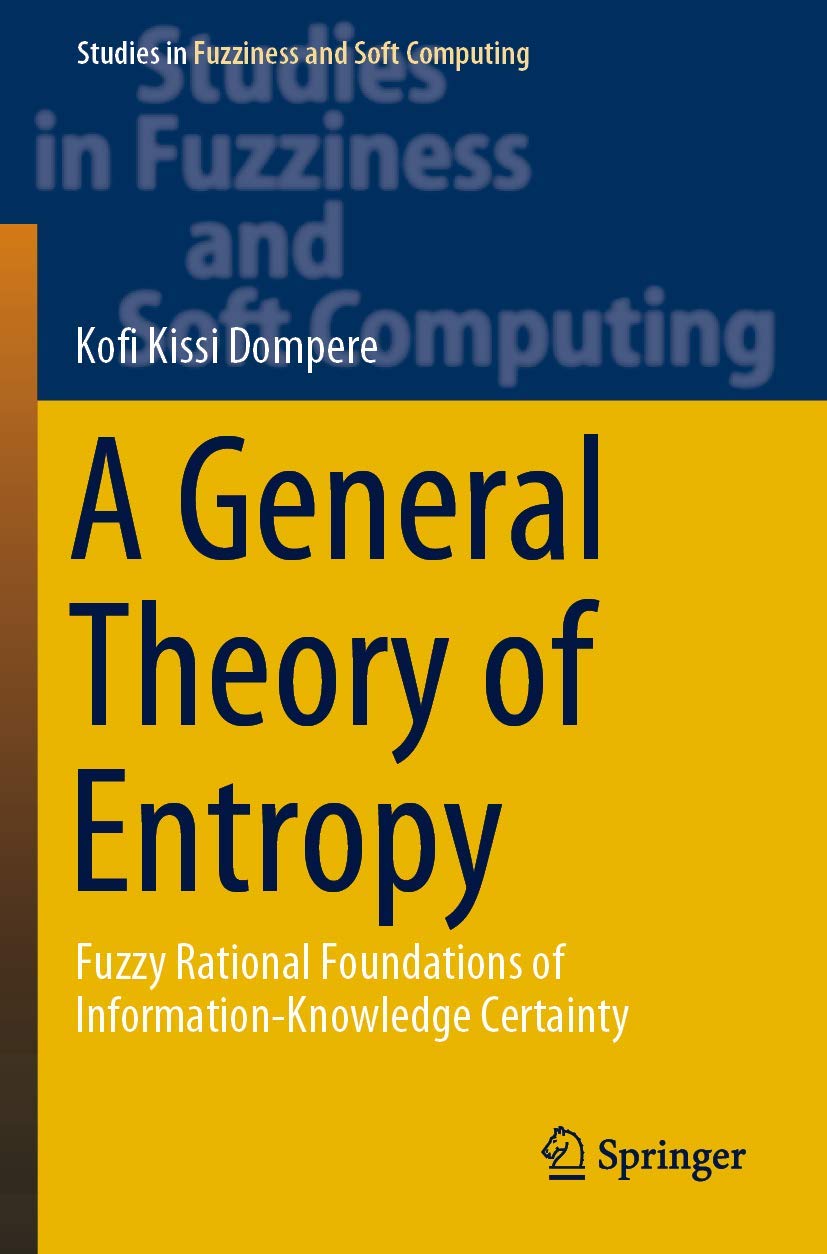
Title
A General Theory of Entropy: Fuzzy Rational Foundations of InformationKnowledge Certainty (Studies in Fuzziness and Soft Comput,Used
Sold by Ergodebooks, an authorized reseller.
Returns accepted within 30 days | support@ergodebooks.com
Shipping Information
- Free Standard Shipping — United States only
- Processing Time: 3–5 business days
- Estimated Delivery: 6–10 business days after dispatch
- Double-boxed, fully insured & discreetly packaged
- Tracking number sent via email once dispatched
Returns & Refund
Returns accepted within 30 days of delivery.
Damaged or Defective Item
Free return shipping + replacement or full refund
Wrong Item Received
Free return shipping + replacement or full refund
Change of Mind
Return shipping at customer's expense · 25% restocking fee applies
Payment Option

This book presents an epistemic framework for dealing with informationknowledge and certaintyuncertainty problems within the space of qualityquantity dualities. It bridges between theoretical concepts of entropy and entropy measurements, proposing the concept and measurement of fuzzystochastic entropy that is applicable to all areas of knowing under human cognitive limitations over the epistemological space. The book builds on two previous monographs by the same author concerning theories of infostatics and infodynamics, to deal with identification and transformation problems respectively. The theoretical framework is developed by using the toolboxes such as those of the principle of opposites, systems of actualpotential polarities and negativepositive dualities, under different costbenefit timestructures. The category theory and the fuzzy paradigm of thought, under methodological constructionismreductionism duality, are used in the fuzzystochastic and costbenefit spaces to point to directions of global application in knowing, knowledge and decisionchoice actions. Thus, the book is concerned with a general theory of entropy, showing how the fuzzy paradigm of thought is developed to deal with the problems of qualitativequantitative uncertainties over the fuzzystochastic space, which will be applicable to conditions of softhard data, fact, evidence and knowledge over the spaces of problemsolution dualities, decisionchoice actions in sciences, nonsciences, engineering and planning sciences to abstract acceptable informationknowledge elements.
⚠️ WARNING (California Proposition 65):
This product may contain chemicals known to the State of California to cause cancer, birth defects, or other reproductive harm.
For more information, please visit www.P65Warnings.ca.gov.