If you have any questions, you are always welcome to contact us. We'll get back to you as soon as possible, withing 24 hours on weekdays.
Customer service
All questions about your order, return and delivery must be sent to our customer service team by e-mail at yourstore@yourdomain.com
Sale & Press
If you are interested in selling our products, need more information about our brand or wish to make a collaboration, please contact us at press@yourdomain.com
Help
If you have any questions, you are always welcome to contact us. We'll get back to you as soon as possible, withing 24 hours on weekdays.
Customer service
All questions about your order, return and delivery must be sent to our customer service team by e-mail at yourstore@yourdomain.com
Sale & Press
If you are interested in selling our products, need more information about our brand or wish to make a collaboration, please contact us at press@yourdomain.com
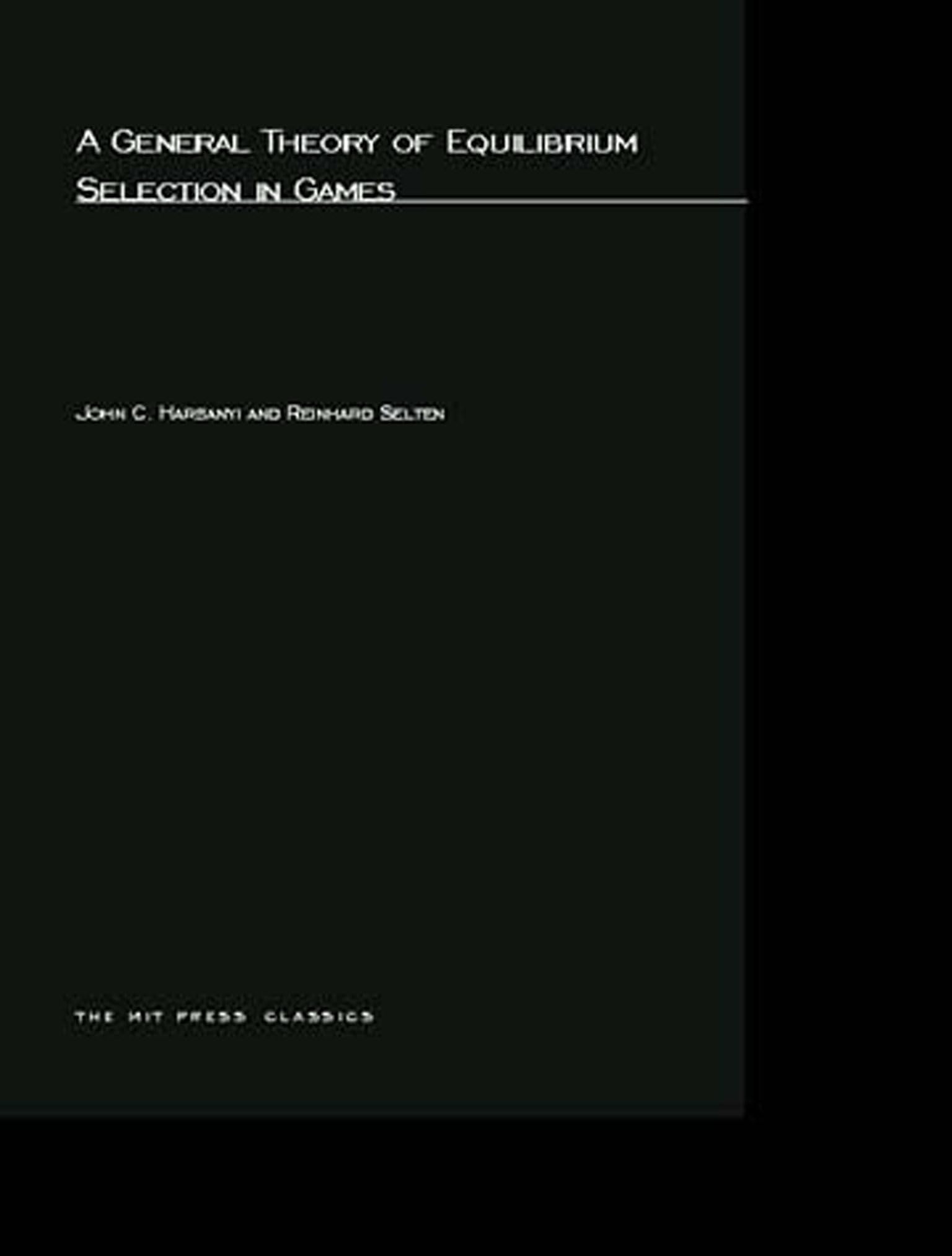
The authors, two of the most prominent game theorists of this generation, have devoted a number of years to the development of the theory presented here, and to its economic applications. They propose rational criteria for selecting one particular uniformly perfect equilibrium point as the solution of any noncooperative game. And, because any cooperative game can be remodelled as a noncooperative bargaining game, their theory defines a onepoint solution for any cooperative game as well. By providing solutions based on the same principles of rational behavior for all classes of games, both cooperative and noncooperative, both those with complete and with incomplete information, Harsanyi and Selten's approach achieves a remarkable degree of theoretical unification for game theory as a whole and provides a deeper insight into the nature of gametheoretic rationality. The book applies this theory to a number of specific game classes, such as unanimity games; bargaining with transaction costs; trade involving one seller and several buyers; twoperson bargaining with incomplete information on one side, and on both sides. The last chapter discusses the relationship of the authors' theory to other recently proposed solution concepts, particularly the KohbergMertens stability theory.
⚠️ WARNING (California Proposition 65):
This product may contain chemicals known to the State of California to cause cancer,
birth defects, or other reproductive harm.
For MAP (Minimum Advertised Price) violations and Intellectual Property (IP) or Trademark concerns, please contact:
support@ergodebooks.com
⚠️ California Proposition 65 Warning: Some products sold on this website may expose you to chemicals known to the State of California to cause cancer, birth defects, or other reproductive harm. For more information, visit www.P65Warnings.ca.gov.