
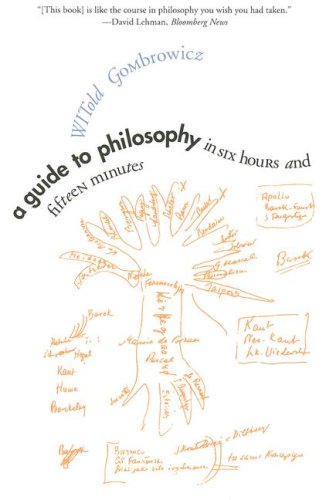
Title
A Guide to Philosophy in Six Hours and Fifteen Minutes,Used
Sold by Ergodebooks, an authorized reseller.
Returns accepted within 30 days | support@ergodebooks.com
Shipping Information
- Free Standard Shipping — United States only
- Processing Time: 3–5 business days
- Estimated Delivery: 6–10 business days after dispatch
- Double-boxed, fully insured & discreetly packaged
- Tracking number sent via email once dispatched
Returns & Refund
Returns accepted within 30 days of delivery.
Damaged or Defective Item
Free return shipping + replacement or full refund
Wrong Item Received
Free return shipping + replacement or full refund
Change of Mind
Return shipping at customer's expense · 25% restocking fee applies
Payment Option

Witold Gombrowicz (19041969), novelist, essayist, and playwright, was one of the most important Polish writers of the twentieth century. A candidate for the Nobel Prize in Literature in 1968, he was described by Milan Kundera as one of the great novelists of our century and by John Updike as one of the profoundest of the late moderns.Gombrowiczs works were considered scandalous and subversive by the ruling powers in Poland and were banned for nearly forty years. He spent his last years in France teaching philosophy; this book is a series of reflections based on his lectures.Gombrowicz discusses Kant, Hegel, Schopenhauer, Kierkegaard, Sartre, and Heidegger in six onehour essays and addresses Marxism in a shorter fifteenminute piece. The texta small literary gem full of sardonic wit, brilliant insights, and provocative criticismconstructs the philosophical lineage of his work.
⚠️ WARNING (California Proposition 65):
This product may contain chemicals known to the State of California to cause cancer, birth defects, or other reproductive harm.
For more information, please visit www.P65Warnings.ca.gov.
- Q: What is the page count of this book? A: This book contains one hundred twenty-eight pages. It offers a compact yet insightful exploration of philosophical themes.
- Q: What is the binding type of this book? A: This book is paperback bound. This makes it lightweight and portable for easy reading.
- Q: What are the dimensions of this book? A: The book measures five inches in length, zero point five one inches in width, and seven point five two inches in height. These dimensions make it easy to fit into a bag.
- Q: Who is the author of this book? A: The author is Witold Gombrowicz, a notable Polish writer. He is recognized for his contributions to literature and philosophy.
- Q: What topics does this book cover? A: The book covers major philosophical figures and themes, including Kant, Hegel, and Marxism. It consists of six essays and a shorter piece that reflects on these topics.
- Q: How do I read this book effectively? A: You can read this book by following the structured essays, each designed to be read in one hour. This makes it suitable for readers with limited time.
- Q: Is this book suitable for beginners in philosophy? A: Yes, this book is suitable for beginners. The essays are concise and provide accessible insights into complex philosophical ideas.
- Q: What age group is this book appropriate for? A: This book is appropriate for adults and mature teens. It discusses advanced philosophical concepts that require a certain level of understanding.
- Q: How should I care for this paperback book? A: To care for this book, store it in a dry place and avoid exposure to direct sunlight. This will help preserve its condition.
- Q: Can I lend this book to others? A: Yes, you can lend this book to others. Its engaging content makes it a great choice for discussion among friends.
- Q: What if the book arrives damaged? A: If the book arrives damaged, you should contact the seller for a return or exchange. Most sellers provide customer support for such issues.
- Q: Is there a warranty for this book? A: No, there is typically no warranty for books. However, check the seller's return policy for any guarantees.
- Q: How do I store this book? A: Store this book upright on a shelf with other books. Ensure it is not squeezed between heavy items to avoid bending.
- Q: What makes this book different from other philosophy books? A: This book is unique because it distills complex ideas into brief essays. Its author's distinct voice adds to its appeal.
- Q: Is there a glossary or index in this book? A: No, this book does not include a glossary or index. Readers are encouraged to engage directly with the text.
- Q: How can this book enhance my understanding of philosophy? A: This book enhances understanding by presenting philosophical concepts in a relatable manner. Gombrowicz’s reflections stimulate critical thinking.