
Title
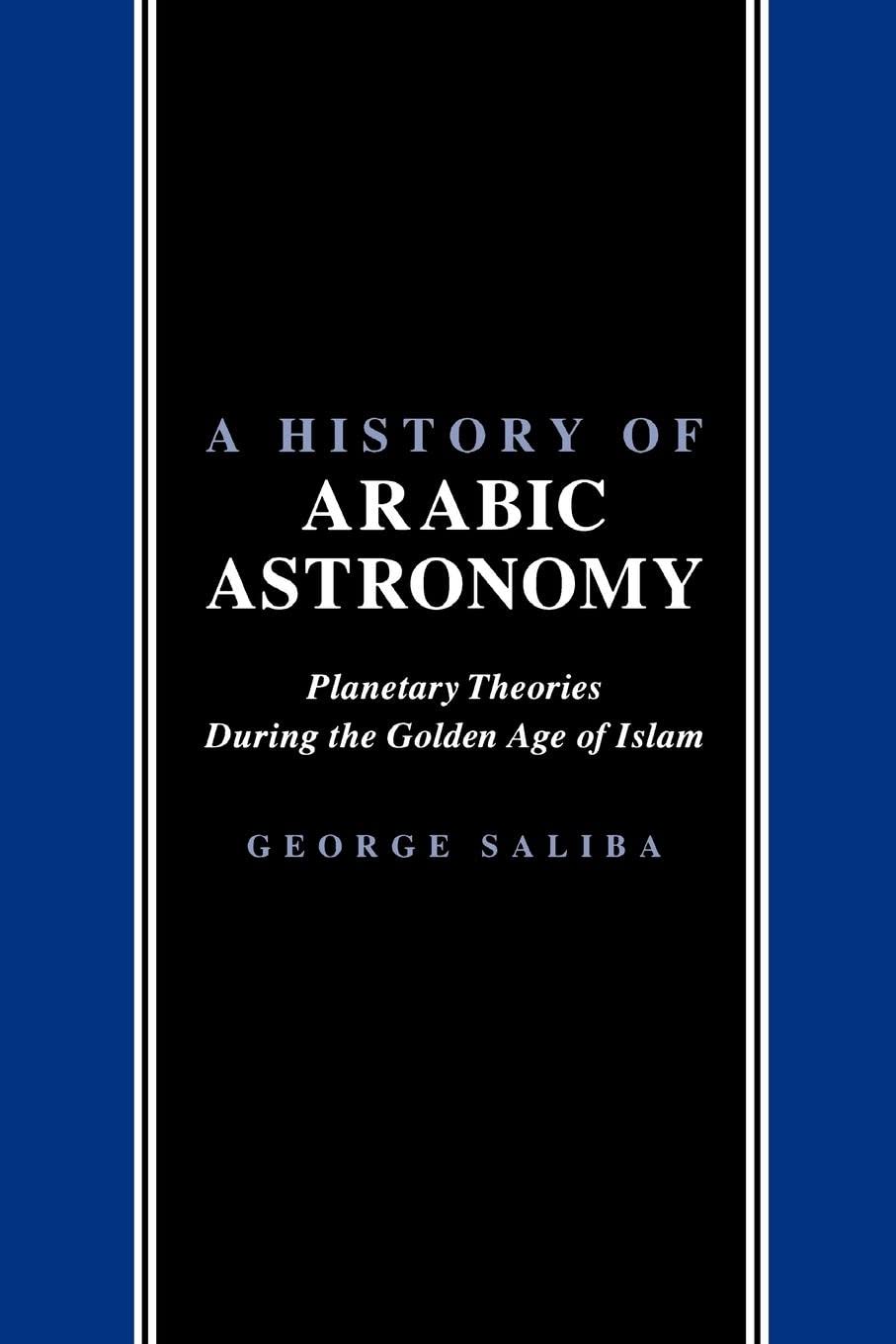
A History Of Arabic Astronomy: Planetary Theories During The Golden Age Of Islam (Nyu Studies In Ne Civilization, 2),New
Sold by Ergodebooks, an authorized reseller.
Returns accepted within 30 days | support@ergodebooks.com
Shipping Information
- Free Standard Shipping — United States only
- Processing Time: 3–5 business days
- Estimated Delivery: 6–10 business days after dispatch
- Double-boxed, fully insured & discreetly packaged
- Tracking number sent via email once dispatched
Returns & Refund
Returns accepted within 30 days of delivery.
Damaged or Defective Item
Free return shipping + replacement or full refund
Wrong Item Received
Free return shipping + replacement or full refund
Change of Mind
Return shipping at customer's expense · 25% restocking fee applies
Payment Option

A History of Arabic Astronomy is a comprehensive survey of Arabic planetary theories from the eleventh century to the fifteenth century based on recent manuscript discoveries. George Saliba argues that the medieval period, often called a period of decline in Islamic intellectual history, was scientifically speaking, a very productive period in which astronomical theories of the highest order were produced.Based on the most recent manuscript discoveries, this book broadly surveys developments in Arabic planetary theories from the eleventh century to the fifteenth. Taken together, the primary texts and essays assembled in this book reverse traditional beliefs about the rise and fall of Arabic science, demonstrating how the traditional age of decline in Arabic science was indeed a Golden Age as far as astronomy was concerned.Some of the techniques and mathematical theorems developed during this period were identical to those which were employed by Copernicus in developing his own nonPtolemaic astronomy. Significantly, this volume will shed muchneeded light on the conditions under which such theories were developed in medieval Islam. It clearly demonstrates the distinction that was drawn between astronomical activities and astrological ones, and reveals, contrary to common perceptions about medieval Islam, the accommodation that was obviously reached between religion and astronomy, and the degree to which astronomical planetary theories were supported, and at times even financed, by the religious community itself. This in stark contrast to the systematic attacks leveled by the same religious community against astrology.To students of European intellectual history, the book reveals the technical relationship between the astronomy of the Arabs and that of Copernicus. Salibas definitive work will be of particular interest to historians of Arabic science as well as to historians of medieval and Renaissance European science.
⚠️ WARNING (California Proposition 65):
This product may contain chemicals known to the State of California to cause cancer, birth defects, or other reproductive harm.
For more information, please visit www.P65Warnings.ca.gov.