
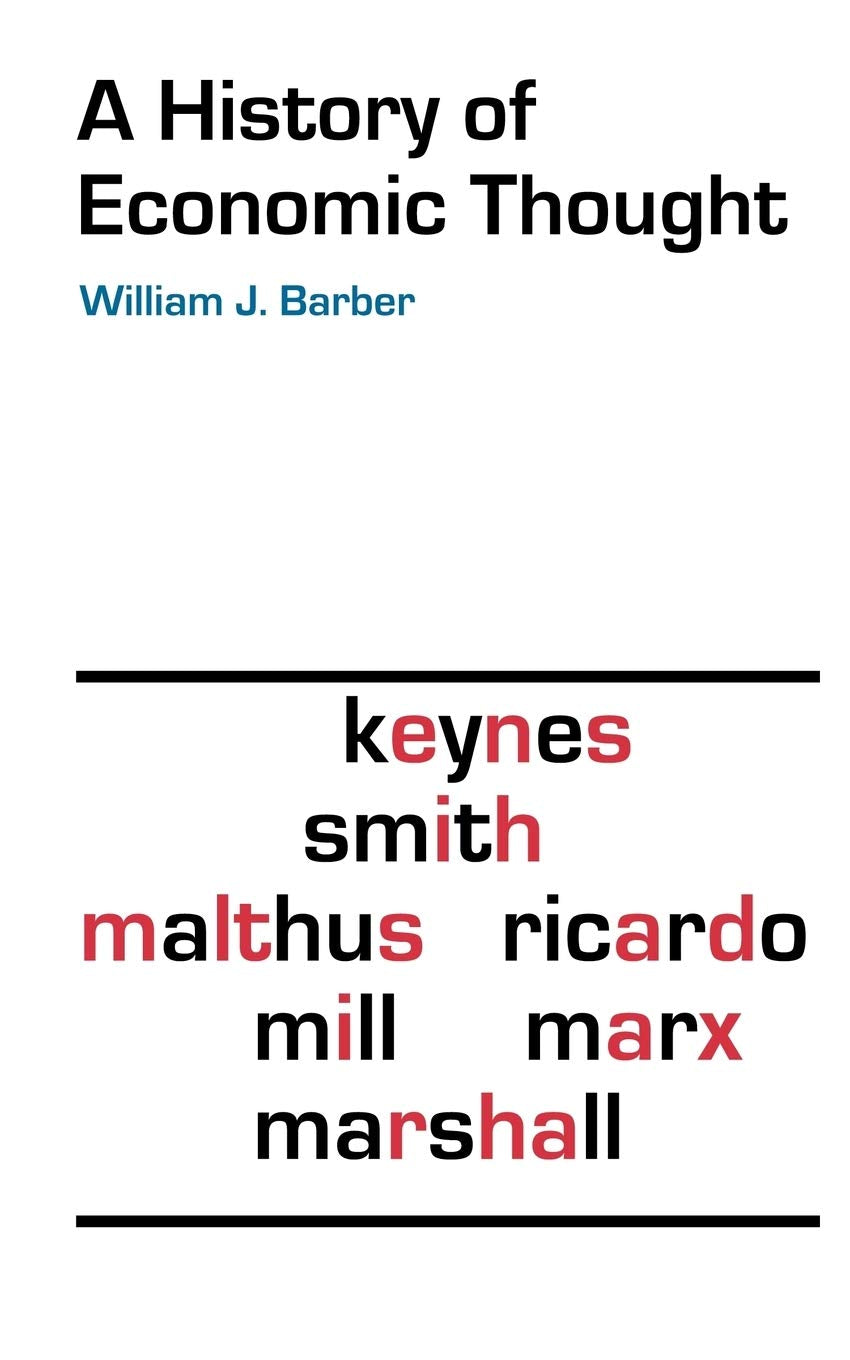
Title
A History Of Economic Thought,New
Sold by Ergodebooks, an authorized reseller.
Returns accepted within 30 days | support@ergodebooks.com
Shipping Information
- Free Standard Shipping — United States only
- Processing Time: 3–5 business days
- Estimated Delivery: 6–10 business days after dispatch
- Double-boxed, fully insured & discreetly packaged
- Tracking number sent via email once dispatched
Returns & Refund
Returns accepted within 30 days of delivery.
Damaged or Defective Item
Free return shipping + replacement or full refund
Wrong Item Received
Free return shipping + replacement or full refund
Change of Mind
Return shipping at customer's expense · 25% restocking fee applies
Payment Option

An invigorating study of the development of systematic economic ideasStudy of the grand ideas in economics has a perpetual intellectual fascination in it's own right. It can also have practical relevance, as the global economic downturn that began in 2007 reminds us. For several decades, the economics establishment had been dismissive of Keynesianism, arguing that the world had moved beyond the 'depression economics' with which it dealt. Keynesian economics, however, has now staged a comeback as governments attempt to formulate policy responses to the Great Recession of the first decade of the twentyfirst century.Many of the issues that faced economists in the past are still with us. The theories and methods of such men as Adam Smith, T. R. Malthus, David Ricardo, J.S. Mill, Karl Marx, Alfred Marshall, and J. M. Keynes are often relevant to us todayand we can always learn from their mistakes.In his stimulating analysis Professor Barber assesses the thought of a number of important economists both in terms of the issues of their day and in relation to modern economic thought. By concentrating on the greatest exponents he highlights the central properties of the four main schools of economic thought classical, Marxian, neoclassical, and Keynesian and shows that although each of these traditions is rooted in a different stage of economic development, they can all provide insights into the recurring problems of modern economics.
⚠️ WARNING (California Proposition 65):
This product may contain chemicals known to the State of California to cause cancer, birth defects, or other reproductive harm.
For more information, please visit www.P65Warnings.ca.gov.
- Q: What is the page count of this book? A: This book has two hundred seventy pages. It provides a comprehensive overview of economic thought across different eras.
- Q: What is the binding type of 'A History of Economic Thought'? A: This book is available in paperback binding. Paperback editions are typically flexible and lightweight, making them easy to handle.
- Q: What are the dimensions of this book? A: The dimensions are five inches in length, zero point five five inches in width, and seven point nine nine inches in height. This size makes it portable and easy to read.
- Q: What is the main theme of the book? A: The main theme is the evolution of systematic economic ideas. It discusses historical economic theories and their relevance today.
- Q: Who is the author of this book? A: The author is William J. Barber. He is known for his insightful analysis of economic thought and history.
- Q: What topics are covered in the book? A: The book covers various schools of economic thought, including classical, Marxian, neo-classical, and Keynesian. It examines their historical context and modern implications.
- Q: Who would benefit from reading this book? A: Students and professionals in economics will benefit. It’s also suitable for anyone interested in understanding economic history and modern economic issues.
- Q: Is this book suitable for beginners in economics? A: Yes, it is suitable for beginners. The author presents complex ideas in an accessible manner, making it a good starting point.
- Q: Can this book be used as a reference for academic work? A: Yes, it can be used as a reference. The detailed analysis and historical context make it a valuable resource for academic studies.
- Q: What is the main focus of the author's analysis? A: The main focus is on significant economists and their theories. Professor Barber highlights the relevance of their ideas to contemporary economic challenges.
- Q: Are there any illustrations or charts in the book? A: No, the book does not include illustrations or charts. It primarily focuses on textual analysis and commentary.
- Q: What is the publication year of 'A History of Economic Thought'? A: The publication year is not specified in the provided details. However, it is pertinent to check the latest editions for updated content.
- Q: How should I store this book to keep it in good condition? A: Store it in a cool, dry place away from direct sunlight. Keeping it upright on a shelf will help maintain its shape and condition.
- Q: Is there a warranty or return policy for this book? A: The specific warranty or return policy is not mentioned. It’s best to consult the retailer for their policies regarding returns.
- Q: What should I do if the book arrives damaged? A: If the book arrives damaged, contact the seller immediately for a replacement or refund. Most retailers have procedures for handling damaged goods.