
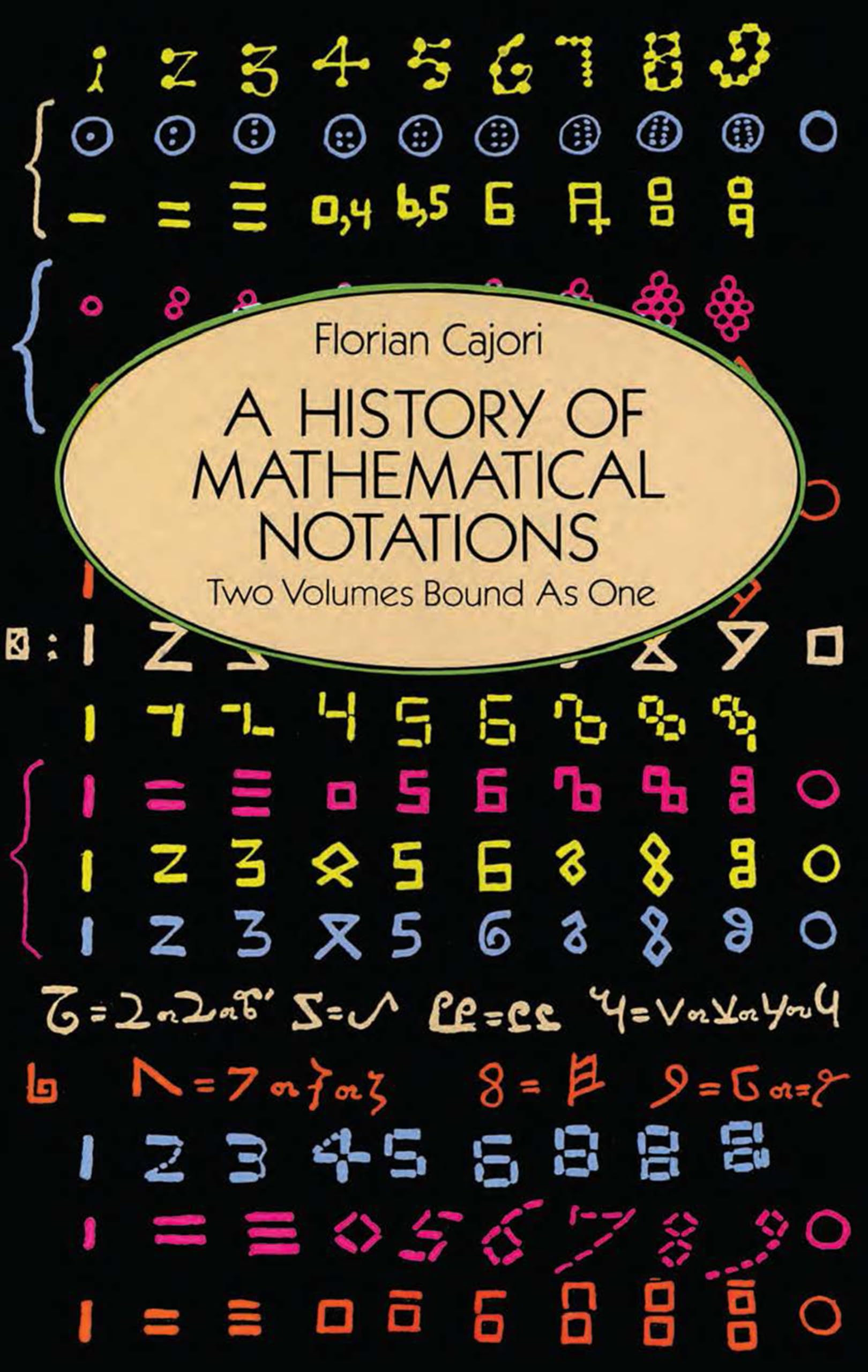
Title
A History of Mathematical Notations (Dover Books on Mathematics),New
Sold by Ergodebooks, an authorized reseller.
Returns accepted within 30 days | support@ergodebooks.com
Shipping Information
- Free Standard Shipping — United States only
- Processing Time: 3–5 business days
- Estimated Delivery: 6–10 business days after dispatch
- Double-boxed, fully insured & discreetly packaged
- Tracking number sent via email once dispatched
Returns & Refund
Returns accepted within 30 days of delivery.
Damaged or Defective Item
Free return shipping + replacement or full refund
Wrong Item Received
Free return shipping + replacement or full refund
Change of Mind
Return shipping at customer's expense · 25% restocking fee applies
Payment Option

This classic study notes the first appearance of a mathematical symbol and its origin, the competition it encountered, its spread among writers in different countries, its rise to popularity, its eventual decline or ultimate survival. The author's coverage of obsolete notations and what we can learn from them is as comprehensive as those which have survived and still enjoy favor. Originally published in 1929 in a twovolume edition, this monumental work is presented here in one volume.
⚠️ WARNING (California Proposition 65):
This product may contain chemicals known to the State of California to cause cancer, birth defects, or other reproductive harm.
For more information, please visit www.P65Warnings.ca.gov.
- Q: What is the main focus of 'A History of Mathematical Notations'? A: The book explores the first appearances of mathematical symbols, their origins, and their evolution over time, including their popularity and decline.
- Q: Who is the author of this book? A: The book is authored by Florian Cajori.
- Q: How many pages does the book contain? A: The book contains a total of 820 pages.
- Q: Is this book suitable for beginners in mathematics? A: While the book provides historical insights, it may be more suitable for readers with a foundational understanding of mathematical concepts.
- Q: What edition of the book is available? A: This is the First Edition of the book, published on December 14, 2011.
- Q: What type of binding does the book have? A: The book is available in a paperback binding.
- Q: When was the original edition of the book published? A: The original edition of the book was published in 1929.
- Q: Are there any illustrations or diagrams in the book? A: The book primarily focuses on textual analysis and historical commentary, and may not contain extensive illustrations.
- Q: What can I learn from obsolete mathematical notations discussed in the book? A: The author provides insights into the significance of obsolete notations and what they reveal about the evolution of mathematical thought.
- Q: Is this book a good resource for researchers in the field of mathematics? A: Yes, this book is a valuable resource for researchers and historians interested in the development and history of mathematical notation.