
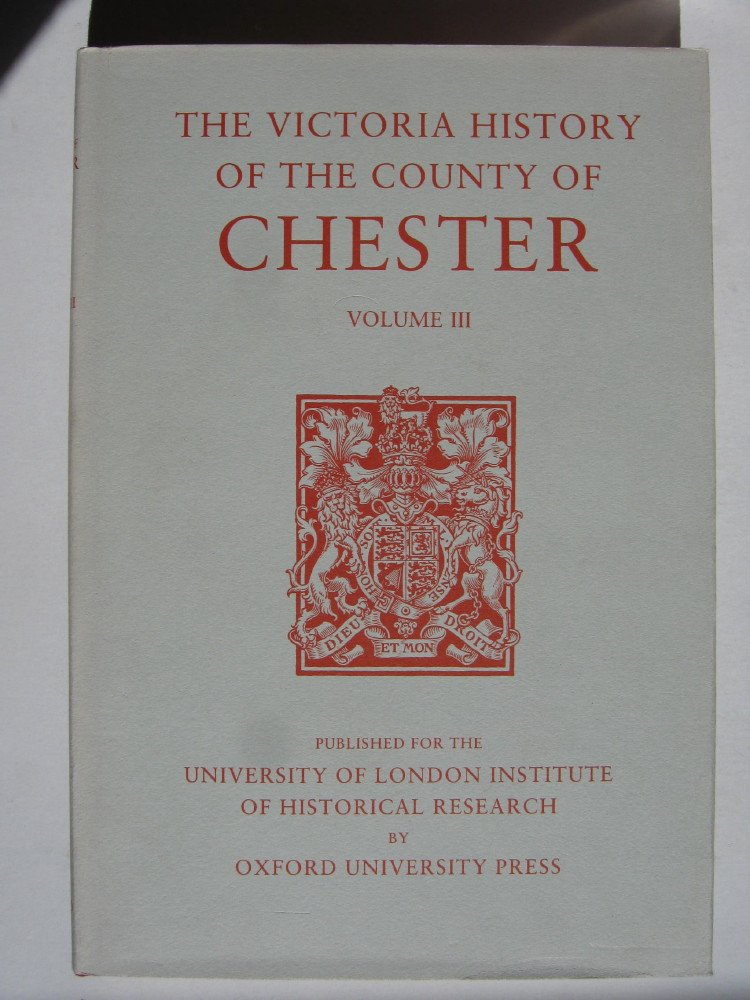
Title
A History of the County of Chester: Volume III (Victoria County History),Used
Sold by Ergodebooks, an authorized reseller.
Returns accepted within 30 days | support@ergodebooks.com
Shipping Information
- Free Standard Shipping — United States only
- Processing Time: 3–5 business days
- Estimated Delivery: 6–10 business days after dispatch
- Double-boxed, fully insured & discreetly packaged
- Tracking number sent via email once dispatched
Returns & Refund
Returns accepted within 30 days of delivery.
Damaged or Defective Item
Free return shipping + replacement or full refund
Wrong Item Received
Free return shipping + replacement or full refund
Change of Mind
Return shipping at customer's expense · 25% restocking fee applies
Payment Option

VOLUME III contains the history of ecclesiastical organization in Cheshire, both before and after the Reformation, medieval religious houses, Chester cathedral, education before 1903, and the more historically important endowedgrammar schools in the county. In the Middle Ages the organization of the church in Cheshire was based on parishes which in the east of the county were exceptionally large, while those of the west resembled more closely the normal English parish. Between 1075 and 1102 Chester was the seat of a bishop; for the rest of the Middle Ages the county lay in the diocese of Coventry and Lichfield. In 15411 the vast but poorly endowed diocese of Chester was formed, extending into Westmorland and the North Riding of Yorkshire. In the 19th century it was reduced in size until it included little more than the county of Cheshire. The county produced both protestant and Catholic martyrs, and the nonconformist sects were well represented. The largest and most important of the religious houses were St. Werburgh's abbey at Chester, which became the cathedral church of the new diocese in 1541, and Vale Royal, a Cistercianhouse founded by Edward I. Recent archaeological work has revealed much about some of the smaller houses, especially Norton. The city of Chester contained, in addition to St Werburgh's, a nunnery, friaries, and hospitals. Like thediocese, Chester cathedral suffered from an inadequate endowment, but its standing among English cathedrals improved under energetic deans in the late 19th and the 20th century. The rapid growth of industrial towns, especiallyin northeast Cheshire, created a pressing need for schools, bur the institution of school boards, the late 19thcentury solution favoured by central government, failed to make headway. Grammar schools were endowed in many of thetowns and villages in the 16th century and later, and the histories of seventeen of them are described in the volume.
⚠️ WARNING (California Proposition 65):
This product may contain chemicals known to the State of California to cause cancer, birth defects, or other reproductive harm.
For more information, please visit www.P65Warnings.ca.gov.