
Title
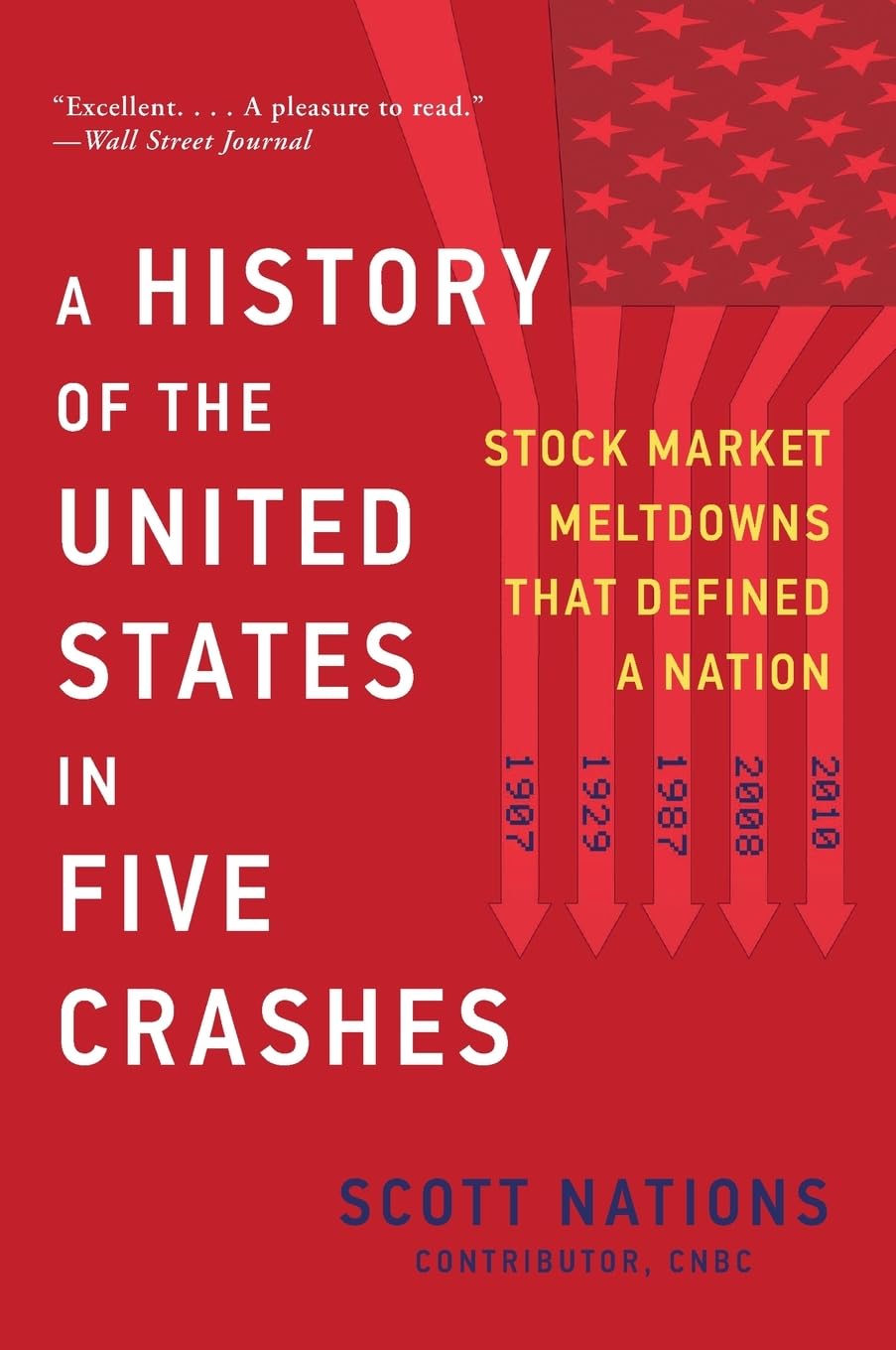
A History of the United States in Five Crashes: Stock Market Meltdowns That Defined a Nation,Used
Sold by Ergodebooks, an authorized reseller.
Returns accepted within 30 days | support@ergodebooks.com
Shipping Information
- Free Standard Shipping — United States only
- Processing Time: 3–5 business days
- Estimated Delivery: 6–10 business days after dispatch
- Double-boxed, fully insured & discreetly packaged
- Tracking number sent via email once dispatched
Returns & Refund
Returns accepted within 30 days of delivery.
Damaged or Defective Item
Free return shipping + replacement or full refund
Wrong Item Received
Free return shipping + replacement or full refund
Change of Mind
Return shipping at customer's expense · 25% restocking fee applies
Payment Option

In this absorbing, smart, and accessible blend of economic and cultural history, Scott Nations, a longtime trader, financial engineer, and CNBC contributor, takes us on a journey through the five significant stock market crashes in the past century to reveal how they defined the United States todayThe Panic of 1907: When the Knickerbocker Trust Company failed, after a brazen attempt to manipulate the stock market led to a disastrous run on the banks, the Dow lost nearly half its value in weeks. Only billionaire J.P. Morgan was able to save the stock market.Black Tuesday (1929): As the newly created Federal Reserve System repeatedly adjusted interest rates in all the wrong ways, investment trusts, the darlings of that decade, became the catalyst that caused the bubble to burst, and the Dow fell dramatically, leading swiftly to the Great Depression.Black Monday (1987): When 'portfolio insurance,' a new tool meant to protect investments, instead led to increased losses, and corporate raiders drove stock prices above their real values, the Dow dropped an astonishing 22.6 percent in one day.The Great Recession (2008): As homeowners began defaulting on mortgages, investment portfolios that contained them collapsed, bringing the nation's largest banks, much of the economy, and the stock market down with them.The Flash Crash (2010): When one investment manager, using a runaway computer algorithm that was dangerously unstable and poorly understood, reacted to the economic turmoil in Greece, the stock market took an unprecedentedly sudden plunge, with the Dow shedding 998.5 points (roughly a trillion dollars in valuation) in just minutes.The stories behind the great crashes are filled with drama, human foibles, and heroic rescues. Taken together they tell the larger story of a nation reaching enormous heights of financial power while experiencing precipitous dips that alter and reset a market where millions of Americans invest their savings, and on which they depend for their futures. Scott Nations vividly shows how each of these major crashes played a role in America's political and cultural fabric, each providing painful lessons that have strengthened us and helped us to build the nation we know today.A History of the United States in Five Crashes clearly and compellingly illustrates the connections between these major financial collapses and examines the solid, clearcut lessons they offer for preventing the next one.
⚠️ WARNING (California Proposition 65):
This product may contain chemicals known to the State of California to cause cancer, birth defects, or other reproductive harm.
For more information, please visit www.P65Warnings.ca.gov.
- Q: How many pages does the book have? A: The book has three hundred fifty-two pages. This provides a comprehensive exploration of significant stock market crashes in U.S. history.
- Q: What is the binding type of this book? A: This book is paperback bound. This makes it lightweight and easy to carry for readers.
- Q: What are the dimensions of the book? A: The book measures five point thirty-one inches in length, zero point seventy-nine inches in width, and seven point ninety-nine inches in height. These dimensions make it a convenient size for reading.
- Q: Who is the author of this book? A: The author is Scott Nations. He is a CNBC contributor and a financial engineer with extensive experience in stock trading.
- Q: What genre does this book belong to? A: This book falls under the genre of Motivation and Self-Improvement. It offers insights into financial history and lessons learned from past crises.
- Q: Can this book be used as a reference for financial education? A: Yes, this book serves as an excellent reference for financial education. It provides clear connections between historical events and modern financial practices.
- Q: What age group is this book suitable for? A: This book is suitable for adults and older teens. It addresses complex financial topics that require a certain level of understanding.
- Q: How can I apply the lessons from this book? A: You can apply the lessons by analyzing past financial crises and their impacts on the economy. This understanding can inform your investment decisions.
- Q: Is there a particular reading level required for this book? A: Yes, a college reading level is recommended for this book. The content involves detailed financial concepts and historical analysis.
- Q: How should I store this book to keep it in good condition? A: Store the book in a cool, dry place away from direct sunlight. This helps to preserve the quality of the pages and the binding.
- Q: What if the book arrives damaged? A: If the book arrives damaged, contact the seller for a return or exchange. Most sellers have policies in place for handling such issues.
- Q: Can I return this book if I don't like it? A: Yes, you can return the book if you don't like it. Check the specific return policy of the seller for details.
- Q: Is there any specific care required for this paperback book? A: No specific care is required, but avoid exposing it to moisture. Keeping it clean and dry will help maintain its condition.
- Q: How does this book compare to other financial history books? A: This book offers a unique perspective by focusing on five major crashes, making it distinct from general financial history books that cover broader topics.
- Q: Is this book appropriate for beginners in finance? A: While it contains valuable insights, it may not be ideal for complete beginners. Some prior knowledge of financial concepts would be helpful.
- Q: What are the main themes covered in this book? A: The main themes include financial crises, investment strategies, and historical lessons. These themes illustrate the interplay between economics and society.