
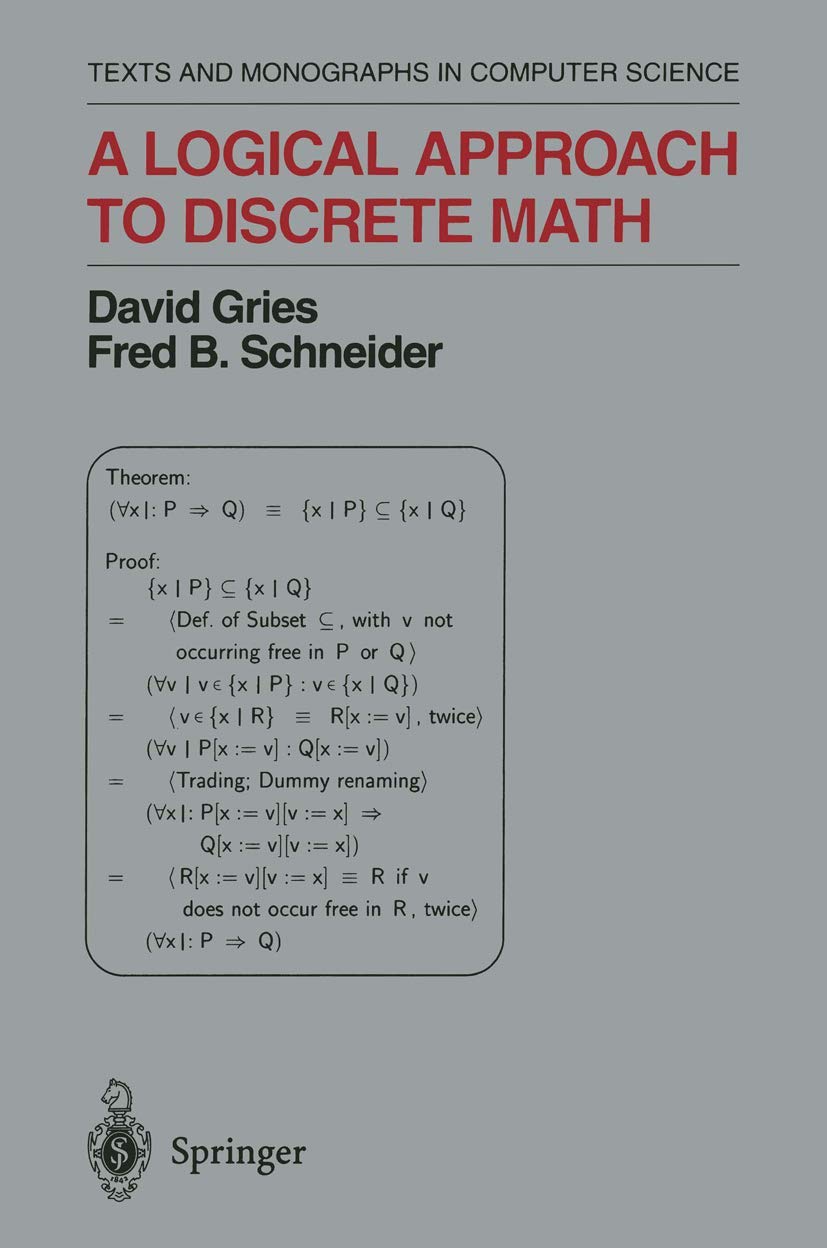
Title
A Logical Approach to Discrete Math (Texts and Monographs in Computer Science),New
Sold by Ergodebooks, an authorized reseller.
Returns accepted within 30 days | support@ergodebooks.com
Shipping Information
- Free Standard Shipping — United States only
- Processing Time: 3–5 business days
- Estimated Delivery: 6–10 business days after dispatch
- Double-boxed, fully insured & discreetly packaged
- Tracking number sent via email once dispatched
Returns & Refund
Returns accepted within 30 days of delivery.
Damaged or Defective Item
Free return shipping + replacement or full refund
Wrong Item Received
Free return shipping + replacement or full refund
Change of Mind
Return shipping at customer's expense · 25% restocking fee applies
Payment Option

This text attempts to change the way we teach logic to beginning students. Instead of teaching logic as a subject in isolation, we regard it as a basic tool and show how to use it. We strive to give students a skill in the propo sitional and predicate calculi and then to exercise that skill thoroughly in applications that arise in computer science and discrete mathematics. We are not logicians, but programming methodologists, and this text reflects that perspective. We are among the first generation of scientists who are more interested in using logic than in studying it. With this text, we hope to empower further generations of computer scientists and math ematicians to become serious users of logic. Logic is the glue Logic is the glue that binds together methods of reasoning, in all domains. The traditional proof methods for example, proof by assumption, con tradiction, mutual implication, and induction have their basis in formal logic. Thus, whether proofs are to be presented formally or informally, a study of logic can provide understanding.
⚠️ WARNING (California Proposition 65):
This product may contain chemicals known to the State of California to cause cancer, birth defects, or other reproductive harm.
For more information, please visit www.P65Warnings.ca.gov.
- Q: What are the dimensions of this book? A: The book measures six point four three inches in length, one point one five inches in width, and nine point five seven inches in height.
- Q: How many pages does this book have? A: This book contains five hundred thirty-two pages, providing an extensive exploration of discrete mathematics.
- Q: What type of binding does this book have? A: This book is bound in hardcover, which offers durability and longevity for frequent use.
- Q: Who is the author of this book? A: The author of this book is David Gries, who approaches the subject from a practical perspective.
- Q: What is the primary focus of this book? A: The primary focus of the book is to teach logic as a tool for computer science and discrete mathematics.
- Q: Is this book suitable for beginners? A: Yes, this book is designed for beginning students to help them grasp the fundamentals of logic.
- Q: What subjects does this book cover? A: This book covers topics in logic, propositional and predicate calculi, and their applications in computer science.
- Q: Can this book help with programming logic? A: Yes, the book emphasizes the application of logic in programming methodologies and computer science.
- Q: Is this book appropriate for advanced learners? A: While aimed at beginners, advanced learners may also find value in its practical applications of logic.
- Q: How should I care for this book? A: To keep the book in good condition, store it upright in a dry place and avoid exposure to moisture.
- Q: What if the book arrives damaged? A: If the book arrives damaged, you should contact the seller for information on their return policy and possible exchanges.
- Q: Is there a warranty for this book? A: Typically, books do not come with a warranty, but check with the retailer for their specific policies.
- Q: How can I enhance my understanding of the material? A: To enhance your understanding, consider supplementing your reading with exercises and practical applications discussed in the book.
- Q: What is the unique perspective of this book? A: The book presents a unique perspective by focusing on using logic rather than merely studying it.
- Q: Does this book contain exercises or practice problems? A: Yes, the book includes exercises that allow students to apply the concepts of logic in practical scenarios.