
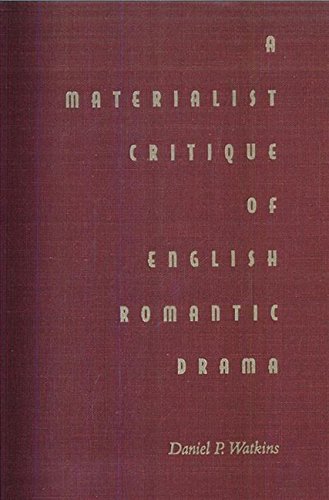
Title
A Materialist Critique Of English Romantic Drama,New
Sold by Ergodebooks, an authorized reseller.
Returns accepted within 30 days | support@ergodebooks.com
Shipping Information
- Free Standard Shipping — United States only
- Processing Time: 3–5 business days
- Estimated Delivery: 6–10 business days after dispatch
- Double-boxed, fully insured & discreetly packaged
- Tracking number sent via email once dispatched
Returns & Refund
Returns accepted within 30 days of delivery.
Damaged or Defective Item
Free return shipping + replacement or full refund
Wrong Item Received
Free return shipping + replacement or full refund
Change of Mind
Return shipping at customer's expense · 25% restocking fee applies
Payment Option

An important contribution to our understanding of 'Romantic ideology.'... The book will be of interest to Romanticists in general, not just drama specialists, and those interested in applied Marxist theory will find the book valuable. Byron specialists will find this an essential book.'Michael Scrivener, Wayne State UniversityWhile existing criticism of English Romantic drama is principally concerned with conventional Romantic themes and subjects and guided by idealist methodology, Watkins interrogates the expressed thematic interests of Romantic drama in order to disclose the political, social, and historical conflicts that energize and condition those interests. In the most contentious theoretical dimension of his work, Watkins considers why drama deteriorated so badly during the Romantic period. Subsequent chapters are built around close readings of selected Romantic verse dramas, including Coleridge's Osorio, Lamb's John Woodvil, Joanna Baillie's DeMonfort, Walter Scott's Halidon Hill, and most of Byron's plays.Watkins locates the deterioration of the drama in the general historical transition in England from an aristocratic to a middleclass social order. Emerging in Renaissance England as the supreme expression of an aristocratic worldview, drama was ill equipped to express the new class consciousness coming to maturation two centuries later. Watkins contends, however, that the debilitating effect of social transformation does not render drama insignificant but rather gives it a special historical importance because it documents the various ideological struggles between a withering aristocracy and an inchoate bourgeoisie. It also charts with precision the socialideological spaces into which the bourgeoisie inserts itself as it begins its mastery of social reality.These struggles involve numerous social issues and relations, ranging from gender and the family to religion and economics. They also embrace and explain a variety of seemingly isolated psychological phenomena present in Romantic drama, ranging from nostalgia to anxiety.Daniel P. Watkins is associate professor of English at Duquesne University and the author of Social Relations in Byron's Eastern Tales and Keats's Poetry and the Politics of the Imagination and the coeditor of Spirits of Fire: English Romantic Writers and Contemporary Historical Methods.
⚠️ WARNING (California Proposition 65):
This product may contain chemicals known to the State of California to cause cancer, birth defects, or other reproductive harm.
For more information, please visit www.P65Warnings.ca.gov.