If you have any questions, you are always welcome to contact us. We'll get back to you as soon as possible, withing 24 hours on weekdays.
Customer service
All questions about your order, return and delivery must be sent to our customer service team by e-mail at yourstore@yourdomain.com
Sale & Press
If you are interested in selling our products, need more information about our brand or wish to make a collaboration, please contact us at press@yourdomain.com
Help
If you have any questions, you are always welcome to contact us. We'll get back to you as soon as possible, withing 24 hours on weekdays.
Customer service
All questions about your order, return and delivery must be sent to our customer service team by e-mail at yourstore@yourdomain.com
Sale & Press
If you are interested in selling our products, need more information about our brand or wish to make a collaboration, please contact us at press@yourdomain.com
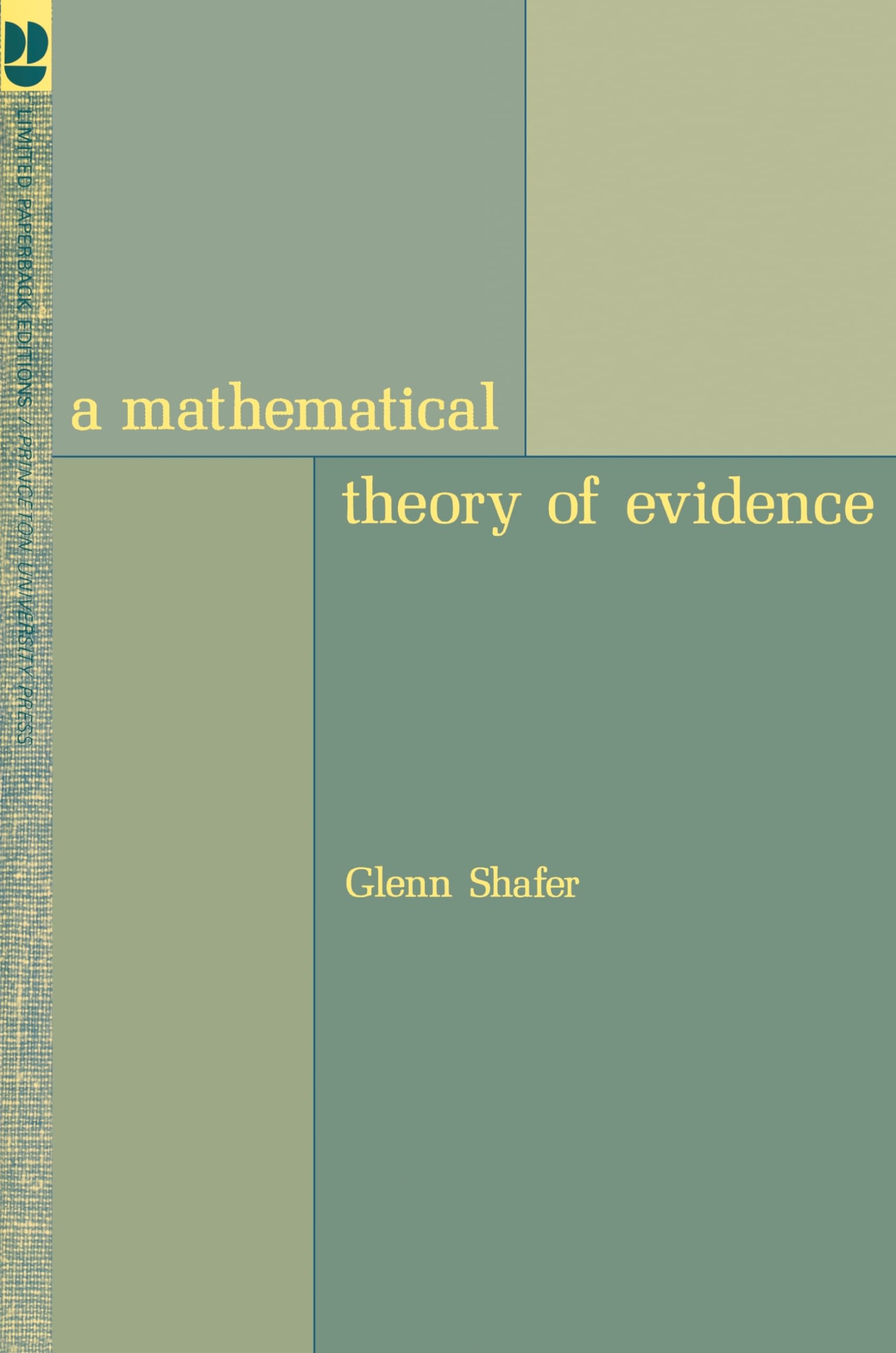
Both in science and in practical affairs we reason by combining facts only inconclusively supported by evidence. Building on an abstract understanding of this process of combination, this book constructs a new theory of epistemic probability. The theory draws on the work of A. P. Dempster but diverges from Depster's viewpoint by identifying his 'lower probabilities' as epistemic probabilities and taking his rule for combining 'upper and lower probabilities' as fundamental.The book opens with a critique of the wellknown Bayesian theory of epistemic probability. It then proceeds to develop an alternative to the additive set functions and the rule of conditioning of the Bayesian theory: set functions that need only be what Choquet called 'monotone of order of infinity.' and Dempster's rule for combining such set functions. This rule, together with the idea of 'weights of evidence,' leads to both an extensive new theory and a better understanding of the Bayesian theory. The book concludes with a brief treatment of statistical inference and a discussion of the limitations of epistemic probability. Appendices contain mathematical proofs, which are relatively elementary and seldom depend on mathematics more advanced that the binomial theorem.
⚠️ WARNING (California Proposition 65):
This product may contain chemicals known to the State of California to cause cancer,
birth defects, or other reproductive harm.
For MAP (Minimum Advertised Price) violations and Intellectual Property (IP) or Trademark concerns, please contact:
support@ergodebooks.com
⚠️ California Proposition 65 Warning: Some products sold on this website may expose you to chemicals known to the State of California to cause cancer, birth defects, or other reproductive harm. For more information, visit www.P65Warnings.ca.gov.