
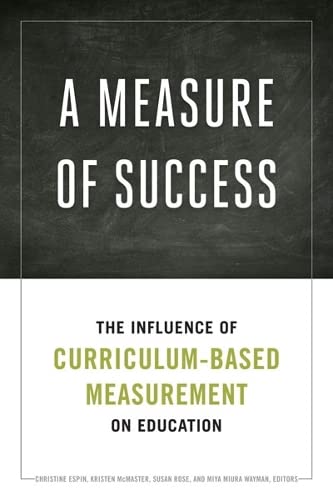
Title
A Measure Of Success: The Influence Of Curriculumbased Measurement On Education,Used
Sold by Ergodebooks, an authorized reseller.
Returns accepted within 30 days | support@ergodebooks.com
Shipping Information
- Free Standard Shipping — United States only
- Processing Time: 3–5 business days
- Estimated Delivery: 6–10 business days after dispatch
- Double-boxed, fully insured & discreetly packaged
- Tracking number sent via email once dispatched
Returns & Refund
Returns accepted within 30 days of delivery.
Damaged or Defective Item
Free return shipping + replacement or full refund
Wrong Item Received
Free return shipping + replacement or full refund
Change of Mind
Return shipping at customer's expense · 25% restocking fee applies
Payment Option

Simple in concept, farreaching in implementation, CurriculumBased Measurement (CBM) was developed in the 1980s as an efficient way to assess the progress of struggling students, including those with disabilities. Today, there are few areas of special education policy and practice that have not been influenced by CBM progress monitoring. The impact of CBM is reflected in recent education reforms that emphasize improvements in assessment and databased decision making. Gathering an international group of leading researchers and practitioners, A Measure of Success provides a comprehensive picture of the past, present, and possible future of CBM progress monitoring. The book will be instrumental for researchers and practitioners in both general and special education, particularly those involved in the rapidly growing Response to Intervention (RTI) approach, an approach used to determine the performance and placement of students with learning difficulties.A Measure of Success presents a nuanced examination of CBM progress monitoring in reading, math, and contentarea learning to assess students at all levels, from early childhood to secondary school, and with a wide range of abilities, from high and lowincidence disabilities to no disabilities. This study also evaluates how the approach has affected instructional practices, teacher training, psychology and school psychology, educational policy, and research in the United States and beyond.Timely and unique, this volume will interest anyone in education who wants to harness the potential advantage of progress monitoring to improve outcomes for students.Contributors: Laurence Bergeron; Lionel A. Blatchley; Renee Bradley; Mary T. Brownell, U of Florida; Todd W. Busch, U of St. Thomas; Heather M. Campbell, St. Olaf College; Ann Casey; Theodore J. Christ, U of Minnesota; Kelli D. Cummings, U of Oregon; Eric Dion, U du Qubec Montral; Isabelle Dub, U du Qubec Montral; Hank Fien, U of Oregon; Anne Foegen, Iowa State U; Douglas Fuchs, Vanderbilt U; Lynn S. Fuchs, Vanderbilt U; Gary Germann; Kim Gibbons; Roland H. Good III, U of Oregon; Anne W. Graves, San Diego State U; John L. Hosp, U of Iowa; Michelle K. Hosp; Joseph R. Jenkins, U of Washington; Ruth A. Kaminski; Panayiota Kendeou, Neapolis U Pafos, Cyprus; Dongil Kim, Seoul National U, South Korea; Amanda Kloo, U of Pittsburgh; Danika Landry, U du Qubec Montral; Erica Lembke, U of Missouri; Francis E. Lentz Jr., U of Cincinnati; Sylvia LinanThompson, U of Texas at Austin; Charles D. Machesky; Doug Marston; James L. McLeskey, U of Florida; Timothy C. Papadopoulos, U of Cyprus; Kelly A. PowellSmith; Greg Roberts, U of Texas at Austin; Margaret J. Robinson; Steven L. Robinson, Minnesota State U, Mankato; Catherine Roux, U du Qubec Montral; Barbara J. Scierka; Edward S. Shapiro, Lehigh U; Jongho Shin, Seoul National U, South Korea; Mark R. Shinn, National Louis U; James G. Shriner, U of Illinois, UrbanaChampaign; Paul T. Sindelar, U of Florida; Deborah L. Speece, U of Maryland; Pamela M. Stecker, Clemson U; Martha L. Thurlow, U of Minnesota; RentaTich, U of Minnesota; Gerald Tindal, U of Oregon; Paul van den Broek, Leiden U, the Netherlands; Sharon Vaughn, U of Texas at Austin; Dana L. Wagner, Augsburg College; Teri Wallace, Minnesota State U, Mankato; Jeanne Wanzek, Florida State U; Mary Jane White, U of Minnesota; Mitchell L. Yell, U of South Carolina; Naomi Zigmond, U of Pittsburgh.
⚠️ WARNING (California Proposition 65):
This product may contain chemicals known to the State of California to cause cancer, birth defects, or other reproductive harm.
For more information, please visit www.P65Warnings.ca.gov.