If you have any questions, you are always welcome to contact us. We'll get back to you as soon as possible, withing 24 hours on weekdays.
Customer service
All questions about your order, return and delivery must be sent to our customer service team by e-mail at yourstore@yourdomain.com
Sale & Press
If you are interested in selling our products, need more information about our brand or wish to make a collaboration, please contact us at press@yourdomain.com
Help
If you have any questions, you are always welcome to contact us. We'll get back to you as soon as possible, withing 24 hours on weekdays.
Customer service
All questions about your order, return and delivery must be sent to our customer service team by e-mail at yourstore@yourdomain.com
Sale & Press
If you are interested in selling our products, need more information about our brand or wish to make a collaboration, please contact us at press@yourdomain.com
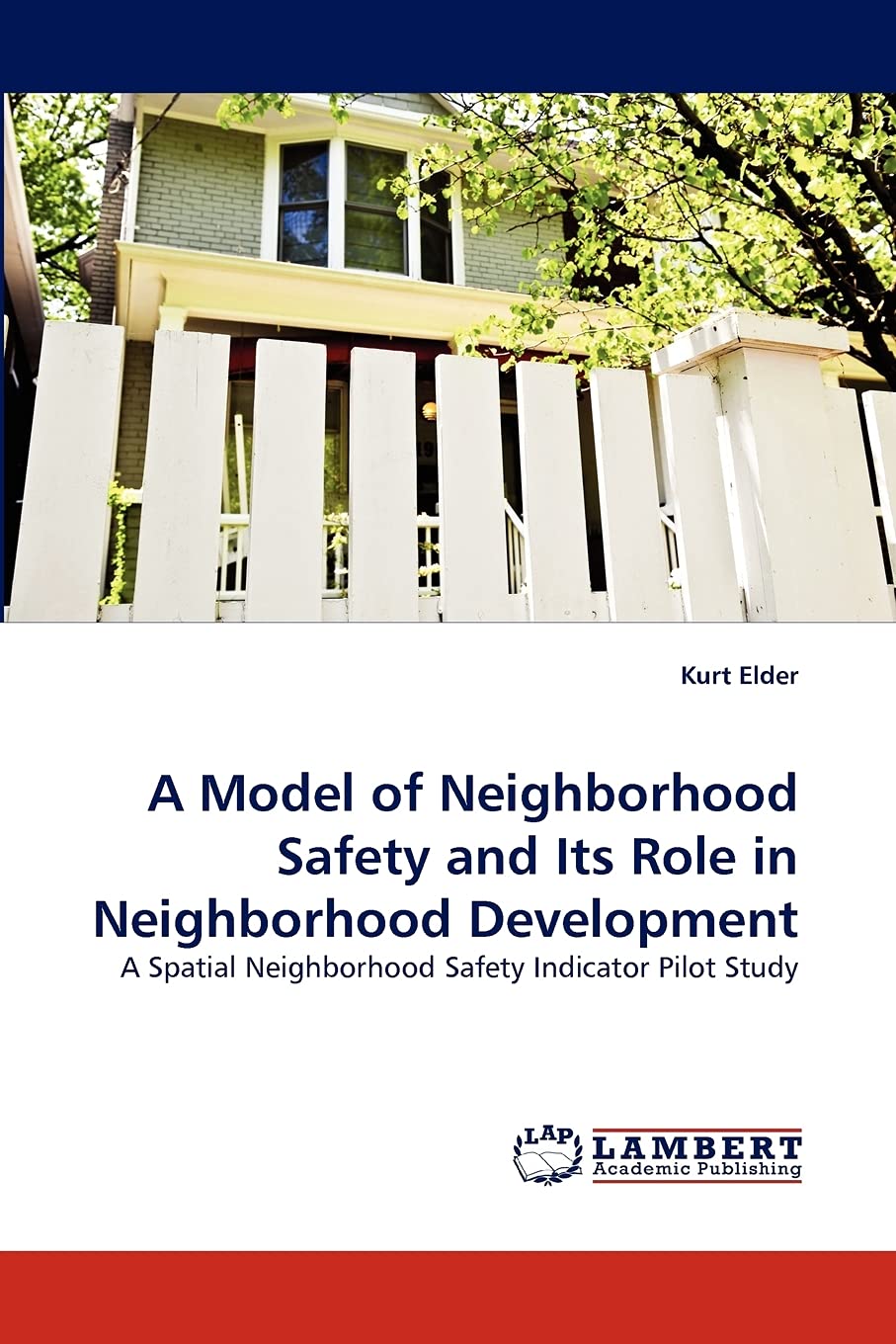
This work assists the reader in understanding the dynamics and factors of neighborhood safety, and then to illustrate how to effectively convey those components into a model that neighborhood leaders, community developers and decision makers can easily understand. Through a review of literature, a model was compiled that brought together popular neighborhood safety concepts of the last half century. The work demonstrates through GIS cluster, choropleth and point analysis how the theoretical expectations of neighborhood safety components (e.g. crime, disorder, social control, structural constraints, and concentrated disadvantage) and processes (e.g. common explanatory processes and causal feedback loops), in an urban space, form a dynamic structure. Through identified indicators and benchmarks, these neighborhood safety concepts and theoretical linkages were spatially assessed. Six indicators were reviewed to detail components of the model and its relational nature. This work provides a solid base from which to further indivual perceptions, evaluation processes and community objectives.
⚠️ WARNING (California Proposition 65):
This product may contain chemicals known to the State of California to cause cancer,
birth defects, or other reproductive harm.
For MAP (Minimum Advertised Price) violations and Intellectual Property (IP) or Trademark concerns, please contact:
support@ergodebooks.com
⚠️ California Proposition 65 Warning: Some products sold on this website may expose you to chemicals known to the State of California to cause cancer, birth defects, or other reproductive harm. For more information, visit www.P65Warnings.ca.gov.