
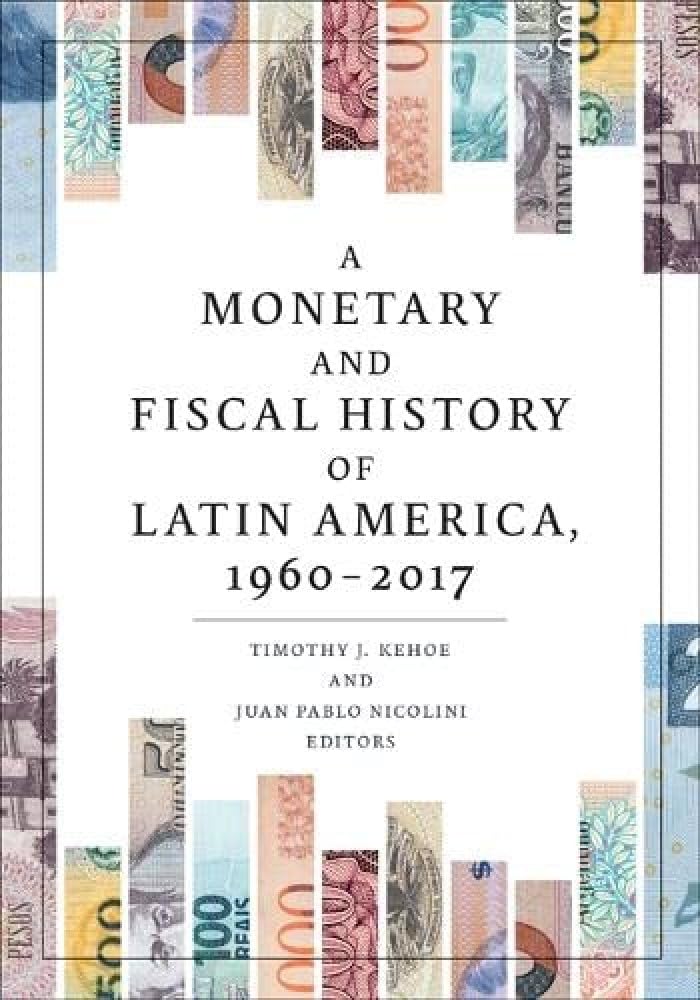
Title
A Monetary and Fiscal History of Latin America, 19602017,Used
Sold by Ergodebooks, an authorized reseller.
Returns accepted within 30 days | support@ergodebooks.com
Shipping Information
- Free Standard Shipping — United States only
- Processing Time: 3–5 business days
- Estimated Delivery: 6–10 business days after dispatch
- Double-boxed, fully insured & discreetly packaged
- Tracking number sent via email once dispatched
Returns & Refund
Returns accepted within 30 days of delivery.
Damaged or Defective Item
Free return shipping + replacement or full refund
Wrong Item Received
Free return shipping + replacement or full refund
Change of Mind
Return shipping at customer's expense · 25% restocking fee applies
Payment Option

A major, new, and comprehensive look at six decades of macroeconomic policies across the regionWhat went wrong with the economic development of Latin America over the past halfcentury? Along with periods of poor economic performance, the regions countries have been plagued by a wide variety of economic crises. This major new work brings together dozens of leading economists to explore the economic performance of the ten largest countries in South America and of Mexico. Together they advance the fundamental hypothesis that, despite different manifestations, these crises all have been the result of poorly designed or poorly implemented fiscal and monetary policies.Each country is treated in its own section of the book, with a lead chapter presenting a comprehensive database of the countrys fiscal, monetary, and economic data from 1960 to 2017. The chapters are drawn from oneday academic conferenceshosted in all but one case, in the focus countrywith participants including noted economists and former leading policy makers. Cowritten with Nobel Prize winner Thomas J. Sargent, the editors introduction provides a conceptual framework for analyzing fiscal and monetary policy in countries around the world, particularly those less developed. A final chapter draws conclusions and suggests directions for further research.A vital resource for advanced undergraduate and graduate students of economics and for economic researchers and policy makers, A Monetary and Fiscal History of Latin America, 19602017 goes further than any book in stressing both the singularities and the similarities of the economic histories of Latin Americas largest countries.Contributors: Mark Aguiar, Princeton U; Fernando Alvarez, U of Chicago; Manuel Amador, U of Minnesota; Joao Ayres, InterAmerican Development Bank; Saki Bigio, UCLA; Luigi Bocola, Stanford U; Francisco J. Buera, Washington U, St. Louis; Guillermo Calvo, Columbia U; Rodrigo Caputo, U of Santiago; Roberto Chang, Rutgers U; Carlos Javier Charotti, Central Bank of Paraguay; Simn Cueva, TNK Economics; Julin P. Daz, Loyola U Chicago; Sebastian Edwards, UCLA; Carlos Esquivel, Rutgers U; Eduardo Fernndez Arias, Peking U; Carlos Fernndez Valdovinos (former Central Bank of Paraguay); Arturo Jos Galindo, Banco de la Repblica, Colombia; Mrcio Garcia, PUCRio; Felipe Gonzlez Soley, U of Southampton; Diogo Guillen, PUCRio; Lars Peter Hansen, U of Chicago; Patrick Kehoe, Stanford U; Carlos Gustavo Machicado Salas, Bolivian Catholic U; Joaqun Marandino, U Torcuato Di Tella; Alberto Martin, U Pompeu Fabra; Cesar Martinelli, George Mason U; Felipe Meza, Instituto Tecnolgico Autnomo de Mxico; Pablo Andrs Neumeyer, U Torcuato Di Tella; Gabriel Oddone, U de la Repblica; Daniel Osorio, Banco de la Repblica; Jos Peres Cajas, U of Barcelona; David PerezReyna, U de los Andes; Fabrizio Perri, Minneapolis Fed; Andrew Powell, InterAmerican Development Bank; Diego Restuccia, U of Toronto; Diego Saravia, U de los Andes; Thomas J. Sargent, New York U; Jos A. Scheinkman, Columbia U; Teresa TerMinassian (formerly IMF); Marco Vega, Pontificia U Catlica del Per; Carlos Vgh, Johns Hopkins U; Franois R. Velde, Chicago Fed; Alejandro Werner, IMF.
⚠️ WARNING (California Proposition 65):
This product may contain chemicals known to the State of California to cause cancer, birth defects, or other reproductive harm.
For more information, please visit www.P65Warnings.ca.gov.