
Title
A Multigrid Tutorial,Used
Sold by Ergodebooks, an authorized reseller.
Returns accepted within 30 days | support@ergodebooks.com
Shipping Information
- Free Standard Shipping — United States only
- Processing Time: 3–5 business days
- Estimated Delivery: 6–10 business days after dispatch
- Double-boxed, fully insured & discreetly packaged
- Tracking number sent via email once dispatched
Returns & Refund
Returns accepted within 30 days of delivery.
Damaged or Defective Item
Free return shipping + replacement or full refund
Wrong Item Received
Free return shipping + replacement or full refund
Change of Mind
Return shipping at customer's expense · 25% restocking fee applies
Payment Option

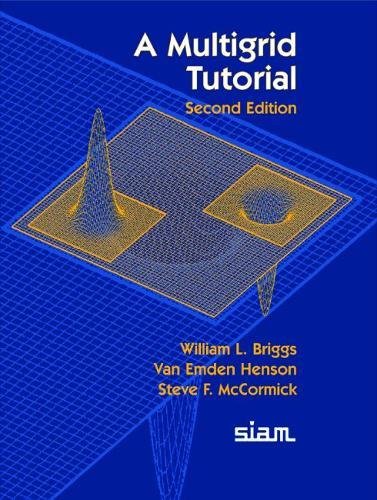
This second edition of the popular A Multigrid Tutorial preserves the introductory spirit of the first edition while roughly doubling the amount of material covered. The topics of the first edition have been enhanced with additional discussion, new numerical experiments, and improved figures. New topics in the second edition include nonlinear equations, Neumann boundary conditions, variable mesh and variable coefficient problems, anisotropic problems, algebraic multigrid (AMG), adaptive methods, and finite elements. This introductory book is ideally suited as a companion textbook for graduate numerical analysis courses. It is written for computational mathematicians, engineers, and other scientists interested in learning about multigrid.
⚠️ WARNING (California Proposition 65):
This product may contain chemicals known to the State of California to cause cancer, birth defects, or other reproductive harm.
For more information, please visit www.P65Warnings.ca.gov.
- Q: What is the page count of 'A Multigrid Tutorial'? A: This book has two hundred ten pages. It provides a comprehensive overview of multigrid methods suitable for a variety of readers.
- Q: What are the dimensions of the book? A: The book measures six point seventy-five inches in length, zero point twenty-five inches in width, and nine point five inches in height. These dimensions make it portable and easy to handle.
- Q: What type of binding does the book have? A: The book is published in paperback binding. This makes it flexible and lightweight for easy reading.
- Q: Who is the author of 'A Multigrid Tutorial'? A: The author is William L. Briggs. He is known for his expertise in computational mathematics and numerical methods.
- Q: Is this book suitable for beginners? A: Yes, this book is suitable for beginners. It is written in an introductory style, making complex topics accessible.
- Q: Can I use this book for graduate courses? A: Yes, this book is ideal for graduate numerical analysis courses. It serves as a companion textbook for advanced students.
- Q: How should I care for this book? A: To care for the book, keep it in a dry place and avoid exposure to direct sunlight. This will help preserve its condition.
- Q: Is this book safe to handle for young readers? A: Yes, the book is safe to handle. It contains no hazardous materials and is suitable for educational purposes.
- Q: What if the book arrives damaged? A: If the book arrives damaged, you should contact customer support for a return or exchange. They will assist you with the process.
- Q: Does this book cover advanced multigrid topics? A: Yes, it covers advanced topics such as nonlinear equations and algebraic multigrid. These discussions enhance the foundational material.
- Q: Are there numerical experiments included in this book? A: Yes, the book includes new numerical experiments. These experiments illustrate the concepts and methods discussed throughout the text.
- Q: What is the main focus of 'A Multigrid Tutorial'? A: The main focus is on multigrid methods for numerical analysis. It emphasizes practical applications and theoretical foundations.
- Q: Is this book part of a series or standalone? A: This book is a standalone title but serves as a companion for related courses. It builds on the concepts introduced in the first edition.
- Q: Who is the publisher of this book? A: The publisher is SIAM: Society for Industrial and Applied Mathematics. They specialize in publications related to mathematics and applied sciences.
- Q: Can this book be used for self-study? A: Yes, this book is suitable for self-study. Its structured content allows learners to progress at their own pace.