
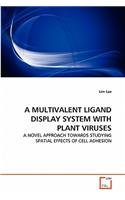
Title
A MULTIVALENT LIGAND DISPLAY SYSTEM WITH PLANT VIRUSES: A NOVEL APPROACH TOWARDS STUDYING SPATIAL EFFECTS OF CELL ADHESION,Used
Sold by Ergodebooks, an authorized reseller.
Returns accepted within 30 days | support@ergodebooks.com
Shipping Information
- Free Standard Shipping — United States only
- Processing Time: 3–5 business days
- Estimated Delivery: 6–10 business days after dispatch
- Double-boxed, fully insured & discreetly packaged
- Tracking number sent via email once dispatched
Returns & Refund
Returns accepted within 30 days of delivery.
Damaged or Defective Item
Free return shipping + replacement or full refund
Wrong Item Received
Free return shipping + replacement or full refund
Change of Mind
Return shipping at customer's expense · 25% restocking fee applies
Payment Option

A display platform with viruses containing cell binding sequences can be utilized to study how these ligands with nanoscale ordering can affect cell adhesion, spreading and mesenchymal stem cell differentiation. Previous studies have largely relied on polymeric display systems with clusters of ligands to probe cellular response, but the spatial resolution of polymeric display is limited due to its heterogeneity. The virus display system, being a monodispersed particle, is an ideal tool that allows for superior nanometer scale control. Our findings with the virusdisplay system reveal that ligand clusters spaced with 23 nanometers result in cellular morphological changes, starting from adhesion to spreading, as well as cell differentiation. These results suggest that clusters of ligands on the viruses induce different cellular activities by activating a cluster of the receptors versus a single ligand/receptor event. These cellular events could lead to new insights to some of the fundamental questions in cell differentiation, tumorigenesis and tissue/organ development.
⚠️ WARNING (California Proposition 65):
This product may contain chemicals known to the State of California to cause cancer, birth defects, or other reproductive harm.
For more information, please visit www.P65Warnings.ca.gov.