If you have any questions, you are always welcome to contact us. We'll get back to you as soon as possible, withing 24 hours on weekdays.
Customer service
All questions about your order, return and delivery must be sent to our customer service team by e-mail at yourstore@yourdomain.com
Sale & Press
If you are interested in selling our products, need more information about our brand or wish to make a collaboration, please contact us at press@yourdomain.com
Help
If you have any questions, you are always welcome to contact us. We'll get back to you as soon as possible, withing 24 hours on weekdays.
Customer service
All questions about your order, return and delivery must be sent to our customer service team by e-mail at yourstore@yourdomain.com
Sale & Press
If you are interested in selling our products, need more information about our brand or wish to make a collaboration, please contact us at press@yourdomain.com
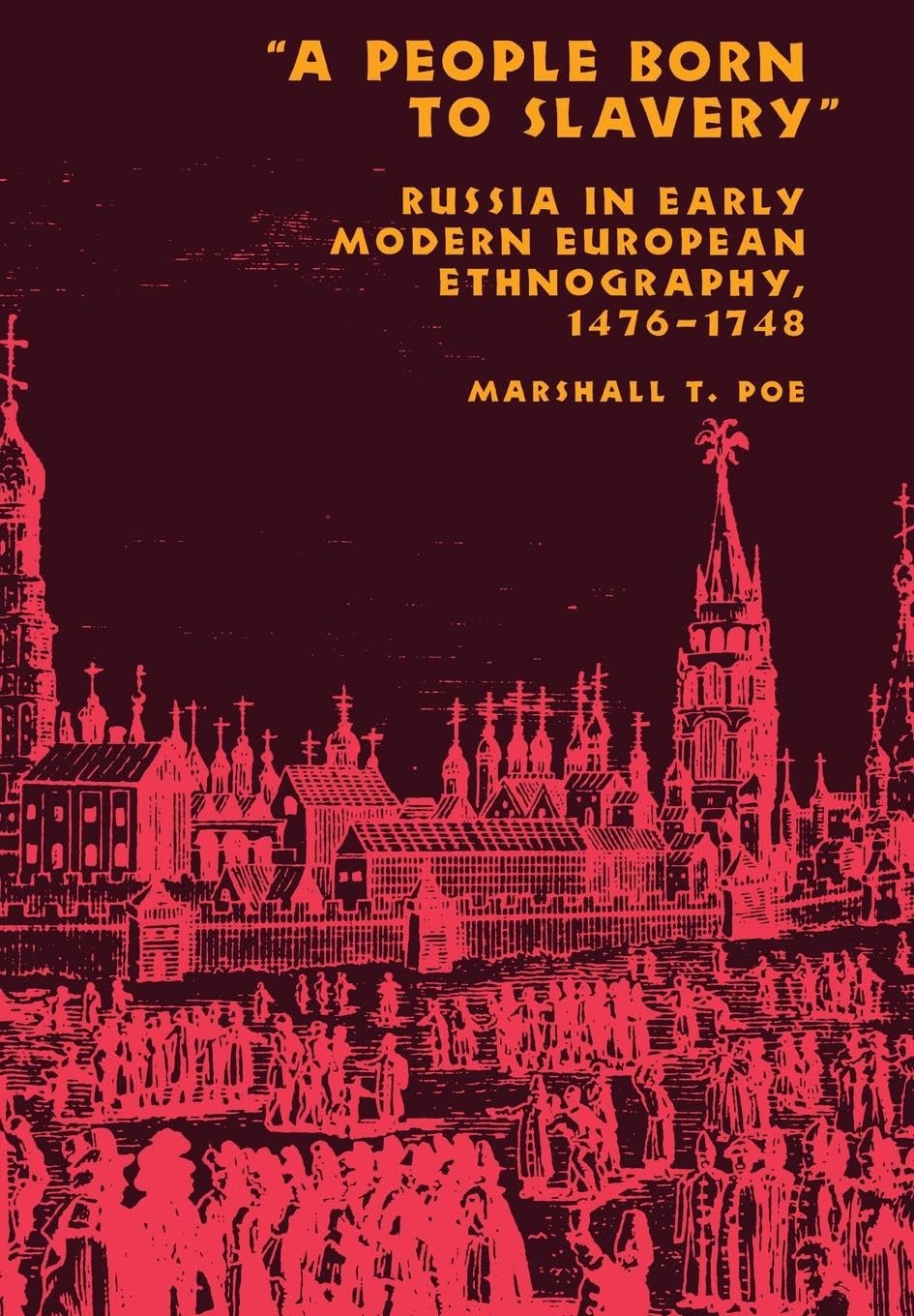
Many Americans and Europeans have for centuries viewed Russia as a despotic country in which people are inclined to accept suffering and oppression. What are the origins of this stereotype of Russia as a society fundamentally apart from nations in the West, and how accurate is it?In the first book devoted to answering these questions, Marshall T. Poe traces the roots of today's perception of Russia and its people to the eyewitness descriptions of sixteenth and seventeenthcentury European travelers. His fascinating accountthe most complete review of early modern European writings about Russia ever undertakenexplores how the image of "Russian tyranny" took hold in the popular imagination and eventually became the basis for the notion of "Oriental Despotism" first set forth by Montesquieu.Poe, the preeminent scholar of these valuable primary sources, carefully assesses their reliability. He argues convincingly that although the foreigners exaggerated the degree of Russian "slavery," they accurately described their encounters and correctly concluded that the political culture of Muscovite autocracy was unlike that of European kingship. With his findings, Poe challenges the notion that all Europeans projected their own fantasies onto Russia. Instead, his evidence suggests that many early travelers produced, in essence, reliable ethnographies, not works of exotic "Orientalism."
⚠️ WARNING (California Proposition 65):
This product may contain chemicals known to the State of California to cause cancer,
birth defects, or other reproductive harm.
For MAP (Minimum Advertised Price) violations and Intellectual Property (IP) or Trademark concerns, please contact:
support@ergodebooks.com
⚠️ California Proposition 65 Warning: Some products sold on this website may expose you to chemicals known to the State of California to cause cancer, birth defects, or other reproductive harm. For more information, visit www.P65Warnings.ca.gov.