
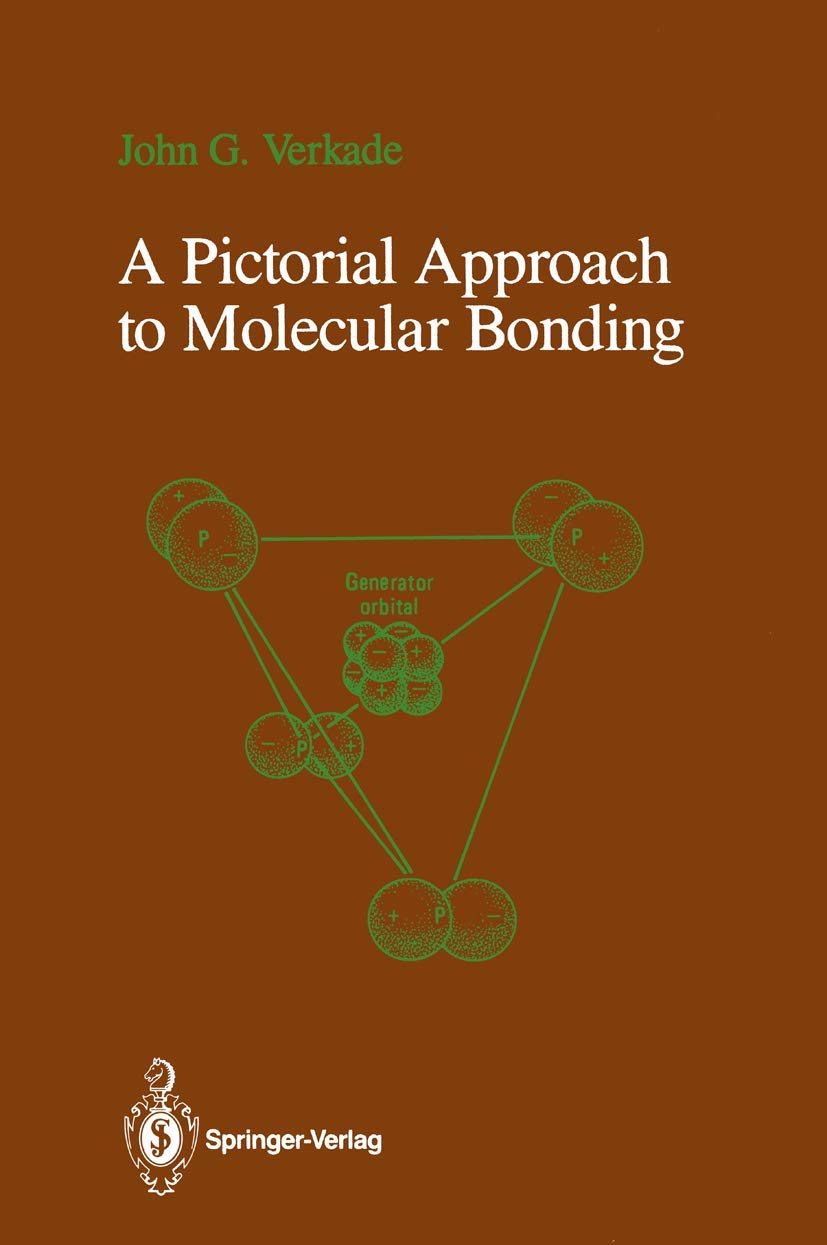
Title
A Pictorial Approach To Molecular Bonding
Sold by Ergodebooks, an authorized reseller.
Returns accepted within 30 days | support@ergodebooks.com
Shipping Information
- Free Standard Shipping — United States only
- Processing Time: 3–5 business days
- Estimated Delivery: 6–10 business days after dispatch
- Double-boxed, fully insured & discreetly packaged
- Tracking number sent via email once dispatched
Returns & Refund
Returns accepted within 30 days of delivery.
Damaged or Defective Item
Free return shipping + replacement or full refund
Wrong Item Received
Free return shipping + replacement or full refund
Change of Mind
Return shipping at customer's expense · 25% restocking fee applies
Payment Option

With The Development Of Accurate Molecular Calculations In Recent Years, Useful Predictions Of Molecular Electronic Properties Are Currently Being Made. It Is Therefore Becoming Increasingly Important For The Nontheoretically Oriented Chemist To Appreciate The Underlying Principles Governing Molecular Orbital Formation And To Distinguish Them From The Quantitative Details As Sociated With Particular Molecules. It Seems Highly Desirable Then That The Non Theoretician Be Able To Deduce Results Of General Validity Without Esoteric Mathematics. In This Context, Pictorial Reasoning Is Particularly Useful. Such An Approach Is Virtually Indispensable If Bonding Concepts Are To Be Taught To Chemistry Students Early In Their Careers. Undergraduate Chemistry Majors Typically Find It Difficult To Formulate Molecular Orbital Schemes, Especially Delocalized Ones, For Molecules More Complicated Than Diatomics. The Major Reason For This Regrettable Situation Is The General Impracticability Of Teaching Group Theory Before Students Take Organic And Inorganic Courses, Wherein The Applications Of These Concepts Are Most Beneficial. Consequently Many Students Graduate With The Misconcep Tion That The Ground Rules Governing Bonding In Molecules Such As Nh3 Are Somehow Different From Those Which Apply To Aromatic Systems Such As C H 6 6 Conversely, Seniors And Many Graduate Students Are Usually Only Vaguely, If At All, Aware That Sigma Bonding (Like Extended Pi Bonding) Can Profitably Be Described In A Delocalized Manner When Discussing The Uvphotoelectron Spectrum Of Ch , For Example.
⚠️ WARNING (California Proposition 65):
This product may contain chemicals known to the State of California to cause cancer, birth defects, or other reproductive harm.
For more information, please visit www.P65Warnings.ca.gov.
- Q: How many pages does this book have? A: This book has two hundred eighty-two pages. It provides a comprehensive exploration of molecular bonding principles.
- Q: What is the binding type of this book? A: The binding type is hardcover. This makes it durable and suitable for frequent use in academic settings.
- Q: What are the book's dimensions? A: The book measures three-fourths of an inch in thickness, six and a half inches in width, and nine and a half inches in height. These dimensions make it easy to handle and store.
- Q: Who is the author of this book? A: The author is John G. Verkade. He is known for his expertise in chemistry and molecular bonding.
- Q: What is the main subject of this book? A: The main subject is molecular bonding. It focuses on teaching the principles governing molecular orbital formation.
- Q: Is this book suitable for undergraduate students? A: Yes, this book is suitable for undergraduate chemistry majors. It is designed to help them understand complex bonding concepts.
- Q: How can this book help me understand molecular bonding? A: This book uses pictorial reasoning to simplify complex concepts. It helps readers grasp molecular orbital schemes without delving into advanced mathematics.
- Q: Is this book beneficial for beginners in chemistry? A: Yes, this book is beneficial for beginners. It presents molecular bonding concepts in an accessible way for those new to the subject.
- Q: What teaching method does this book emphasize? A: The book emphasizes pictorial reasoning. This approach aids in teaching bonding concepts early in a student's chemistry education.
- Q: What is the target audience for this book? A: The target audience includes undergraduate and graduate students in chemistry. It aims to clarify misconceptions about molecular bonding.
- Q: Does this book require prior knowledge of group theory? A: No, this book does not require prior knowledge of group theory. It is designed for readers who may not have a strong theoretical background.
- Q: Can this book be used for self-study? A: Yes, this book can be used for self-study. Its clear explanations and illustrations make it suitable for independent learners.
- Q: What is the main advantage of using pictorial reasoning? A: The main advantage is that it simplifies complex concepts. This method allows students to understand bonding without needing advanced mathematical skills.
- Q: Is the content of this book applicable to real-world chemistry? A: Yes, the content is applicable to real-world chemistry. It helps demystify the principles governing molecular bonding in various compounds.
- Q: What kind of illustrations does this book include? A: The book includes visual representations of molecular structures. These illustrations aid in understanding abstract concepts and bonding theories.