
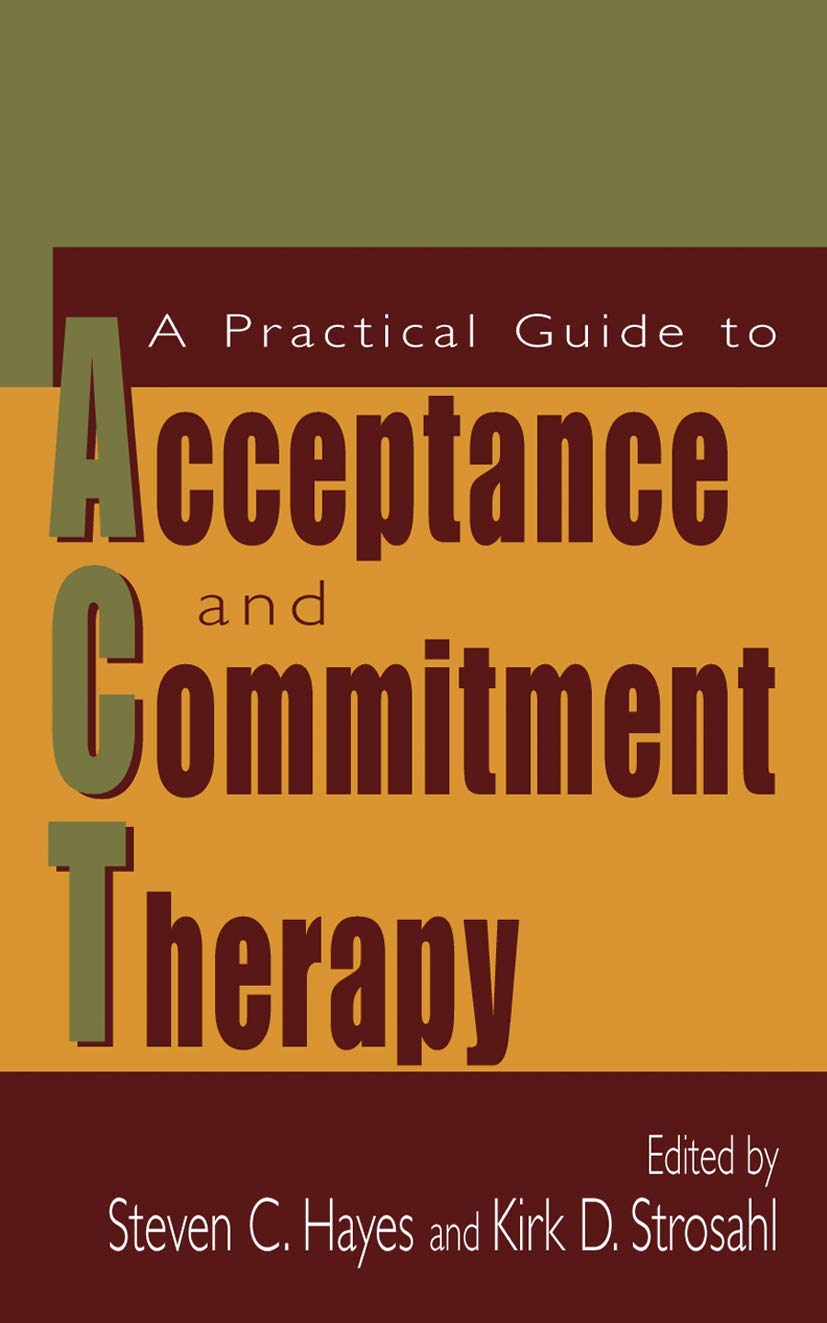
Title
A Practical Guide to Acceptance and Commitment Therapy,Used
Sold by Ergodebooks, an authorized reseller.
Returns accepted within 30 days | support@ergodebooks.com
Shipping Information
- Free Standard Shipping — United States only
- Processing Time: 3–5 business days
- Estimated Delivery: 6–10 business days after dispatch
- Double-boxed, fully insured & discreetly packaged
- Tracking number sent via email once dispatched
Returns & Refund
Returns accepted within 30 days of delivery.
Damaged or Defective Item
Free return shipping + replacement or full refund
Wrong Item Received
Free return shipping + replacement or full refund
Change of Mind
Return shipping at customer's expense · 25% restocking fee applies
Payment Option

This book is the most practical clinical guide on Acceptance and Commit ment Therapy (ACT said as one word, not as initials) yet available. It is designed to show how the ACT model and techniques apply to various disorders, settings, and delivery options. The authors of these chapters are experts in applying ACT in these various areas, and it is intriguing how the same core principles of ACT are given a nip here and a tuck there to fit it to so many issues. The purpose of this book, in part, is to emboldened researchers and clinicians to begin to apply ACT wherever it seems to fit. The chapters in the book demonstrate that ACT may be a useful treat ment approach for a very wide range of clinical problems. Already there are controlled data in many of these areas, and soon that database will be much larger. The theory underlying ACT (Relational Frame Theory or 'RFT'and yes, here you say the initials) makes a powerful claim: psy chopathology is, to a significant degree, built into human language. Fur ther, it suggests ways to diminish destructive languagebased functions and ways of augmenting helpful ones. To the extent that this model is cor rect, ACT should apply to a very wide variety of behavioral issues because of the centrality of language and cognition in human functioning.
⚠️ WARNING (California Proposition 65):
This product may contain chemicals known to the State of California to cause cancer, birth defects, or other reproductive harm.
For more information, please visit www.P65Warnings.ca.gov.
- Q: What is the main focus of 'A Practical Guide to Acceptance and Commitment Therapy'? A: This book primarily focuses on Acceptance and Commitment Therapy (ACT), providing practical insights into its application across various clinical disorders and settings.
- Q: Who are the authors of this book? A: The book is authored by Steven C. Hayes and other experts who have significant experience in applying ACT in different areas.
- Q: Is this book suitable for beginners in therapy? A: Yes, the book is designed to be practical and accessible, making it suitable for both beginners and experienced clinicians interested in ACT.
- Q: What type of binding does this book have? A: The book is available in hardcover binding, which enhances its durability and presentation.
- Q: How many pages does the book contain? A: The book contains a total of 414 pages, providing comprehensive coverage of the ACT framework and its applications.
- Q: When was 'A Practical Guide to Acceptance and Commitment Therapy' published? A: The book was published on December 21, 2004.
- Q: What are the key benefits of reading this book? A: Readers can gain insights into the practical application of ACT, learn how to address a wide range of clinical problems, and understand the underlying theory of Relational Frame Theory.
- Q: Does this book include empirical research or data? A: Yes, the book includes references to controlled data supporting the application of ACT across various clinical issues.
- Q: Is there a specific edition of this book? A: Yes, this book is the 2004 edition, which may contain insights and research relevant to that time.
- Q: Can this book help with specific mental health issues? A: Yes, the chapters cover various mental health issues, demonstrating how ACT can be a useful treatment approach for a wide range of clinical problems.