If you have any questions, you are always welcome to contact us. We'll get back to you as soon as possible, withing 24 hours on weekdays.
Customer service
All questions about your order, return and delivery must be sent to our customer service team by e-mail at yourstore@yourdomain.com
Sale & Press
If you are interested in selling our products, need more information about our brand or wish to make a collaboration, please contact us at press@yourdomain.com
Help
If you have any questions, you are always welcome to contact us. We'll get back to you as soon as possible, withing 24 hours on weekdays.
Customer service
All questions about your order, return and delivery must be sent to our customer service team by e-mail at yourstore@yourdomain.com
Sale & Press
If you are interested in selling our products, need more information about our brand or wish to make a collaboration, please contact us at press@yourdomain.com
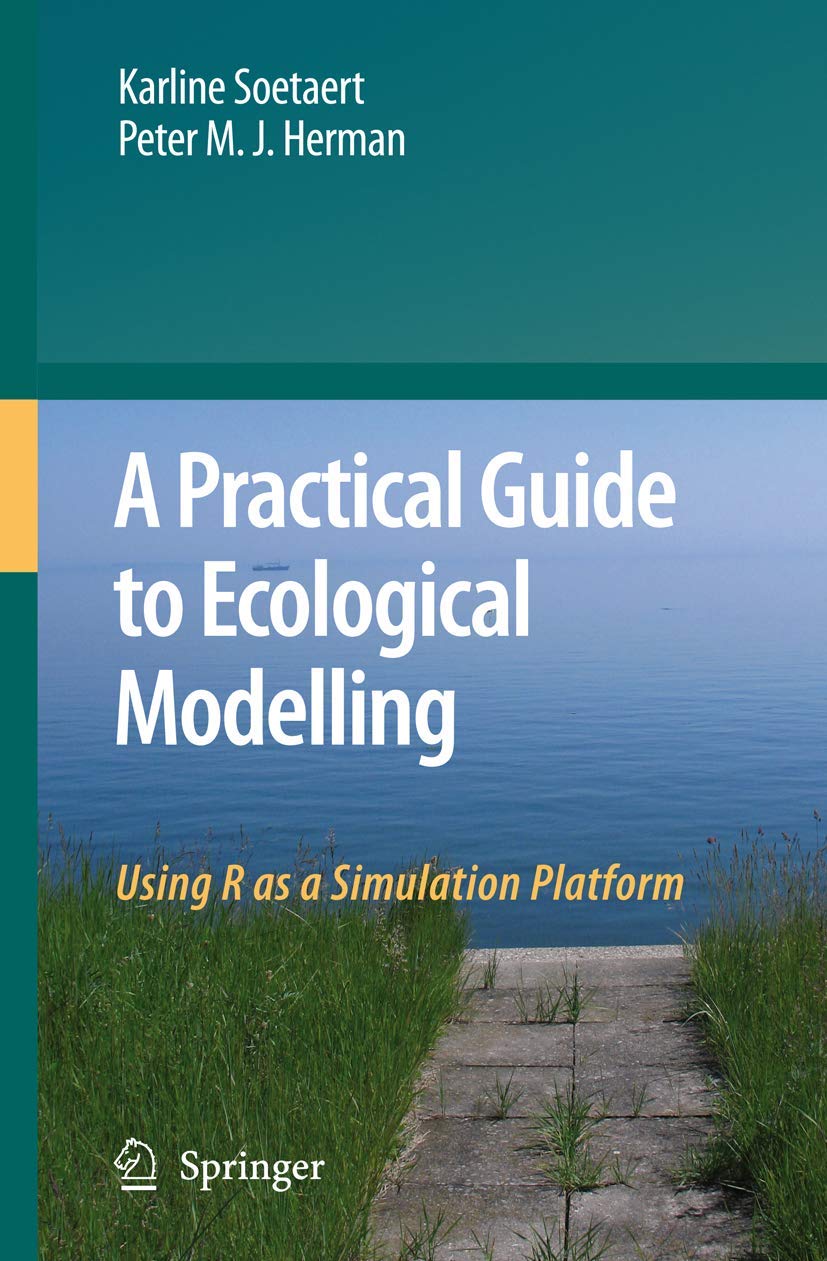
Mathematical modelling is an essential tool in presentday ecological research. Yet for many ecologists it is still problematic to apply modelling in their research. In our experience, the major problem is at the conceptual level: proper understanding of what a model is, how ecological relations can be translated consistently into mathematical equations, how models are solved, steady states calculated and interpreted. Many textbooks jump over these conceptual hurdles to dive into detailed formulations or the mathematics of solution. This book attempts to fill that gap. It introduces essential concepts for mathematical modelling, explains the mathematics behind the methods, and helps readers to implement models and obtain handson experience. Throughout the book, emphasis is laid on how to translate ecological questions into interpretable models in a practical way.The book aims to be an introductory textbook at the undergraduategraduate level, but will also be useful to seduce experienced ecologists into the world of modelling. The range of ecological models treated is wide, from LotkaVolterra type of principleseeking models to environmental or ecosystem models, and including matrix models, lattice models and sequential decision models. All chapters contain a concise introduction into the theory, workedout examples and exercises. All examples are implemented in the opensource package R, thus taking away problems of software availability for use of the book. All code used in the book is available on a dedicated website.
⚠️ WARNING (California Proposition 65):
This product may contain chemicals known to the State of California to cause cancer,
birth defects, or other reproductive harm.
For MAP (Minimum Advertised Price) violations and Intellectual Property (IP) or Trademark concerns, please contact:
support@ergodebooks.com
⚠️ California Proposition 65 Warning: Some products sold on this website may expose you to chemicals known to the State of California to cause cancer, birth defects, or other reproductive harm. For more information, visit www.P65Warnings.ca.gov.