
Title
A Pragmatic Theory of Fallacy (Studies in Rhetoric and Communication),Used
Sold by Ergodebooks, an authorized reseller.
Returns accepted within 30 days | support@ergodebooks.com
Shipping Information
- Free Standard Shipping — United States only
- Processing Time: 3–5 business days
- Estimated Delivery: 6–10 business days after dispatch
- Double-boxed, fully insured & discreetly packaged
- Tracking number sent via email once dispatched
Returns & Refund
Returns accepted within 30 days of delivery.
Damaged or Defective Item
Free return shipping + replacement or full refund
Wrong Item Received
Free return shipping + replacement or full refund
Change of Mind
Return shipping at customer's expense · 25% restocking fee applies
Payment Option

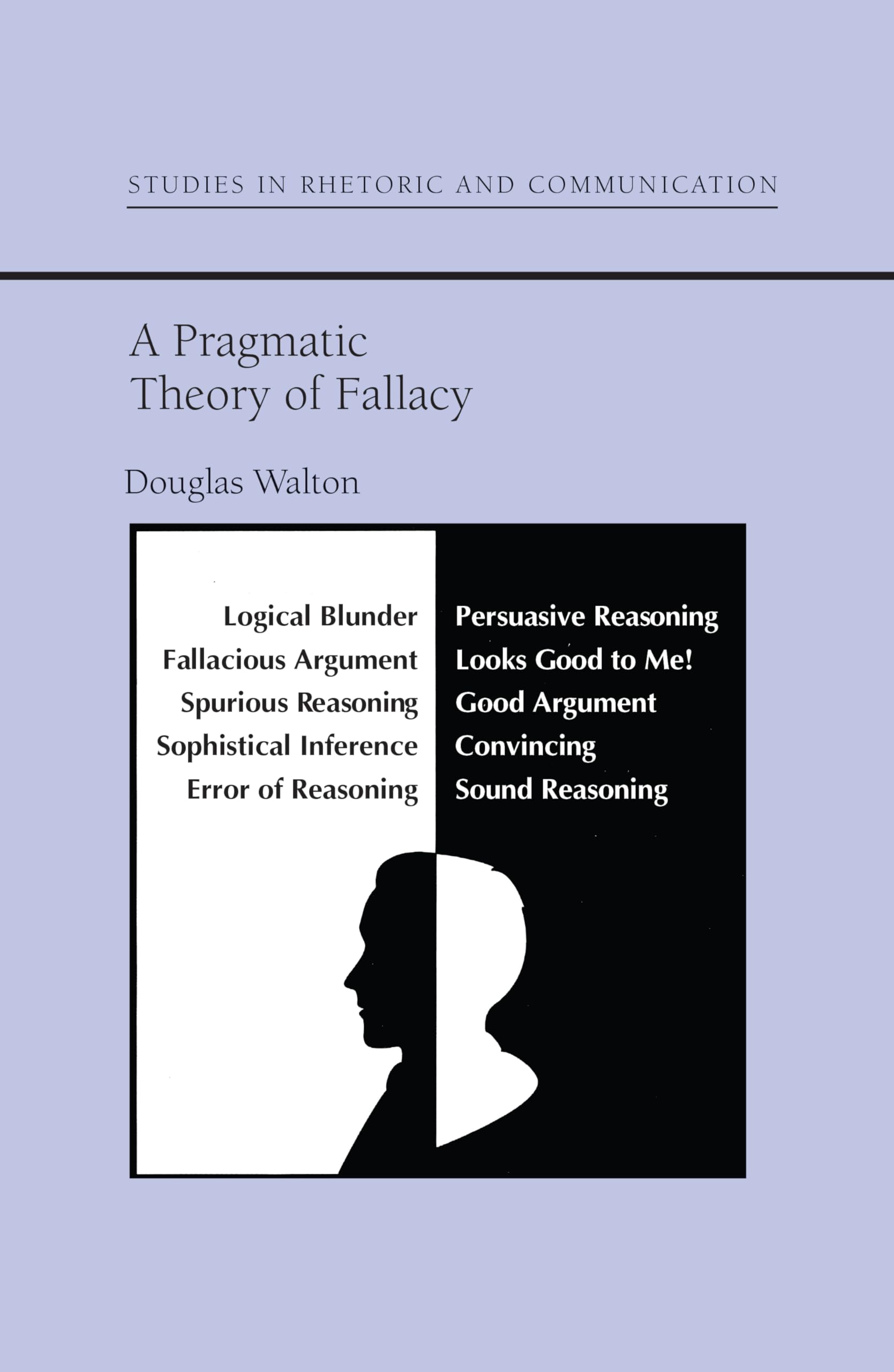
Takes a new analytical look at the concept of fallacy and presents an uptodate analysis of its usefulness for argumentation studiesAlthough fallacies have been common since Aristotle, until recently little attention has been devoted to identifying and defining them. Furthermore, the concept of fallacy itself has lacked a sufficiently clear meaning to make it a useful tool for evaluating arguments. Douglas Walton takes a new analytical look at the concept of fallacy and presents an uptodate analysis of its usefulness for argumentation studies. Walton uses case studies illustrating familiar arguments and tricky deceptions in everyday conversation where the charge of fallaciousness is at issue.The numerous case studies show in concrete terms many practical aspects of how to use textual evidence to identify and analyze fallacies and to evaluate arguments as fallacious. Walton looks at how an argument is used in the context of conversation. He defines a fallacy as a conversational move, or sequence of moves, that is supposed to be an argument that contributes to the purpose of the conversation but in reality interferes with it. The view is a pragmatic one, based on the assumption that when people argue, they do so in a context of dialogue, a conventionalized normative framework that is goaldirected. Such a contextual framework is shown to be crucial in determining whether an argument has been used correctly. Walton also shows how examples of fallacies given in the logic textbooks characteristically turn out to be variants of reasonable, even if defeasible or questionable arguments, based on presumptive reasoning. This is the essence of the evaluation problem. A key thesis of the book, which must not be taken for granted as previous textbooks have so often done, is that you can spot a fallacy from how it was used in a context of dialogue. This is an innovative and even, as Walton notes, "a radical and controversial" theory of fallacy.
⚠️ WARNING (California Proposition 65):
This product may contain chemicals known to the State of California to cause cancer, birth defects, or other reproductive harm.
For more information, please visit www.P65Warnings.ca.gov.