
Title
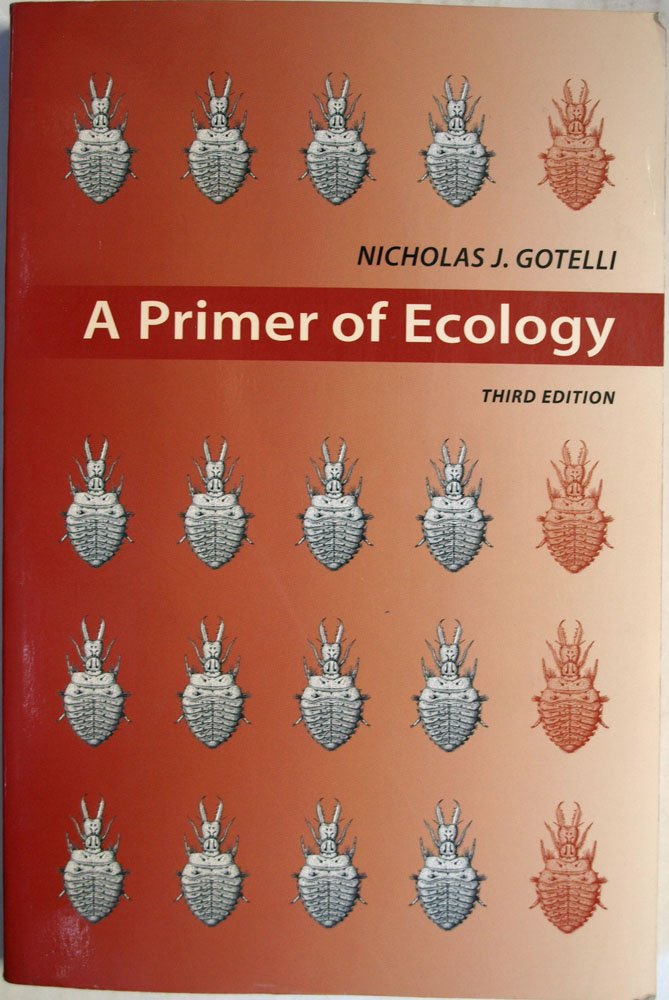
A Primer of Ecology,Used
Sold by Ergodebooks, an authorized reseller.
Returns accepted within 30 days | support@ergodebooks.com
Shipping Information
- Free Standard Shipping — United States only
- Processing Time: 3–5 business days
- Estimated Delivery: 6–10 business days after dispatch
- Double-boxed, fully insured & discreetly packaged
- Tracking number sent via email once dispatched
Returns & Refund
Returns accepted within 30 days of delivery.
Damaged or Defective Item
Free return shipping + replacement or full refund
Wrong Item Received
Free return shipping + replacement or full refund
Change of Mind
Return shipping at customer's expense · 25% restocking fee applies
Payment Option

A Primer of Ecology, Third Edition, presents a concise but detailed exposition of the most common mathematical models in population and community ecology. It is intended to demystify ecological models and the mathematics behind them by deriving the models from first principles. The book may be used as a selfteaching tutorial by students, as a primary textbook, or as a supplemental text to a general ecology textbook.The Primer explains in detail basic concepts of exponential and logistic population growth, agestructured demography, metapopulation dynamics, competition, predation, island biogeography, and, in a chapter new to this edition, succession. Each chapter is carefully graded from simple material that is appropriate for beginning undergraduates to advanced material, which is suited for upperdivision undergraduates and beginning graduate students. Advanced topics include environmental and demographic stochasticity, discrete population growth and chaos, stagestructured demography, intraguild predation, nonlinear predatorprey isoclines, and passive sampling. Each chapter follows the same structure: model presentation and predictions, model assumptions, model variations, empirical examples, and problems.Essential equations are highlighted for students' use. Intermediate algebraic 'expressions' are also illustrated so that students see where the equations came from. New terms are introduced in the text in boldface type to alert students to novel concepts. The Primer contains more mathematical detail than many ecology textbooks, but avoids jargon and mathematical terminology that can intimidate students. Both simple and advanced problems are included, followed by fully worked solutions so that students can gain confidence and a better understanding of the models. Citations are kept to a minimum.
⚠️ WARNING (California Proposition 65):
This product may contain chemicals known to the State of California to cause cancer, birth defects, or other reproductive harm.
For more information, please visit www.P65Warnings.ca.gov.