
Title
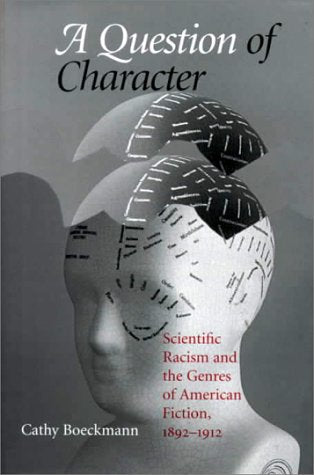
A Question Of Character: Scientific Racism And The Genres Of American Fiction, 18921912 (Studies In American Literary Realism A,Used
Sold by Ergodebooks, an authorized reseller.
Returns accepted within 30 days | support@ergodebooks.com
Shipping Information
- Free Standard Shipping — United States only
- Processing Time: 3–5 business days
- Estimated Delivery: 6–10 business days after dispatch
- Double-boxed, fully insured & discreetly packaged
- Tracking number sent via email once dispatched
Returns & Refund
Returns accepted within 30 days of delivery.
Damaged or Defective Item
Free return shipping + replacement or full refund
Wrong Item Received
Free return shipping + replacement or full refund
Change of Mind
Return shipping at customer's expense · 25% restocking fee applies
Payment Option

Review'[The] Discussions Of Twain, Howells, Chesnutt, And Johnson . . . Lucidly Illustrate The Ways That Four Of Our Major Writers Struggled To Create Literary Forms Enabling Them Not Only To Reflect But Also To Intervene In Contemporary Racial Debates, And In The Process To Begin Shifting The Generic Boundaries Of American Literature.'American Literary Realism'[A Question Of Character] Fills In Significant Gaps In The Critical Discourse About Genre, Race, And Science At The Turn Of The Century. . . . [The] Introduction And First Chapter Are Extremely Useful For Explicating How Racial Discourse In Realism And Sentimentalism Helps Determine Genre. . . . [This Book] Should Be Required Reading For Scholars Interested In Early Theories About Scientific Racism.'Choiceproduct Descriptionboeckmann Links Character, Literary Genre, And Science, Revealing How Major Literary Works Both Contributed To And Disrupted The Construction Of Race In Turnofthecentury America.In A Question Of Character, Cathy Boeckmann Establishes A Strong Link Between Racial Questions And The Development Of Literary Traditions At The End Of The 19Th Century In America. This Period Saw The Rise Of 'Scientific Racism,' Which Claimed That The Races Were Distinguished Not Solely By Exterior Appearance But Also By A Set Of Inherited Character Traits. As Boeckmann Explains, This Emphasis On Character Meant That Race Was Not Only A Thematic Concern In The Literature Of The Period But Also A Generic Or Formal One As Well.Boeckmann Explores The Intersections Between Race And Literary History By Tracing The Language Of Character Through Both Scientific And Literary Writing. Nineteenthcentury Pseudosciences Such As Phrenology And Physiognomy Had A Vocabulary For Discussing Racial Character That Overlapped Conceptually With The Conventions For Portraying Race In Literature. Through Close Readings Of Novels By Thomas Dixon, Mark Twain, William Dean Howells, Charles Chesnutt, And James Weldon Johnsoneach Of Which Deals With A Black Character 'Passing' As Whiteboeckmann Shows How This Emphasis On Character Relates To The Shift From Romantic And Sentimental Fiction To Realism. Because Each Of These Genres Had Very Specific Conventions Regarding The Representation Of Character, Genres Often Dictated How Races Could Be Depicted.About The Authorcatherine Ann Boeckmann,An Independent Scholar, Is Communication Specialist At Mckinsey & Company In Atlanta.
⚠️ WARNING (California Proposition 65):
This product may contain chemicals known to the State of California to cause cancer, birth defects, or other reproductive harm.
For more information, please visit www.P65Warnings.ca.gov.
- Q: What is the page count of the book? A: This book has two hundred forty-eight pages, providing an in-depth exploration of character and race in literature.
- Q: What are the dimensions of the book? A: The book measures six inches in length, one inch in width, and nine point zero two inches in height, making it a standard hardcover size.
- Q: What type of binding does this book have? A: This book features a hardcover binding, which offers durability and a professional appearance for collectors and readers.
- Q: Who is the author of this book? A: The author of this book is Catherine Ann Boeckmann, a scholar who examines the intersections of race and literature.
- Q: What category does this book belong to? A: This book is categorized under Movements & Periods, focusing on literary developments at the turn of the century.
- Q: How do I read this book effectively? A: To read this book effectively, approach it with an interest in historical contexts and character analysis, as it explores complex themes.
- Q: Is this book suitable for academic study? A: Yes, this book is suitable for academic study, particularly in literature, cultural studies, and race relations courses.
- Q: What themes are explored in this book? A: This book explores themes of scientific racism, character representation, and the evolution of literary genres during a critical historical period.
- Q: What should I do to preserve the book's condition? A: To preserve the book's condition, store it in a cool, dry place and avoid direct sunlight to prevent fading and damage.
- Q: How can I clean the book if it gets dirty? A: To clean the book, gently wipe the cover with a soft, dry cloth. Avoid using water or cleaners that could damage the material.
- Q: Can I return the book if I'm not satisfied? A: Yes, you can return the book if you are not satisfied, subject to the seller's return policy details.
- Q: What if the book arrives damaged? A: If the book arrives damaged, contact the seller immediately to initiate a return or exchange process.
- Q: Is this book appropriate for young readers? A: No, this book may not be appropriate for young readers due to its complex themes and academic nature.
- Q: How does this book compare to others in its genre? A: This book offers a unique perspective on character and race, distinguishing it from other literary analysis works of the same period.
- Q: What kind of research does the author use in this book? A: The author utilizes both literary texts and scientific writings from the period to analyze the construction of race in American literature.
- Q: Is this book part of a series? A: Yes, this book is part of the Studies in American Literary Realism and Naturalism series, which focuses on important literary movements.