
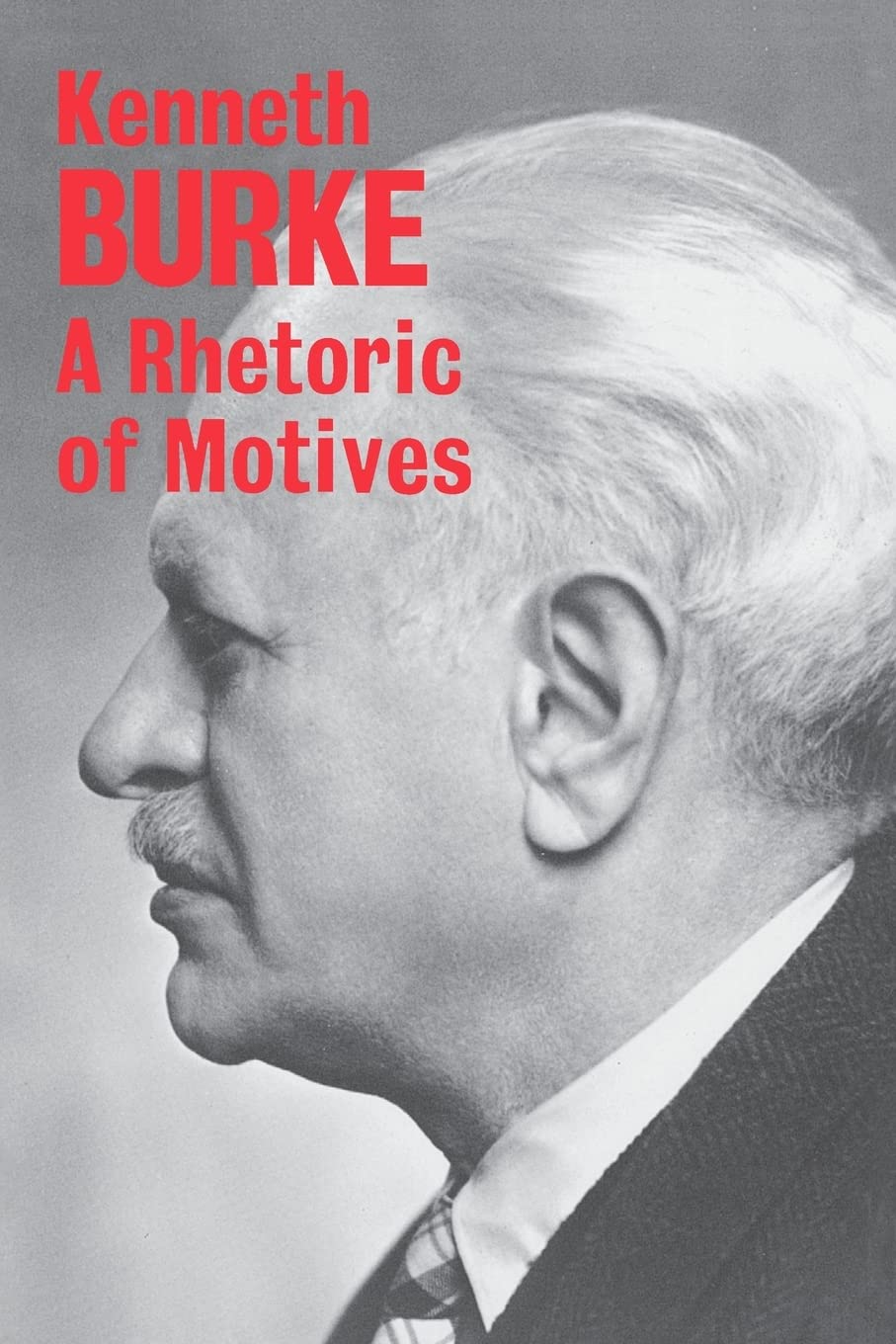
Title


A Rhetoric Of Motives
Sold by Ergodebooks, an authorized reseller.
Returns accepted within 30 days | support@ergodebooks.com
Shipping Information
- Free Standard Shipping — United States only
- Processing Time: 3–5 business days
- Estimated Delivery: 6–10 business days after dispatch
- Double-boxed, fully insured & discreetly packaged
- Tracking number sent via email once dispatched
Returns & Refund
Returns accepted within 30 days of delivery.
Damaged or Defective Item
Free return shipping + replacement or full refund
Wrong Item Received
Free return shipping + replacement or full refund
Change of Mind
Return shipping at customer's expense · 25% restocking fee applies
Payment Option

As Critic, Kenneth Burke'S Preoccupations Were At The Beginning Purely Esthetic And Literary; But After Counterstatement (1931), He Began To Discriminate A Rhetorical Or Persuasive Component In Literature, And Thereupon Became A Philosopher Of Language And Human Conduct.In A Grammar Of Motives (1945) And A Rhetoric Of Motives (1950), Burke'S Conception Of Symbolic Action Comes Into Its Own: All Human Activitieslinguisitc Or Extralinguisticare Modes Of Symbolizing; Man Is Defined As The Symbolusing (And Misusing) Animal. The Critic'S Job Becomes One Of The Interpreting Human Symbolizing Wherever He Finds It, With The Aim Of Illuminating Human Motivation. Thus The Reach Of The Literary Critic Now Extends To The Social And Ethical.A Grammar Of Motives Is A Methodical Meditation On Such Complex Linguistic Forms As Plays, Stories, Poems, Theologies, Metaphysical Systems, Political Philosophies, Constitutions. A Rhetoric Of Motives Expands The Field To Human Ways Of Persuasion And Identification. Persuasion, As Burke Sees It, Ranges From The Bluntest Quest Of Advantage, As In Sales Promotion Or Propaganda, Through Courtship, Social Etiquette, Education, And The Sermon, To A 'Pure' Form That Delights In The Process Of Appeal For Itself Alone, Without Ulterior Purpose. And Identification Ranges From The Politician Who, Addressing An Audience Of Farmers, Says, 'I Was A Farm Boy Myself,' Through The Mysteries Of Social Status, To The Mystic'S Devout Identification With The Sources Of All Being.
⚠️ WARNING (California Proposition 65):
This product may contain chemicals known to the State of California to cause cancer, birth defects, or other reproductive harm.
For more information, please visit www.P65Warnings.ca.gov.
- Q: How many pages are in 'A Rhetoric of Motives'? A: This book contains three hundred fifty-six pages. It provides an in-depth exploration of Kenneth Burke's theories on language and human motivation.
- Q: What is the binding type of this book? A: The binding type is paperback. This makes it a lightweight and flexible option for readers.
- Q: What are the dimensions of 'A Rhetoric of Motives'? A: The dimensions are five point nine one inches in length, zero point nine one inches in width, and eight point nine inches in height. These dimensions make it easy to handle and store.
- Q: Who is the author of 'A Rhetoric of Motives'? A: The author is Kenneth Burke. He was a prominent critic and philosopher known for his work on language and persuasion.
- Q: What genre does 'A Rhetoric of Motives' fall under? A: This book falls under the genre of Criticism and Theory. It discusses the nuances of rhetorical and symbolic action in literature.
- Q: How do I read 'A Rhetoric of Motives' effectively? A: To read this book effectively, approach it as a study of human motivation and language. Take notes on key concepts, especially on symbolism and persuasion.
- Q: Is 'A Rhetoric of Motives' suitable for beginners in literary theory? A: Yes, it is suitable for beginners. While it is academically rigorous, Burke's insights are accessible for those new to literary criticism.
- Q: What themes are explored in 'A Rhetoric of Motives'? A: The book explores themes of persuasion, identification, and symbolic action. Kenneth Burke examines how these elements impact human interaction and motivation.
- Q: How should I care for my paperback copy of 'A Rhetoric of Motives'? A: To care for your paperback copy, keep it away from direct sunlight and store it in a dry place. Avoid bending the cover to preserve its condition.
- Q: What is the recommended storage method for this book? A: Store the book upright on a shelf or in a bookcase. This helps maintain its shape and prevents wear on the spine.
- Q: What if my copy of 'A Rhetoric of Motives' arrives damaged? A: If your copy arrives damaged, you should contact the seller for a return or replacement. Most sellers have policies for handling such issues.
- Q: Does 'A Rhetoric of Motives' come with a warranty? A: No, books typically do not come with warranties. However, returns may be available if the book is defective.
- Q: Can I find similar books to 'A Rhetoric of Motives'? A: Yes, you can find similar books in the Criticism and Theory genre that explore themes of language and motivation. Look for works by authors like Roland Barthes or Mikhail Bakhtin.
- Q: Is there a specific audience for 'A Rhetoric of Motives'? A: Yes, this book is aimed at students, scholars, and anyone interested in literary criticism and rhetorical theory. It appeals to those exploring the intersection of language and human behavior.
- Q: What if I have more questions about 'A Rhetoric of Motives'? A: If you have more questions, consider checking online literary forums or academic resources. Many discussions about Kenneth Burke's work are available for further insights.