
Title
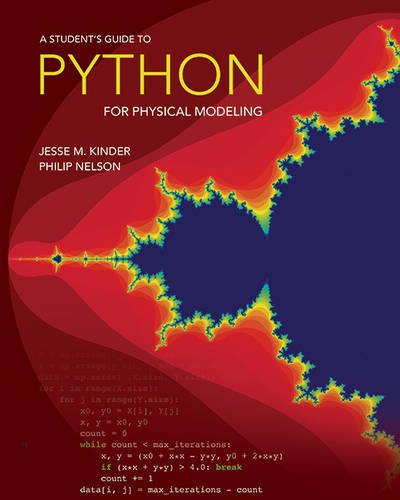
A Student's Guide to Python for Physical Modeling,New
Sold by Ergodebooks, an authorized reseller.
Returns accepted within 30 days | support@ergodebooks.com
Shipping Information
- Free Standard Shipping — United States only
- Processing Time: 3–5 business days
- Estimated Delivery: 6–10 business days after dispatch
- Double-boxed, fully insured & discreetly packaged
- Tracking number sent via email once dispatched
Returns & Refund
Returns accepted within 30 days of delivery.
Damaged or Defective Item
Free return shipping + replacement or full refund
Wrong Item Received
Free return shipping + replacement or full refund
Change of Mind
Return shipping at customer's expense · 25% restocking fee applies
Payment Option

Python is a computer programming language that is rapidly gaining popularity throughout the sciences. A Student's Guide to Python for Physical Modeling aims to help you, the student, teach yourself enough of the Python programming language to get started with physical modeling. You will learn how to install an opensource Python programming environment and use it to accomplish many common scientific computing tasks: importing, exporting, and visualizing data; numerical analysis; and simulation. No prior programming experience is assumed.This tutorial focuses on fundamentals and introduces a wide range of useful techniques, including:Basic Python programming and scripting Numerical arrays Two and threedimensional graphics Monte Carlo simulations Numerical methods, including solving ordinary differential equations Image processing AnimationNumerous code samples and exerciseswith solutionsillustrate new ideas as they are introduced. Webbased resources also accompany this guide and include code samples, data sets, and more.
⚠️ WARNING (California Proposition 65):
This product may contain chemicals known to the State of California to cause cancer, birth defects, or other reproductive harm.
For more information, please visit www.P65Warnings.ca.gov.
- Q: What is 'A Student's Guide to Python for Physical Modeling' about? A: This book aims to teach students the fundamentals of Python programming, specifically for applications in physical modeling. It covers installation of Python, data visualization, numerical analysis, and simulations.
- Q: Do I need prior programming experience to use this book? A: No, the book assumes no prior programming experience, making it suitable for beginners.
- Q: What topics are covered in this guide? A: The guide covers basic Python programming, numerical arrays, graphics, Monte Carlo simulations, numerical methods, image processing, and animation.
- Q: How many pages does this book have? A: The book has 160 pages.
- Q: Who is the author of this book? A: The author is Jesse M. Kinder.
- Q: When was this book published? A: It was published on September 22, 2015.
- Q: What is the binding type of this book? A: The book is available in paperback binding.
- Q: Are there exercises included in the book? A: Yes, the book includes numerous code samples and exercises with solutions to help reinforce learning.
- Q: What resources are available online with this guide? A: Web-based resources accompany the guide, including additional code samples, data sets, and other materials.
- Q: Is this book suitable for advanced programmers? A: While it is designed for beginners, advanced programmers may find the introductory material useful for a refresher or teaching purposes.