If you have any questions, you are always welcome to contact us. We'll get back to you as soon as possible, withing 24 hours on weekdays.
Customer service
All questions about your order, return and delivery must be sent to our customer service team by e-mail at yourstore@yourdomain.com
Sale & Press
If you are interested in selling our products, need more information about our brand or wish to make a collaboration, please contact us at press@yourdomain.com
Help
If you have any questions, you are always welcome to contact us. We'll get back to you as soon as possible, withing 24 hours on weekdays.
Customer service
All questions about your order, return and delivery must be sent to our customer service team by e-mail at yourstore@yourdomain.com
Sale & Press
If you are interested in selling our products, need more information about our brand or wish to make a collaboration, please contact us at press@yourdomain.com
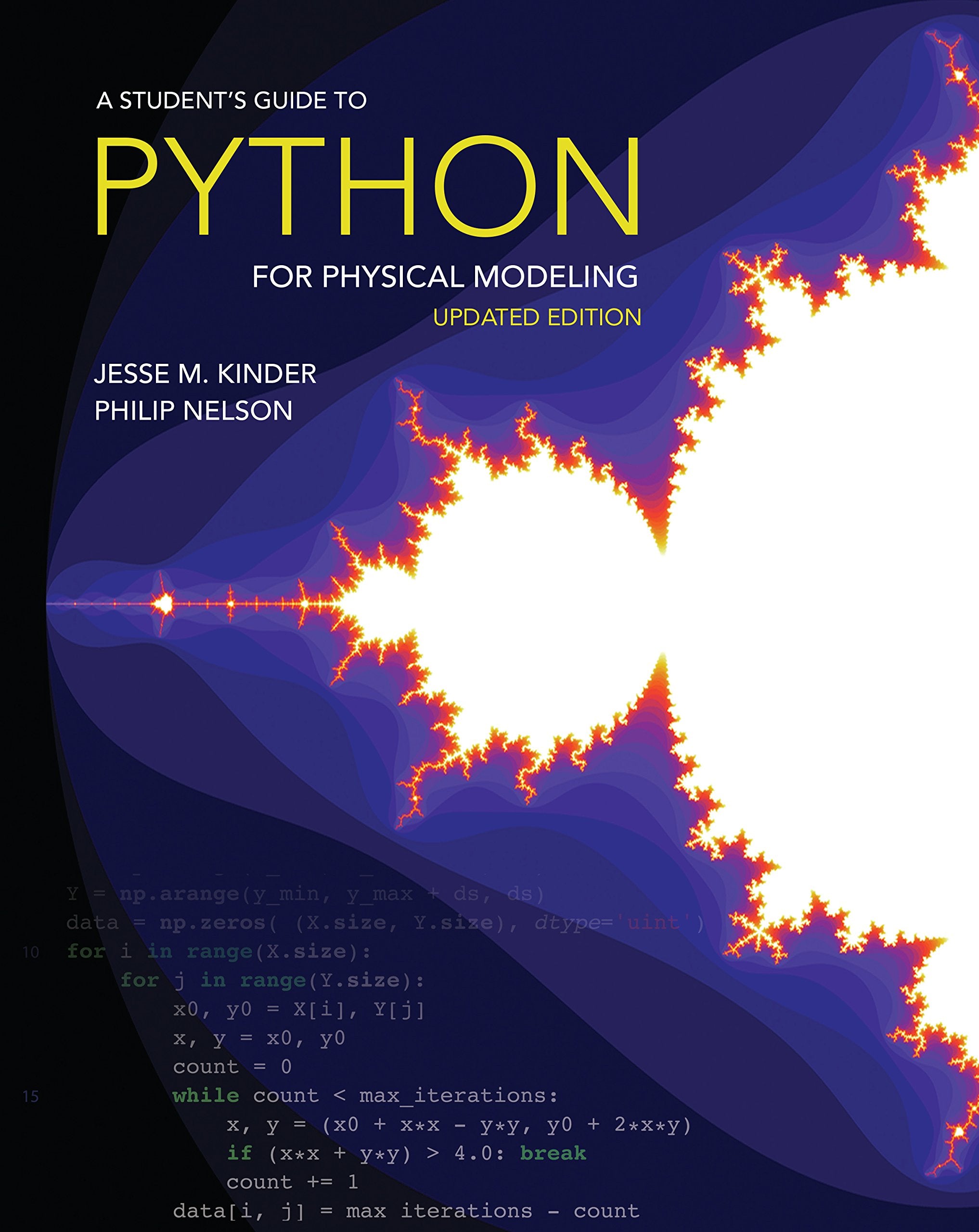
A fully updated tutorial on the basics of the Python programming language for science studentsPython is a computer programming language that is rapidly gaining popularity throughout the sciences. This fully updated edition of A Student's Guide to Python for Physical Modeling aims to help you, the student, teach yourself enough of the Python programming language to get started with physical modeling. You will learn how to install an opensource Python programming environment and use it to accomplish many common scientific computing tasks: importing, exporting, and visualizing data; numerical analysis; and simulation. No prior programming experience is assumed.This tutorial focuses on fundamentals and introduces a wide range of useful techniques, including: Basic Python programming and scriptingNumerical arraysTwo and threedimensional graphicsMonte Carlo simulationsNumerical methods, including solving ordinary differential equationsImage processingAnimationNumerous code samples and exerciseswith solutionsillustrate new ideas as they are introduced. Webbased resources also accompany this guide and include code samples, data sets, and more. This current edition brings the discussion of the Python language, Spyder development environment, and Anaconda distribution up to date. In addition, a new appendix introduces Jupyter notebooks.
⚠️ WARNING (California Proposition 65):
This product may contain chemicals known to the State of California to cause cancer,
birth defects, or other reproductive harm.
For MAP (Minimum Advertised Price) violations and Intellectual Property (IP) or Trademark concerns, please contact:
support@ergodebooks.com
⚠️ California Proposition 65 Warning: Some products sold on this website may expose you to chemicals known to the State of California to cause cancer, birth defects, or other reproductive harm. For more information, visit www.P65Warnings.ca.gov.