
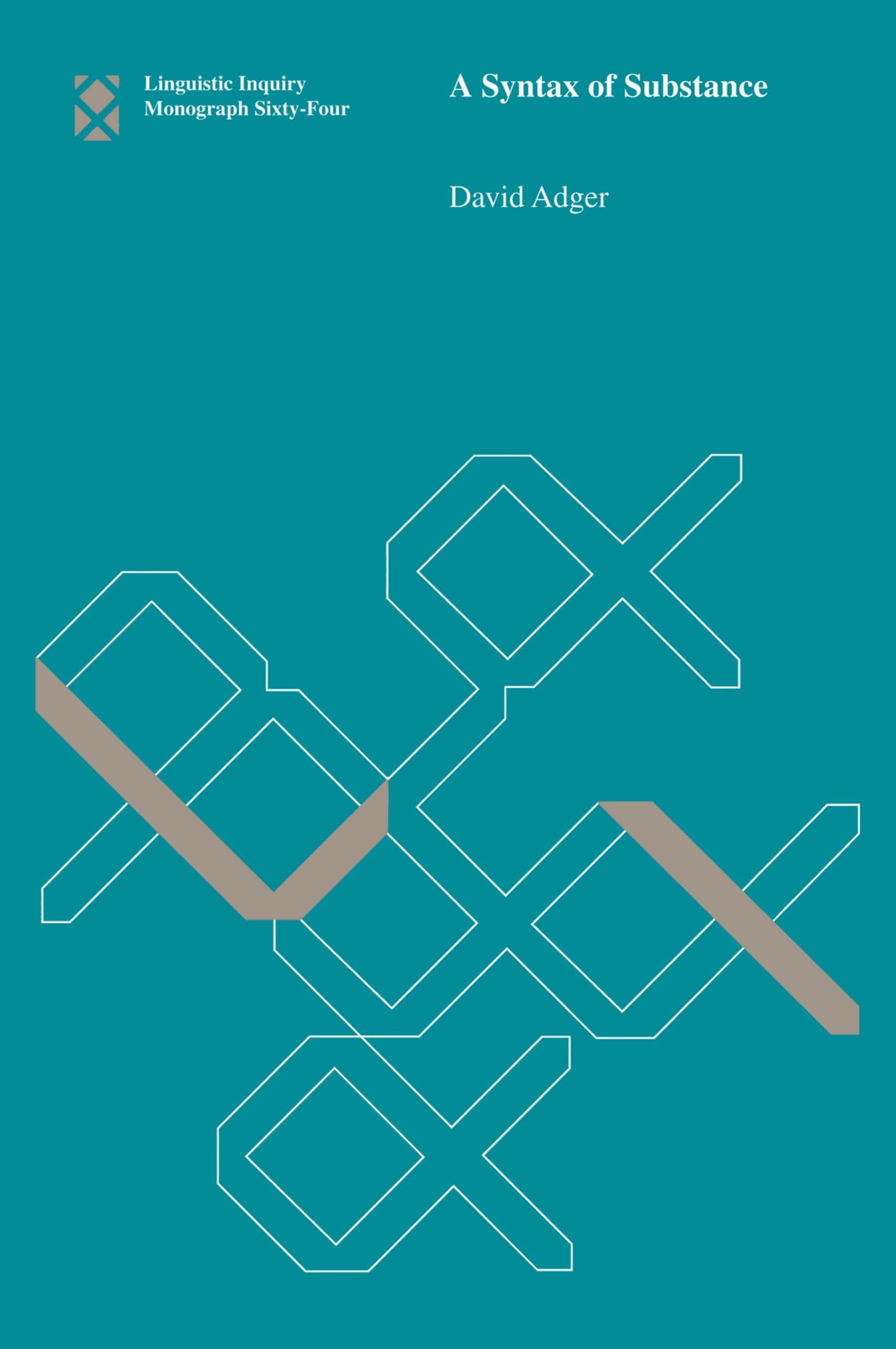
Title
A Syntax of Substance, Volume 64 (Linguistic Inquiry Monographs, 64),Used
Sold by Ergodebooks, an authorized reseller.
Returns accepted within 30 days | support@ergodebooks.com
Shipping Information
- Free Standard Shipping — United States only
- Processing Time: 3–5 business days
- Estimated Delivery: 6–10 business days after dispatch
- Double-boxed, fully insured & discreetly packaged
- Tracking number sent via email once dispatched
Returns & Refund
Returns accepted within 30 days of delivery.
Damaged or Defective Item
Free return shipping + replacement or full refund
Wrong Item Received
Free return shipping + replacement or full refund
Change of Mind
Return shipping at customer's expense · 25% restocking fee applies
Payment Option

A new approach to grammar and meaning of relational nouns is presented along with its empirical consequences.In A Syntax of Substance, David Adger proposes a new approach to phrase structure that eschews functional heads and labels structures exocentrically. His proposal simultaneously simplifies the syntactic system and restricts the range of possible structures, ruling out the ubiquitous (remnant) rollup derivations and forcing a separation of arguments from their apparent heads. This new system has a number of empirical consequences, which Adger explores in the domain of relational nominals across different language families, including Germanic, Romance, Celtic, Polynesian, and Semitic. He shows that the relationality of such nouns as hand, edge, or motherwhich seem to have as part of their meaning a relation between substancesis actually part of the syntactic representation in which they are used rather than an inherent part of their meaning. This empirical outcome follows directly from the new syntactic system, as does a novel analysis of PP complements to nouns and possessors. Given this, he argues that nouns can, in general, be thought of as simply specifications of substance, differentiating them from true predicates.A Syntax of Substance offers an innovative contribution to debates in theoretical syntax about the nature of syntactic representations and how they connect to semantic interpretation and linear order.
⚠️ WARNING (California Proposition 65):
This product may contain chemicals known to the State of California to cause cancer, birth defects, or other reproductive harm.
For more information, please visit www.P65Warnings.ca.gov.
- Q: What is the page count of 'A Syntax of Substance'? A: The book has one hundred eighty-nine pages. This makes it a comprehensive yet manageable read for those interested in linguistics.
- Q: What type of binding does this book have? A: This book is available in paperback binding. Paperback editions are lightweight and flexible, making them easy to carry.
- Q: What are the dimensions of 'A Syntax of Substance'? A: The book measures six inches in length, zero point five one inches in width, and nine point twenty-five inches in height. These dimensions make it suitable for standard bookshelves.
- Q: Who is the author of 'A Syntax of Substance'? A: The author is David Adger. He is known for his contributions to theoretical syntax and linguistics.
- Q: What is the main focus of 'A Syntax of Substance'? A: The book focuses on grammar and meaning of relational nouns. It presents a new approach to phrase structure that simplifies the syntactic system.
- Q: Is this book suitable for beginners in linguistics? A: Yes, it can be suitable for beginners. However, a basic understanding of syntax may enhance the reading experience.
- Q: Does this book require prior knowledge of linguistics? A: Some prior knowledge of linguistics is beneficial. Theoretical discussions may be complex for complete novices.
- Q: How does Adger's approach differ from traditional syntax? A: Adger's approach eschews functional heads and labels structures exocentrically. This contrasts with traditional syntactic theories that rely heavily on functional roles.
- Q: What should I do to care for my paperback copy? A: To care for your paperback book, store it in a cool, dry place and avoid exposure to direct sunlight. Keep it on a shelf to prevent bending.
- Q: How should I clean my paperback book? A: To clean your book, gently wipe the cover with a soft, dry cloth. Avoid using water or cleaning solutions that may damage the cover.
- Q: What if my book arrives damaged? A: If your book arrives damaged, contact the seller as soon as possible to initiate a return or exchange. Most sellers have policies in place for such situations.
- Q: Is this book appropriate for academic use? A: Yes, this book is appropriate for academic use. It provides valuable insights into theoretical syntax that can enhance coursework in linguistics.
- Q: Can I use this book for research purposes? A: Absolutely, this book is suitable for research. It explores complex syntactic theories that are relevant to ongoing discussions in linguistics.
- Q: What type of audience is 'A Syntax of Substance' intended for? A: The book is intended for linguistics students, researchers, and professionals. It addresses advanced topics that may interest those in the field.
- Q: Does the book cover multiple language families? A: Yes, it explores relational nominals across various language families, including Germanic, Romance, Celtic, Polynesian, and Semitic. This broad approach enhances its relevance.