If you have any questions, you are always welcome to contact us. We'll get back to you as soon as possible, withing 24 hours on weekdays.
Customer service
All questions about your order, return and delivery must be sent to our customer service team by e-mail at yourstore@yourdomain.com
Sale & Press
If you are interested in selling our products, need more information about our brand or wish to make a collaboration, please contact us at press@yourdomain.com
Help
If you have any questions, you are always welcome to contact us. We'll get back to you as soon as possible, withing 24 hours on weekdays.
Customer service
All questions about your order, return and delivery must be sent to our customer service team by e-mail at yourstore@yourdomain.com
Sale & Press
If you are interested in selling our products, need more information about our brand or wish to make a collaboration, please contact us at press@yourdomain.com
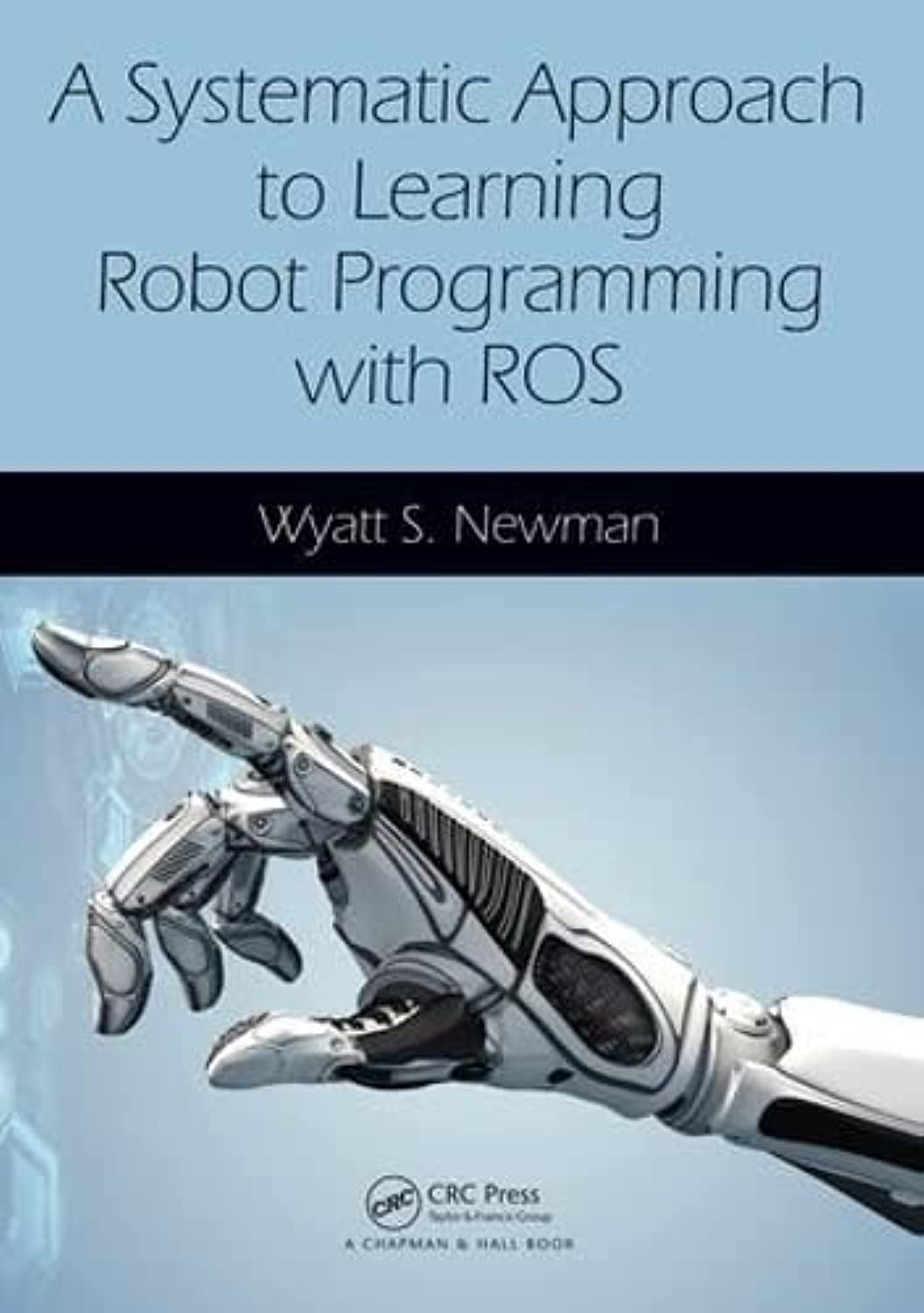
A Systematic Approach to Learning Robot Programming with ROS provides a comprehensive, introduction to the essential components of ROS through detailed explanations of simple code examples along with the corresponding theory of operation. The book explores the organization of ROS, how to understand ROS packages, how to use ROS tools, how to incorporate existing ROS packages into new applications, and how to develop new packages for robotics and automation. It also facilitates continuing education by preparing the reader to better understand the existing online documentation.The book is organized into six parts. It begins with an introduction to ROS foundations, including writing ROS nodes and ROS tools. Messages, Classes, and Servers are also covered. The second part of the book features simulation and visualization with ROS, including coordinate transforms.The next part of the book discusses perceptual processing in ROS. It includes coverage of using cameras in ROS, depth imaging and point clouds, and point cloud processing. Mobile robot control and navigation in ROS is featured in the fourth part of the bookThe fifth section of the book contains coverage of robot arms in ROS. This section explores robot arm kinematics, arm motion planning, arm control with the Baxter Simulator, and an objectgrabber package. The last part of the book focuses on system integration and higherlevel control, including perceptionbased and mobile manipulation.This accessible text includes examples throughout and C++ code examples are also provided at https://github.com/wsnewman/learning_ros
⚠️ WARNING (California Proposition 65):
This product may contain chemicals known to the State of California to cause cancer,
birth defects, or other reproductive harm.
For MAP (Minimum Advertised Price) violations and Intellectual Property (IP) or Trademark concerns, please contact:
support@ergodebooks.com
⚠️ California Proposition 65 Warning: Some products sold on this website may expose you to chemicals known to the State of California to cause cancer, birth defects, or other reproductive harm. For more information, visit www.P65Warnings.ca.gov.