
Title
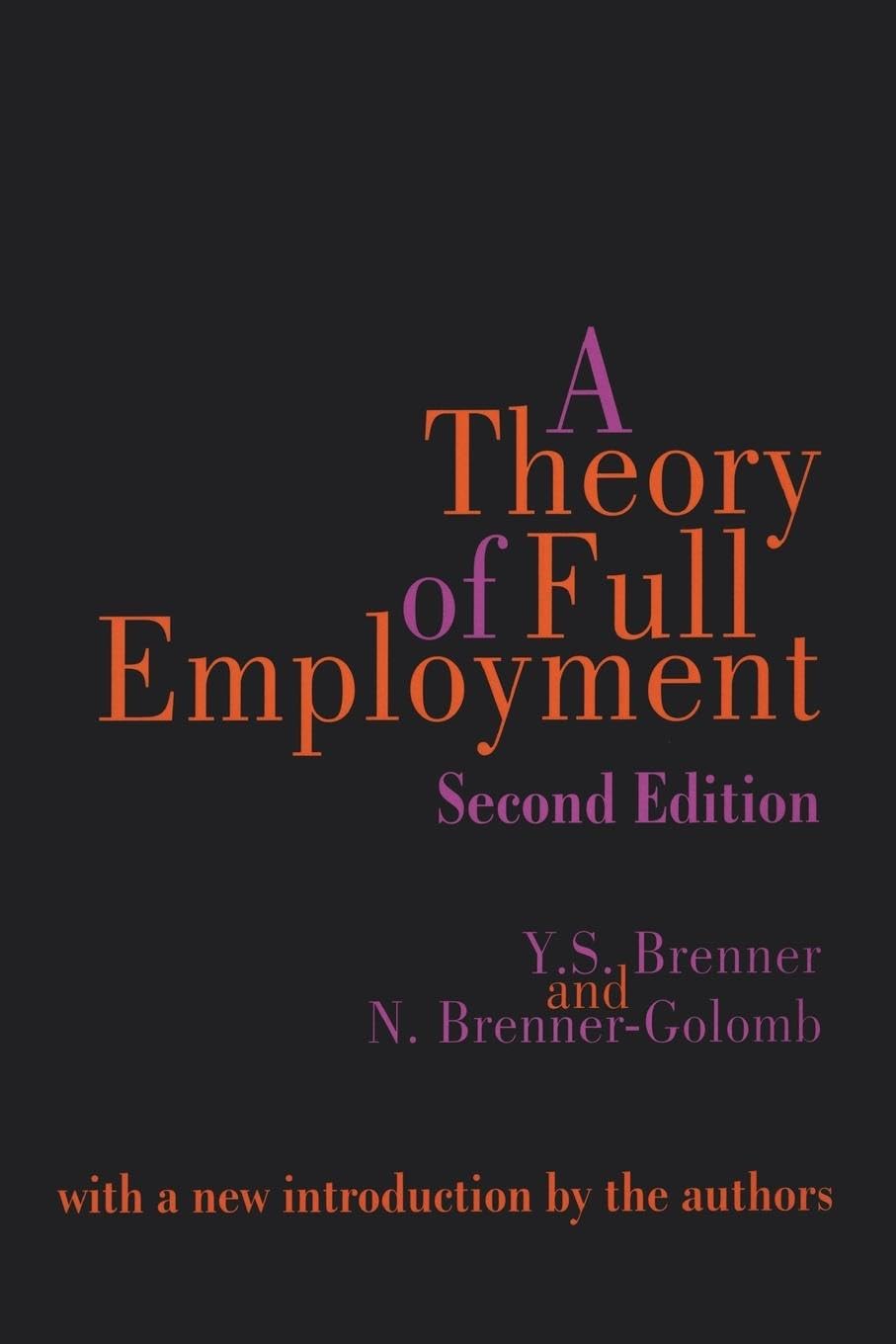
A Theory of Full Employment,Used
Sold by Ergodebooks, an authorized reseller.
Returns accepted within 30 days | support@ergodebooks.com
Shipping Information
- Free Standard Shipping — United States only
- Processing Time: 3–5 business days
- Estimated Delivery: 6–10 business days after dispatch
- Double-boxed, fully insured & discreetly packaged
- Tracking number sent via email once dispatched
Returns & Refund
Returns accepted within 30 days of delivery.
Damaged or Defective Item
Free return shipping + replacement or full refund
Wrong Item Received
Free return shipping + replacement or full refund
Change of Mind
Return shipping at customer's expense · 25% restocking fee applies
Payment Option

In A Theory of Full Employment, Y. S. Brenner reviews the current drift toward a society he finds neither economically expedient nor morally attractive, and N. BrennerGolomb discusses the risks involved for science and society in the newfangled sophism hiding behind postmodern ideas and "political correctness." Both authors emphasize the need to revive the public's political engagement and revise economic theory to restore to society the humane perspective that inspired the welfare state. They contend that if people will abandon outworn habits of thought, consider alternatives, and renew their political engagement, they may find useful employment for all who are able and willing to work and end the fear of destitution.Although scientists' philosophical backgrounds seldom influence their answers, they do determine their questions, and the final outcome can depend on this. Neoclassical economists are ill equipped to ask questions about the longterm dynamic processes of our complex economic reality. They leave out of their models variables not easily quantified and prefer mathematical precision to the study of the intricacy of life. Paul Samuelson, Robert Solow, and others have tried to overcome this by grouping selfadjusting elements into "proxy" variables, thus synthesizing neoclassical and Keynesian ideas. But most of today's critics of the ruling dogma go largely unheard.This volume is intended to convince professional economists who study the economic system as a whole to reexamine some of the assumptions behind reigning economic theories. A second objective is to explain to the general public why currently fashionable policies cannot solve massive longterm unemployment. Finally, it shows that if political engagement is revived, we may escape the economic morass and moral wasteland into which, the fashionable policies have been leading us since the 1970s. This book will appeal to economists, politicians, sociologists, and a wider public concerned about today's economic malaise.
⚠️ WARNING (California Proposition 65):
This product may contain chemicals known to the State of California to cause cancer, birth defects, or other reproductive harm.
For more information, please visit www.P65Warnings.ca.gov.