
Title

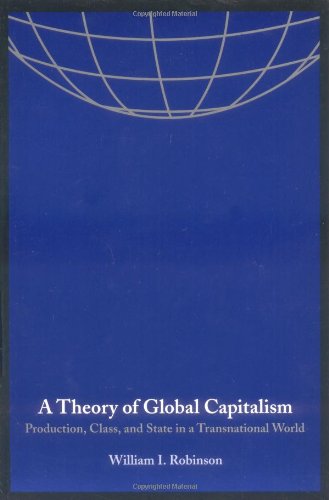
A Theory of Global Capitalism: Production, Class, and State in a Transnational World (Themes in Global Social Change),New
Sold by Ergodebooks, an authorized reseller.
Returns accepted within 30 days | support@ergodebooks.com
Shipping Information
- Free Standard Shipping — United States only
- Processing Time: 3–5 business days
- Estimated Delivery: 6–10 business days after dispatch
- Double-boxed, fully insured & discreetly packaged
- Tracking number sent via email once dispatched
Returns & Refund
Returns accepted within 30 days of delivery.
Damaged or Defective Item
Free return shipping + replacement or full refund
Wrong Item Received
Free return shipping + replacement or full refund
Change of Mind
Return shipping at customer's expense · 25% restocking fee applies
Payment Option

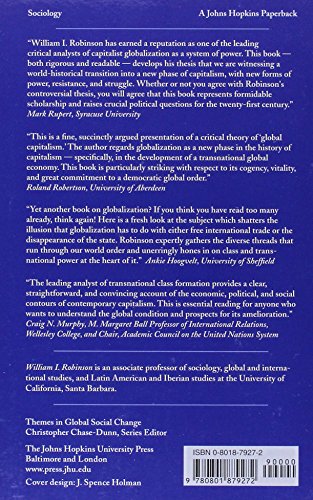
In this book, sociologist William I. Robinson offers a theory of globalization that follows the rise of a new capitalist class and a transnational state. Growing beyond national boundaries, this new class comprises a global system in which Japanese capitalists are just as comfortable investing in Latin America as North Americans are in Southeast Asia. Their development of global, interconnected industries and businesses make them drivers of world capitalism.Robinson explains how global capital mobility has allowed capital to reorganize production worldwide in accordance with a whole range of considerations that allow for maximizing profit making opportunities. As a result, production systems that were once located in a single country have been fragmented and integrated externally into new globalized circuits of accumulation. What this means, however, is not simply that factories are located overseas where labor might be cheaper, but rather that the whole production process is broken down into smaller parts and each of those parts moved to a different country, depending on where investment might be highest. Yet at the same time, this worldwide decentralization and fragmentation of the production process has taken place alongside the centralization of command and control of the global economy in transnational capital.In turn, this economic organization finds a political counterpart in the rise of a transnational state. The leaders of global businesses and industries think about themselves and how they live in new ways. Hegemony in the twentyfirst century, Robinson argues, will be exercised not by a particular nationstate but by this new global ruling class through the machinery of this transnational state. Robinson observes, for example, that global elites, regardless of their nationality, increasingly tend to share similar lifestyles and interact through expanding networks of the transnational state. Globalization is in this way unifying the world into a single mode of production and a single global system and bringing about the integration of different countries and regions into a new global economy and society. But the new global capitalism is rife with contradictions, such as the growing rift between the global rich and the global poor, concludes Robinson. The twentyfirst century is likely to harbor ongoing conflicts and disputes for control between the new transnational ruling group and the expanding ranks of the poor and the marginalized. Sure to stir controversy and debate, A Theory of Global Capitalism will be of interest to sociologists and economists alike.
⚠️ WARNING (California Proposition 65):
This product may contain chemicals known to the State of California to cause cancer, birth defects, or other reproductive harm.
For more information, please visit www.P65Warnings.ca.gov.
- Q: What is the main theme of 'A Theory of Global Capitalism'? A: The main theme of 'A Theory of Global Capitalism' is the emergence of a new capitalist class and a transnational state that extends beyond national boundaries, emphasizing the global interconnectedness of economies.
- Q: Who is the author of this book? A: The author of 'A Theory of Global Capitalism' is William I. Robinson, a sociologist known for his insights on globalization and economic organization.
- Q: What topics does the book cover? A: The book covers topics such as globalization, the rise of global capitalism, the fragmentation of production processes, and the political implications of a transnational state.
- Q: How does the book explain the concept of global capital mobility? A: The book explains global capital mobility as the ability of capital to reorganize production worldwide based on profit maximization, leading to a decentralized yet interconnected global economic system.
- Q: What are the implications of globalization discussed in the book? A: Robinson discusses the implications of globalization, including the growing divide between the global rich and poor, and the ongoing conflicts that may arise between the new transnational ruling class and marginalized groups.
- Q: Is this book suitable for both sociologists and economists? A: Yes, 'A Theory of Global Capitalism' is suitable for both sociologists and economists as it provides a comprehensive analysis of the social and economic dimensions of globalization.
- Q: What is the publication date of this book? A: The book was published on March 12, 2004.
- Q: What format is 'A Theory of Global Capitalism' available in? A: The book is available in paperback format.
- Q: How many pages does the book have? A: The book consists of 224 pages.
- Q: What is the condition of the book? A: The book is in new condition.