
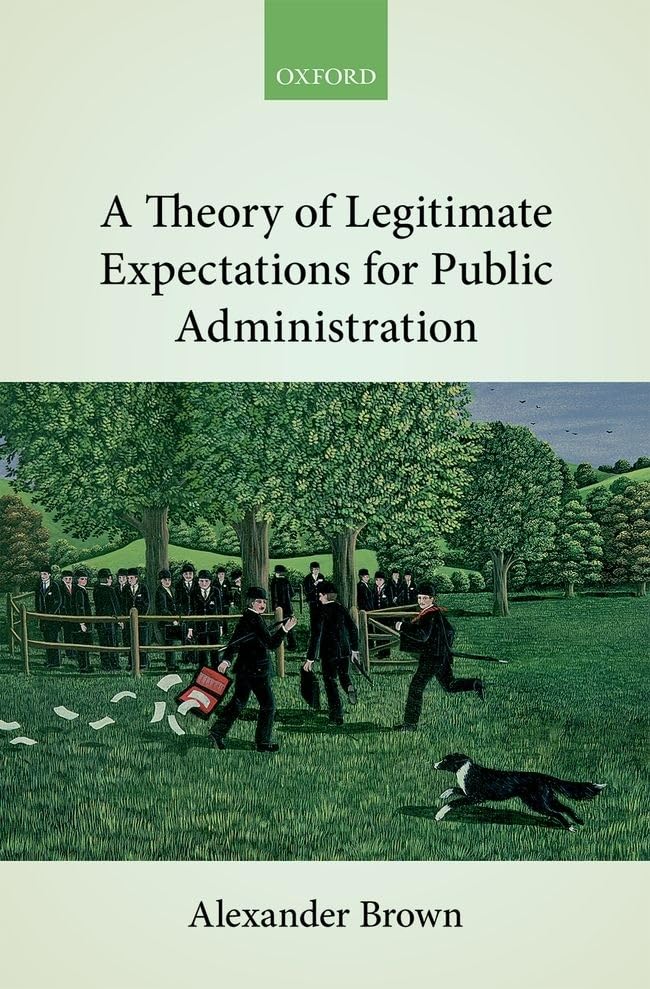
Title
A Theory of Legitimate Expectations for Public Administration,Used
Sold by Ergodebooks, an authorized reseller.
Returns accepted within 30 days | support@ergodebooks.com
Shipping Information
- Free Standard Shipping — United States only
- Processing Time: 3–5 business days
- Estimated Delivery: 6–10 business days after dispatch
- Double-boxed, fully insured & discreetly packaged
- Tracking number sent via email once dispatched
Returns & Refund
Returns accepted within 30 days of delivery.
Damaged or Defective Item
Free return shipping + replacement or full refund
Wrong Item Received
Free return shipping + replacement or full refund
Change of Mind
Return shipping at customer's expense · 25% restocking fee applies
Payment Option

It is an unfortunate but unavoidable feature of even wellordered democratic societies that governmental administrative agencies often create legitimate expectations (procedural or substantive) on the part of nongovernmental agents (individual citizens, groups, businesses, organizations, institutions, and instrumentalities) but find themselves unable to fulfil those expectations for reasons of justice, the public interest, severe financial constraints, and sometimes harsh political realities. How governmental administrative agencies, operating on behalf of society, handle the creation and frustration of legitimate expectations implicates a whole host of values that we have reason to care about, including under nonideal conditionsnot least justice, fairness, autonomy, the rule of law, responsible uses of power, credible commitments, reliance interests, security of expectations, stability, democracy, parliamentary supremacy, and legitimate authority.This book develops a new theory of legitimate expectations for public administration drawing on normative arguments from political and legal theory. Brown begins by offering a new account of the legitimacy of legitimate expectations. He argues that it is the very responsibility of governmental administrative agencies for creating expectations that ought to ground legitimacy, as opposed to the justice or the legitimate authority of those agencies and expectations. He also clarifies some of the main ways in which agencies can be responsible for creating expectations. Moreover, he argues that governmental administrative agencies should be held liable for losses they directly cause by creating and then frustrating legitimate expectations on the part of nongovernmental agents and, if liable, have an obligation to make adequate compensation payments in respect of those losses.
⚠️ WARNING (California Proposition 65):
This product may contain chemicals known to the State of California to cause cancer, birth defects, or other reproductive harm.
For more information, please visit www.P65Warnings.ca.gov.