
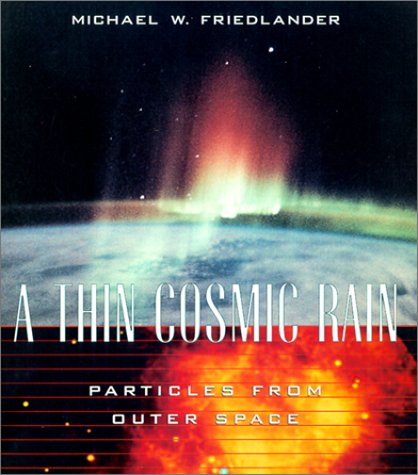
Title
A Thin Cosmic Rain: Particles From Outer Space
Sold by Ergodebooks, an authorized reseller.
Returns accepted within 30 days | support@ergodebooks.com
Shipping Information
- Free Standard Shipping — United States only
- Processing Time: 3–5 business days
- Estimated Delivery: 6–10 business days after dispatch
- Double-boxed, fully insured & discreetly packaged
- Tracking number sent via email once dispatched
Returns & Refund
Returns accepted within 30 days of delivery.
Damaged or Defective Item
Free return shipping + replacement or full refund
Wrong Item Received
Free return shipping + replacement or full refund
Change of Mind
Return shipping at customer's expense · 25% restocking fee applies
Payment Option

Enigmatic For Many Years, Cosmic Rays Are Now Known To Be Not Rays At All, But Particles, The Nuclei Of Atoms, Raining Down Continually On The Earth, Where They Can Be Detected Throughout The Atmosphere And Sometimes Even Thousands Of Feet Underground. This Book Tells The Longrunning Detective Story Behind The Discovery And Study Of Cosmic Rays, A Story That Stretches From The Early Days Of Subatomic Particle Physics In The 1890S To The Frontiers Of Highenergy Astrophysics Today.Writing For The Amateur Scientist And The Educated General Reader, Michael Friedlander, A Cosmic Ray Researcher, Relates The History Of Cosmic Ray Science From Its Accidental Discovery To Its Present Status. He Explains How Cosmic Rays Are Identified And How Their Energies Are Measured, Then Surveys Current Knowledge And Theories Of Thin Cosmic Rain. The Most Thorough, Uptodate, And Readable Account Of These Intriguing Phenomena, His Book Makes Us Party To The Search Into The Nature, Behavior, And Origins Of Cosmic Raysand Into The Sources Of Their Enormous Energy, Sometimes Hundreds Of Millions Times Greater Than The Energy Achievable In The Most Powerful Earthbound Particle Accelerators. As This Search Led Unexpectedly To The Discovery Of New Particles Such As The Muon, Pion, Kaon, And Hyperon, And As It Reveals Scenes Of Awesome Violence In The Cosmos And Offers Clues About Black Holes, Supernovas, Neutron Stars, Quasars, And Neutrinos, We See Clearly Why Cosmic Rays Remain Central To An Astonishingly Diverse Range Of Research Studies On Scales Infinitesimally Small And Large.Attractively Illustrated, Engagingly Written, This Is A Fascinating Inside Look At A Science At The Center Of Our Understanding Of Our Universe.
⚠️ WARNING (California Proposition 65):
This product may contain chemicals known to the State of California to cause cancer, birth defects, or other reproductive harm.
For more information, please visit www.P65Warnings.ca.gov.
- Q: What is the page count of the book? A: The book contains two hundred fifty-six pages. This length allows for an in-depth exploration of cosmic rays and their significance.
- Q: What type of binding does the book have? A: The book is hardcover. This durable binding helps protect the book over time, making it a great addition to any collection.
- Q: Who is the author of 'A Thin Cosmic Rain'? A: The author is Michael W. Friedlander. He is a researcher in the field of cosmic rays and brings expertise to this fascinating subject.
- Q: What is the main topic of this book? A: The book discusses cosmic rays, which are particles from outer space. It delves into their discovery, study, and importance in astrophysics.
- Q: Is this book suitable for a general audience? A: Yes, the book is written for the educated general reader. It presents complex scientific concepts in an engaging and accessible way.
- Q: What kind of illustrations does the book include? A: The book features attractive illustrations. These visuals help enhance the reader's understanding of cosmic rays and related phenomena.
- Q: How should I care for this hardcover book? A: To keep this book in good condition, store it upright in a cool, dry place. Avoid exposure to direct sunlight to prevent fading.
- Q: Is this book safe to read for children? A: While the book is not specifically aimed at children, it can be suitable for older kids interested in science. Parental guidance is recommended.
- Q: Can I find this book in libraries? A: Yes, this book is likely available in many libraries, especially those with strong science or academic collections. Check your local library catalog.
- Q: What should I do if the book arrives damaged? A: If the book arrives damaged, contact the seller immediately for a return or exchange. Most sellers have return policies to address such issues.
- Q: Is there a warranty for this book? A: No, books typically do not come with warranties. However, check the return policy for any specific guarantees on condition.
- Q: How does this book compare to others on cosmic rays? A: This book is noted for its thoroughness and readability. It is considered one of the most comprehensive accounts of cosmic rays available.
- Q: What are cosmic rays? A: Cosmic rays are high-energy particles from outer space. They are primarily composed of atomic nuclei, which continuously bombard the Earth.
- Q: What is the significance of studying cosmic rays? A: Studying cosmic rays helps scientists understand fundamental physics and astrophysical phenomena, including black holes and supernovas.
- Q: Is there a specific age range for readers of this book? A: The book is generally suitable for readers aged twelve and up. Its content can engage both young adults and older audiences.