
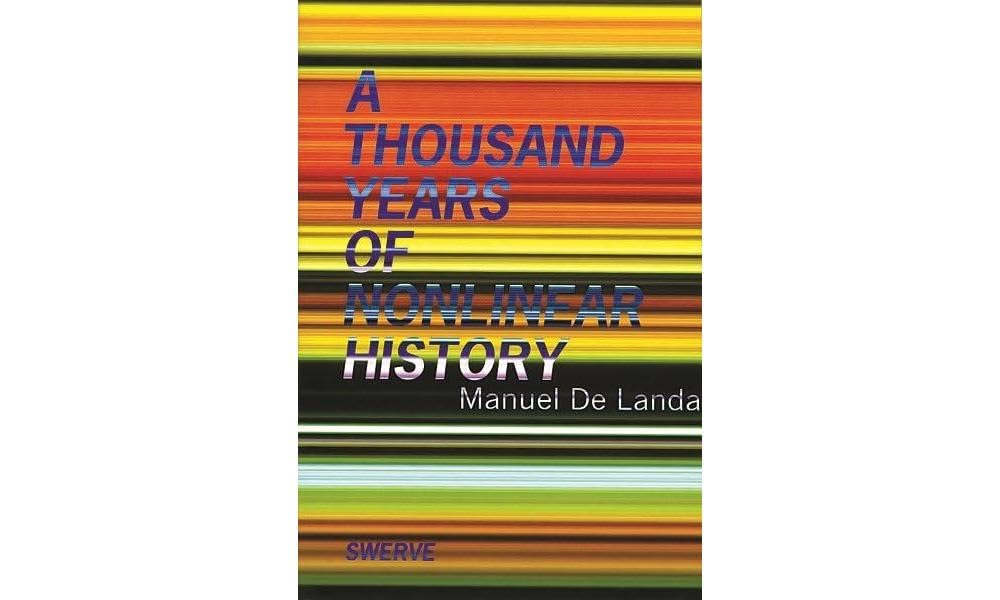
Title
A Thousand Years of Nonlinear History,Used
Sold by Ergodebooks, an authorized reseller.
Returns accepted within 30 days | support@ergodebooks.com
Shipping Information
- Free Standard Shipping — United States only
- Processing Time: 3–5 business days
- Estimated Delivery: 6–10 business days after dispatch
- Double-boxed, fully insured & discreetly packaged
- Tracking number sent via email once dispatched
Returns & Refund
Returns accepted within 30 days of delivery.
Damaged or Defective Item
Free return shipping + replacement or full refund
Wrong Item Received
Free return shipping + replacement or full refund
Change of Mind
Return shipping at customer's expense · 25% restocking fee applies
Payment Option

Following in the wake of his groundbreaking work War in the Age of Intelligent Machines, Manuel De Landa presents a brilliant, radical synthesis of historical development of the last thousand years. A Thousand Years of Nonlinear History sketches the outlines of a renewed materialist philosophy of history in the tradition of Fernand Braudel, Gilles Deleuze, and Flix Guattari, while engaging in an entirely unprecedented manner the critical new understanding of material processes derived from the sciences of dynamics. Working against prevailing attitudes that see history merely as the arena of texts, discourses, ideologies, and metaphors, De Landa traces the concrete movements and interplays of matter and energy through human populations in the last millennium. The result is an entirely novel approach to the study of human societies and their always mobile, semistable forms, cities, economies, technologies, and languages.De Landa attacks three domains that have given shape to human societies: economics, biology, and linguistics. In each case, De Landa discloses the selfdirected processes of matter and energy interacting with the whim and will of human history itself to form a panoramic vision of the West free of rigid teleology and naive notions of progress and, even more important, free of any deterministic source for its urban, institutional, and technological forms. The source of all concrete forms in the Wests history, rather, is shown to derive from internal morphogenetic capabilities that lie within the flow of matterenergy itself.A Swerve Edition.
⚠️ WARNING (California Proposition 65):
This product may contain chemicals known to the State of California to cause cancer, birth defects, or other reproductive harm.
For more information, please visit www.P65Warnings.ca.gov.
- Q: What is the main theme of 'A Thousand Years of Nonlinear History'? A: The main theme of the book is the exploration of historical development over the last thousand years through a materialist philosophy. Manuel De Landa emphasizes the interactions of matter and energy in shaping human societies, moving beyond traditional textual interpretations of history.
- Q: Who is the author of 'A Thousand Years of Nonlinear History'? A: The author of the book is Manuel De Landa, a prominent philosopher and writer known for his work in the fields of history, philosophy, and science.
- Q: What is the publication date of this book? A: The book was published on September 18, 2000.
- Q: Is 'A Thousand Years of Nonlinear History' suitable for academic study? A: Yes, the book is suitable for academic study, especially in fields such as historiography, philosophy of history, and social sciences. It provides a unique perspective on historical processes and is well-researched.
- Q: What type of binding does this book have? A: The book is available in paperback binding.
- Q: How many pages does 'A Thousand Years of Nonlinear History' have? A: The book contains 333 pages.
- Q: What is the condition of the book? A: The book is in new condition.
- Q: What is the significance of the revised edition of this book? A: The revised edition of 'A Thousand Years of Nonlinear History' includes updates and enhancements to the original text, reflecting new insights and developments in the author's research.
- Q: What are the key areas De Landa explores in this book? A: De Landa explores three key areas: economics, biology, and linguistics, analyzing how these domains shape human societies through dynamic interactions of matter and energy.
- Q: Does this book offer a traditional narrative of history? A: No, the book offers a non-traditional narrative by focusing on material processes rather than textual or ideological interpretations of history.