
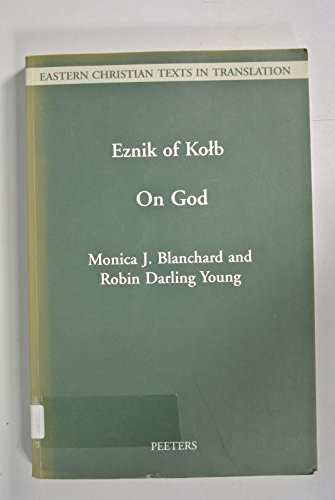
Title
A Treatise on God Written in Armenian by Eznik of Kolb (floruit c. 430c. 450) An English Translation, with Introduction and Not,Used
Sold by Ergodebooks, an authorized reseller.
Returns accepted within 30 days | support@ergodebooks.com
Shipping Information
- Free Standard Shipping — United States only
- Processing Time: 3–5 business days
- Estimated Delivery: 6–10 business days after dispatch
- Double-boxed, fully insured & discreetly packaged
- Tracking number sent via email once dispatched
Returns & Refund
Returns accepted within 30 days of delivery.
Damaged or Defective Item
Free return shipping + replacement or full refund
Wrong Item Received
Free return shipping + replacement or full refund
Change of Mind
Return shipping at customer's expense · 25% restocking fee applies
Payment Option

The conversion of Armenia is traditionally dated to 314 when Gregory the Illuminator (c. 240332) baptized King Trdat (298330) and the royal family. Not until the fifth century did there develop both a Christian literature for Armenians in the Armenian languages, and the beginnings of a literary tradition in several genres which provided a coherent argument against the old religion of Zoroastrianism and made for the creation of Armenia as a Christian nation. Eznik of Kolb, later bishop of Bagrewand, studied in Edessa and in Constantinople among that first generation of Armenian Christians who made available in the newly established Armenian script translations of Greek and Syriac texts, including the Bible and other early Christian writings. Eznik composed a treatise of theology and apologetic in Armenian which has survived untitled in one manuscript. Modern editors and translators have titled this treatise On God or Against the Sects. Eznik addressed perceived threats to Christianity in Armenia from heretical and nonChristian movements, among them Valentinian Gnosticism and the schools of Greek philosophy, Marcionism, Manichaeism and Zoroastrian Zurvanism. Eznik's sources include the Bible; ancient Greek, nonChristian literature; earlier Greek patristic treatises and other works; Syriac patristic texts; and Iranian works either written or oral, concerning the Zurvanite form of Zoroastrianism and Armenian paganism. The central concern of the book is to contrast the monotheistic Christian God with the dualistic or polytheistic deities and religions of his opponents. Eznik's book is unusual in several aspects. It is the first apologetic treatise composed in Armenian, and it also provides a summary of early Christian doctrine as Eznik understood it. It contains unique information on the fifthcentury teachings of Zurvanism and Marcionism. It attests to an Armenian theology conversant with both Syriac and Greek sources. It also opens a window into preChristian Armenian mythology and folklore. The English translation is based on the critical edition of Louis Maries and Charles Mercier.
⚠️ WARNING (California Proposition 65):
This product may contain chemicals known to the State of California to cause cancer, birth defects, or other reproductive harm.
For more information, please visit www.P65Warnings.ca.gov.
- Q: What is the primary focus of 'A Treatise on God' by Eznik of Kolb? A: The primary focus of 'A Treatise on God' is to contrast the monotheistic Christian God with the dualistic and polytheistic deities of non-Christian religions, including Zoroastrianism and Gnosticism.
- Q: Who is the author of this treatise? A: The author of the treatise is Eznik of Kolb, who was a bishop and a prominent figure in early Armenian Christianity.
- Q: When was this book published? A: This book was published on January 1, 1998.
- Q: What is the page count of this book? A: The book contains 122 pages.
- Q: Is this book available in paperback format? A: Yes, 'A Treatise on God' is available in paperback format.
- Q: What type of literature does this book represent? A: This book represents early Christian apologetic literature, specifically the first of its kind written in the Armenian language.
- Q: What unique perspectives does Eznik provide in this treatise? A: Eznik provides unique information on fifth-century teachings of Zurvanism and Marcionism, as well as insights into Armenian mythology and folklore.
- Q: How does this book contribute to understanding Armenian Christian theology? A: The book contributes to understanding Armenian Christian theology by summarizing early Christian doctrine and addressing heretical views present in Armenia at the time.
- Q: What sources did Eznik use for his treatise? A: Eznik used a variety of sources, including the Bible, Greek non-Christian literature, earlier Greek patristic treatises, and Syriac patristic texts.
- Q: Is there an introduction or notes included in this translation? A: Yes, the English translation includes an introduction and notes that provide additional context and insights into the text.