If you have any questions, you are always welcome to contact us. We'll get back to you as soon as possible, withing 24 hours on weekdays.
Customer service
All questions about your order, return and delivery must be sent to our customer service team by e-mail at yourstore@yourdomain.com
Sale & Press
If you are interested in selling our products, need more information about our brand or wish to make a collaboration, please contact us at press@yourdomain.com
Help
If you have any questions, you are always welcome to contact us. We'll get back to you as soon as possible, withing 24 hours on weekdays.
Customer service
All questions about your order, return and delivery must be sent to our customer service team by e-mail at yourstore@yourdomain.com
Sale & Press
If you are interested in selling our products, need more information about our brand or wish to make a collaboration, please contact us at press@yourdomain.com
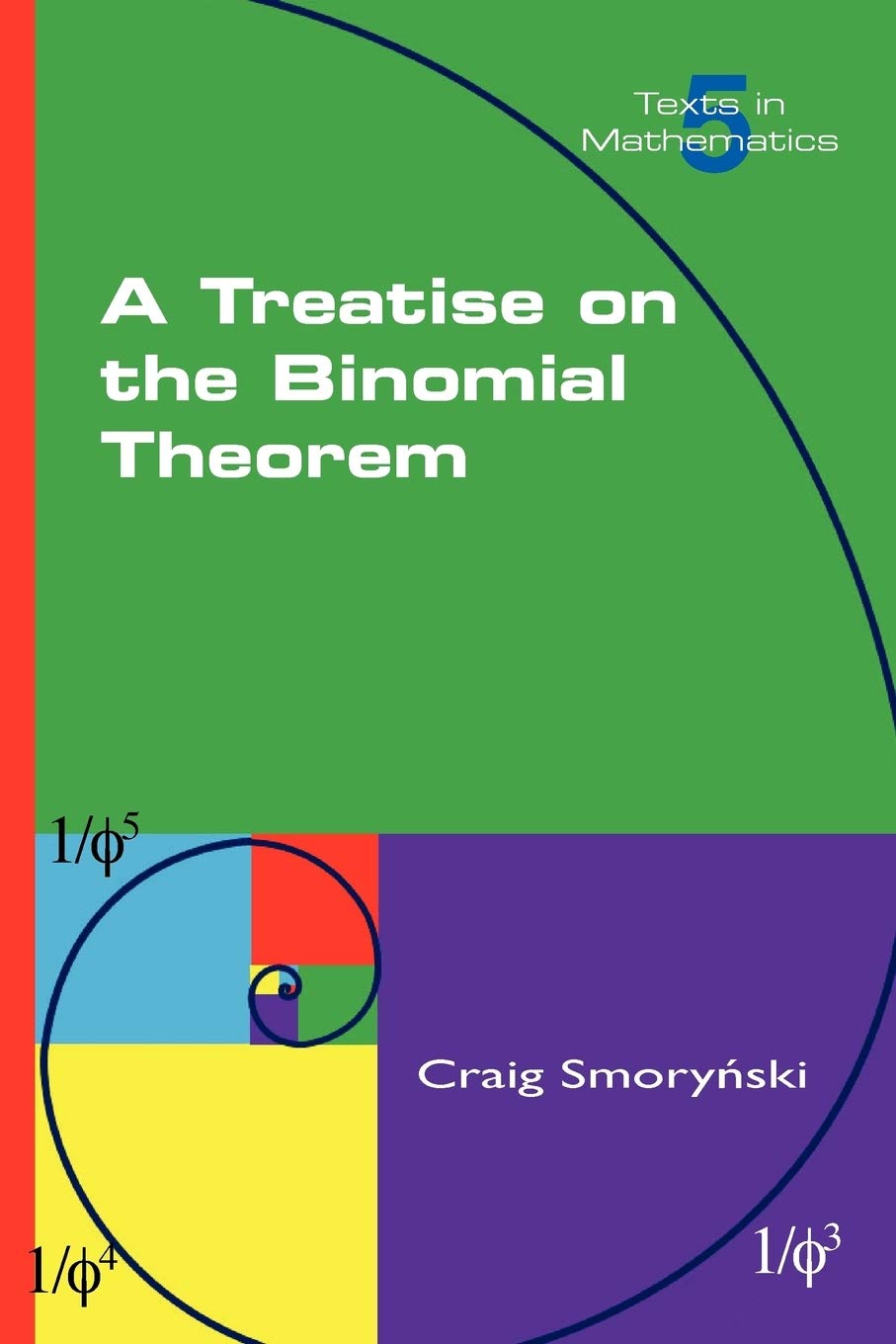
The binomial theorem is usually quite rightly considered as one of the most important theorems in the whole of analysis.' Thus wrote Bernard Bolzano in 1816 in introducing the first correct proof of Newton's generalisation of a century and a half earlier of a result familiar to us all from elementary algebra. Bolzano's appraisal may surprise the modern reader familiar only with the finite algebraic version of the Binomial Theorem involving positive integral exponents, and may also appear incongruous to one familiar with Newton's series for rational exponents. Yet his statement was a sound judgment back in the day. Here the story of the Binomial Theorem is presented in all its glory, from the early days in India, the Moslem world, and China as an essential tool for root extraction, through Newton's generalisation and its central role in infinite series expansions in the 17th and 18th centuries, and to its rigorous foundation in the 19th. The exposition is wellorganised and fairly complete with all the necessary details, yet still readable and understandable for those with a limited mathematical background, say at the Calculus level or just below that. The present book, with its many citations from the literature, will be of interest to anyone concerned with the history or foundations of mathematics.
⚠️ WARNING (California Proposition 65):
This product may contain chemicals known to the State of California to cause cancer,
birth defects, or other reproductive harm.
For MAP (Minimum Advertised Price) violations and Intellectual Property (IP) or Trademark concerns, please contact:
support@ergodebooks.com
⚠️ California Proposition 65 Warning: Some products sold on this website may expose you to chemicals known to the State of California to cause cancer, birth defects, or other reproductive harm. For more information, visit www.P65Warnings.ca.gov.